Leaders of the Presbyterian Mission Agency are trying to look ahead to what the vision of the Presbyterian Church (U.S.A.) should be once the COVID-19 pandemic has ended — and how the PC(USA) can live into the realities of being a Matthew 25 church.
“Where is it we want to be two years down the road?” asked Warren Lesane, chair of the Presbyterian Mission Agency Board, during a Zoom meeting that the board’s coordinating committee held Sept. 17 in preparation for a full online meeting of the board Oct. 7-9.
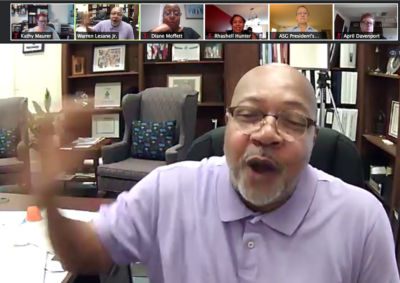
The Presbyterian Mission Agency has claimed Matthew 25 as a vision, so “let’s live into it,” Lesane said. “If I had a pulpit, I’d be preaching right now.”
In part, that work involves collaboration with three work groups the Committee on the Office of the General Assembly has convened that are digging into specific issues — including what the shape of the 2022 General Assembly might look like; what changes in policies and procedures are needed; and issues of church unity, including developing a unified budget and considering the possibility of some kind of merger or realignment of the Presbyterian Mission Agency (PMA) and the Office of the General Assembly (OGA).
The seeds of those conversations were planted last spring — in part through the work of the Moving Forward Implementation Commission. That commission took administrative action June 18 – the day before the 2020 General Assembly convened – to direct that a coordinating table convene to begin the process of developing a truly unified budget in the future for PMA, OGA and the PC(USA), A Corporation, which is the corporate expression of the church.
That action also stated that in a time of fiscal challenges the agencies should be “boldly and broadly collaborative,” and that PMA and OGA should “continue to explore the possibility of merger” and of having the Mission Engagement and Support office raise funds for both agencies, not just for PMA.
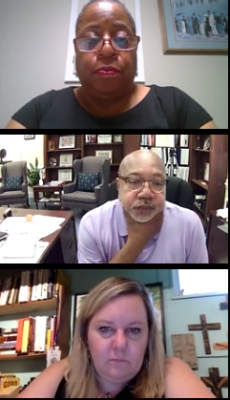
Shannan Vance-Ocampo, who is vice chair of the Presbyterian Mission Agency Board, and Diane Moffett, president and executive director of PMA, have been participating in some of the discussions the Committee on the Office of the General Assembly work teams have been having in recent weeks.
“It’s so important to have a clear vision for the future to guide us,” Moffett told the coordinating committee. For PMA, that’s a focus on making disciples; on churches growing spiritually, numerically and in impact; and dealing with the intersectionality of economics, racism, injustice and gender bias. “That is what is compelling us, driving us,” Moffett said.
Another focus of the work: a resolution that the 2020 General Assembly passed affirming that Black lives matter, calling on the church to “confront and dismantle systemic racism,” and directing PMA and OGA to review all items of business that this shortened online assembly referred to the next assembly in 2022, to consider whether the recommendations in those business items could be acted on through the PC(USA)’s current social witness policy.
As a Reformed denomination, the PC(USA) also needs to think about what needs to change post-pandemic, Moffett said, saying that the PMA staff is working to organize its own leadership retreat and that “all of these conversations are part of a whole,” to determine how to best be a Matthew 25 church moving forward.
“Mission should drive what we do and who we are,” she said. “Not money, not politics, not power. It should be the mission that is driving us to reinvent,” to live into that vision.
There also were some discussions of specifics for the board’s upcoming meeting in October, which will focus on the theme of anti-racism, including discussion of economic justice, the racial wealth gap and reparations, Moffett said.
Vance-Ocampo said one of the challenges of anti-racism training across the PC(USA) is that “the demographics of the Presbyterian Church (U.S.A.) nationally do not look like the staff in Louisville and do not look like this board” — some PC(USA) congregations are essentially all white. “This is a deep theological issue, it’s a deep soul issue,” she said of the anti-racism work — work that’s needed to move the church in the direction of justice.
Some items expected to come up at the October meeting:
- A report on the financial future of Stony Point Center outside New York. In June, Stony Point laid off most of its staff because of the economic impact of the pandemic.
- The findings from Marian Vasser, a consultant from the University of Louisville who’s been providing feedback on power and privilege issues in how the board itself operates, including matters of how information is shared and who gets to voice their opinions.
- Budget updates. Projections given to the A Corporation board in August showed that the PC(USA) is likely to experience a budget shortfall of about $9.1 million at the national level by the end of 2020.
“We had a pretty decent August,” Moffett said. But she said the PC(USA) will encourage all those who can to give to the church on Giving Tuesday (Dec. 1) — trying to put the PC(USA) in as strong a financial position as possible by year’s end.