The entanglement of white Christians and white supremacy – both historically and in the current political environment – “still lives in the DNA of white Christians today,” said author and sociologist of religion Robert P. Jones.
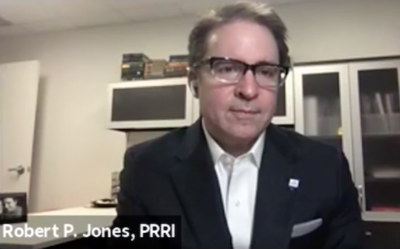
“A close read of history and contemporary public opinion data reveals that white Christians have not just been complacent or complicit — I think that’s the way the story is often told,” Jones said during an online discussion Oct. 13. “But as the nation’s dominant cultural power, we have constructed and sustained a project of perpetuating white supremacy that has really framed the entire American story. This legacy of this unholy union still lives in the DNA of white Christians today, and not just among evangelicals in the South, but among mainline Protestants and Catholics as well.”
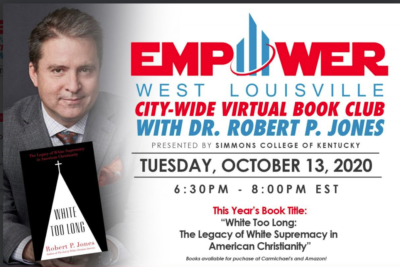
Jones is the founder and chief executive officer of the Public Religion Research Institute (PRRI), a nonprofit, nonpartisan research institute that studies issues involving religion, culture and public policy. He’s also the author of, most recently, “White Too Long: The Legacy of White Supremacy in American Christianity.”
On Oct. 13, Jones spoke during an online discussion hosted by the Citywide Virtual Book Club of Empower West Louisville, a coalition of pastors and churches focused on issues of empowerment and sustainability in the mostly-Black area of West Louisville, and by Simmons College of Kentucky, an historically Black university.
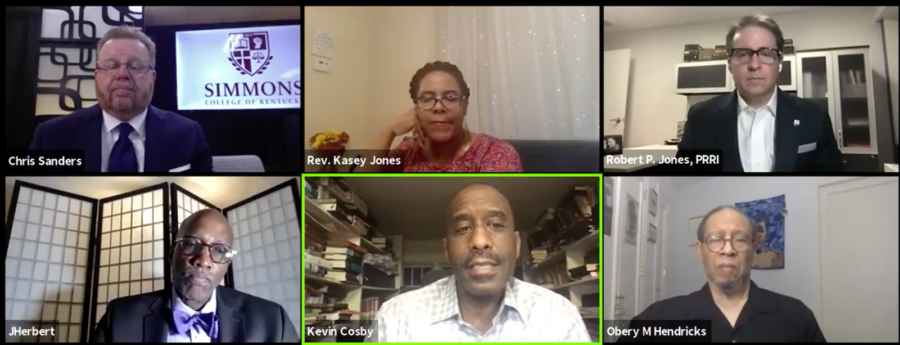
The panel of responders to Jones’ remarks included J. Herbert Nelson, stated clerk of the Presbyterian Church (U.S.A.). Several Louisville Presbyterian congregations – Highland Presbyterian, Central Presbyterian and Crescent Hill Presbyterian – were among the event’s sponsors, along with Cooperative Baptists, Episcopalians and others.
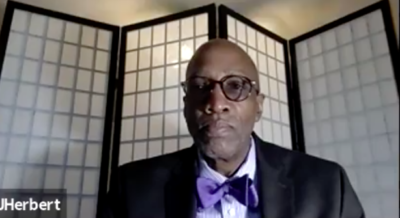
Nelson spoke of the importance of recognizing that “we are in a racist society, and the church has been the bastion of upholding that” — how even in today’s political environment it is “continuing to push for the superiority of white persons.”
Growing up in South Carolina, Nelson saw “how the church was complicit with the ongoing narrative that somehow or another, white America could actually wash their hands in the baptismal font and everything would be all right.”
His father, a civil rights activist, was involved in the response to the Orangeburg Massacre, when highway patrol officers opened fire on a group of unarmed student protestors at South Carolina State University on Feb. 8, 1968, killing three and wounding 28.
Nelson said his father, while a Presbyterian minister, was Black and “could not have gone into First Presbyterian Church (in Orangeburg) during that period of history. Yet we were all Presbyterians.”
That history – a sense of white superiority and the need to preserve its power – continues today at the highest levels, in Congress and the White House, Nelson said.
“Tonight, it’s been nailed,” he said. “It’s about superiority. It’s about the ongoing belief of superiority, no matter who I am. The poorest, worse-off white person in the United States of America still feels they are better … than the most-educated Black person in the United States of America. This is about superiority. It’s about a sickness of the soul,” to believe that “we did not come from the same God, that we were not endowed with the same rights and the same privileges. This is the sin of the United States of America.”
Nelson also encouraged people to read an earlier book Jones wrote – “The End of White Christian America,” for which he won the 2019 Grawemeyer Award in Religion from Louisville Presbyterian Theological Seminary. Jones also spoke at Big Tent in 2019, discussing in part the role that white Christians played in electing Donald Trump as president in 2016 and what could happen in the 2020 election in a few weeks.
Jones’ new book, as he describes it, is part social science, drawing on contemporary public opinion data; part religious and national history; and in part personal narrative — the story of his own family’s participation in the enslavement of Blacks.
Jones grew up a Southern Baptist in Jackson, Mississippi — “I was that kid who was at church all the time.” He went to a Baptist college and a Southern Baptist seminary. And it wasn’t until he took a Baptist history class at Southwestern Baptist Theological Seminary that he learned that his denomination had its roots in slavery and segregation — that the white pastors who formed the Southern Baptist Convention preached the superiority of whites and that slavery was “God’s best design for humanity,” Jones said.
“Virtually every Protestant denomination split over slavery,” Jones said. In Catholic parishes in the north, Blacks had to sit in the back and wait until whites had been served before coming forward to receive the Eucharist. “This was an issue that divided white Christian churches all the way up and down the spectrum,” he said. In the PC(USA), reunion from the split over slavery did not come for more than a century, until 1983.
 That history is still deeply in play now — and very much alive in the national conversation about reparations.
Southern Baptist Theological Seminary in Louisville, the Southern Baptist Convention’s oldest seminary, announced recently that it would set up a $5 million scholarship fund for Black students, but would not remove the names of its founders who owned enslaved people and supported the Confederacy from buildings and programs on the campus.
At least $6 million to $10 million was given to found Southern Seminary in South Carolina in 1859, Jones said. “It’s blood money,” built on the backs of enslaved Blacks who toiled for generations on those plantations, he said. “How do we repair the damage? We have to do something meaningful. It can’t be a gesture” — and the scholarship fund for Black students at the seminary does not extend power or money beyond the doors of the seminary.
In other settings, churches and seminaries have made serious efforts to study their involvement with slavery and to consider what reparations are owed — among them, Princeton Theological Seminary and Columbia Theological Seminary. The extent to which those efforts extend beyond helping the institution and reach out into the community — “that’s where you take the measure of our authenticity and sincerity,” Jones said.
Kasey Jones, the associate coordinator of strategic operations and outreach for the Cooperative Baptist Fellowship, said new models are needed for healthy partnerships between white Christians and Black communities. The old model involved “well-meaning, well-intended white Christians who want to go into Black spaces and want to be in partnership, but have not done the gut work of understanding the harm and hurt that has been done,” she said. Whites also need to understand “you’re not bringing God anywhere. God is already at work” in those Black spaces.
For whites, work now involves advocacy work done in partnership with Black-led movements and establishing funds to do the needed work of repair. When there’s an absence of Black intellect, vision and desire in those conversations, “you still feed that monster of white supremacy,” Kasey Jones said.
Chris Sanders, a lawyer who is coordinator of Empower West Louisville, asked Obery M. Hendricks, a visiting research scholar at Columbia University and author of “The Politics of Jesus: Rediscovering the True Revolutionary Nature of Jesus’ Teachings and How They Have Been Corrupted,” about the political nature of preaching.
When Lakers star LeBron James wears Breonna Taylor’s name on his shoes, “some critics say he should just shut up and dribble,” Sanders said. What about those who say pastors should just preach “and leave politics out of it?”
When he denounces white supremacy, “I am preaching Jesus,” Hendricks said — because Jesus’ teachings were all about how people should treat one another and live in the world. Robert Jones’ book makes it clear that white supremacy is about power and systematic oppression, he said. “You don’t have to have any animus to ascribe to white supremacy” — white Christians may be involved in oppressing, marginalizing and “crushing other folk,” while at the same time “they can hug you and love you” and not comprehend their support of structures of white supremacy.
Scholar Eddie S. Glaude Jr. of Princeton University has spoken of “white supremacy without all the bluster,” Robert Jones said. Many whites think “those people in white sheets burning crosses in people’s yards or lynching people” — that’s not us.
But those same people refuse to support the Black Lives Matter movement or see problems or patterns in data about disparities negatively affecting Blacks and other people of color in healthcare, wealth distribution or the impact of the COVID-19 pandemic, for example. White Christians and especially evangelicals “can hold these two contradictory things together at one time” — claiming they don’t harbor personal ill will towards Blacks, but supporting policy, law and social practices that discriminate against and disenfranchise them, he said. In the 2016 presidential election, 81% of white evangelicals (along with many white mainline Protestants and Catholics) voted for Trump.
What can whites do?
Kevin W. Cosby, pastor of St. Stephen Baptist Church and president of Simmons College, quoted Andy Beshear, the governor of Kentucky, speaking when protests broke out in Louisville after the police shot and killed Breonna Taylor.
Beshear said, “I will never be Black,” Cosby recounted. “But there are three things I can do. I can listen — I can listen to the experiences of Black people. I can learn. … And finally, I can act.”
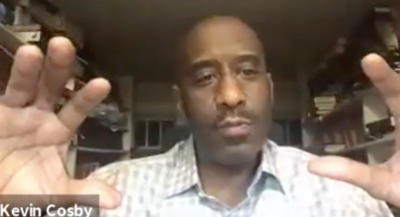
Cosby described racism as the mythology “that everything of significance in the world and the United States emanates from white people. And if that which is to be good and great is to be sustained, then white people must be in control. … The sourness of white supremacy is baked into the American cake,” as pastor Jeremiah Wright has described it.
That desire to return to an America in which whites held virtually all the power – despite the clear demographic changes having a powerful influence on the nation’s politics and on churches – is behind the popularity of the Trump’s signature campaign phrase, “Make America Great Again,” Robert Jones said. As Nelson put it: “It’s really make America white again.”
And Cosby said there has never been a time “when America has ever been just to Black people. Not one day.”
The writer Joel Edward Goza, in his book “America’s Unholy Ghost: The Racist Roots of Our Faith and Politics,” says that “the brilliance of Mamie Till, the mother of Emmett Till, was that she dared to keep the casket open, so that America can see what it has done to my 14-year-old son,” Cosby said. He contends “that should be the agenda of antiracist churches — that when we want to close the casket and not see what white supremacy does to Black bodies, the role of the church is to keep the casket open, and keep our country aware of what we have done and continue to do, until true justice comes.”
View a recording of the Oct. 13 presentation here.