Guest commentary by Lynne A. Pabst
Given all the current ideas of creating a worship space in the home right now, I was asked this question by another Christian educator: How do we support such activities without those suggestions turning into home “altars,” which are not part of the Reformed tradition?
Creating “worship spaces” or “centering spaces” within the home is a vital part of faith formation practice — especially during these times of COVID-19 when the community physical space cannot be used. Home worship spaces also are a great way for multifaith families to connect at home. The new Faith Practices Toolkit from the Office of Faith Formation suggests establishing a “Home Worship Center.”
 This isn’t a new idea. When I was growing up, I think every Protestant family had a Bible on the living room coffee table. In fact, a Bible was a traditional wedding gift for the new couple’s home. As the tradition began to get dusty so did those Bibles, and the church found itself combating the practice of having a Bible in the home that was never opened. So how is a practice of a home worship space encouraged without it becoming an altar or a dusty shrine?
Understand what Reformed worship is. “Christian worship, for Calvin, receives its distinctive character from the word of God and from the fact that God is entirely spiritual and nonmaterial. Worship is the united act of a disciplined congregation receiving God’s word and giving itself to God in praise and obedience.” (L.A. Loetscher in “A Brief History of the Presbyterians”)
“Space that is set apart for worship … is not to be an escape from the world, but a place for encountering the God of all creation who gathers us in and sends us out.” (Book of Order, W-1.0203)
Worship can take place wherever God’s people gather and the Spirit is present. No special material items are needed. So, a family’s worship space may not be a physical one but more of a temporal space. Instead of making space within their home, do they make space within their homelife to worship God?
 Be careful of language used. It is a worshiping space or a space that helps us connect and commune with God and other believers. There is no need to use the term altar, as the sacrifice has already been completed through Jesus Christ.
Items placed in the worship space: Items placed should be used and accessible to all. If a Bible is placed, then there should be a practice of regularly opening and reading it. If a cross or Nativity set is placed in the space, then children should be allowed to hold, touch and look at the items. If the worshipper cannot interact with them, then they become dusty shrines.
Time used: The space, whether physical or temporal, should be used to help one receive God’s Word (not just the Bible, but Jesus), give time for praise and prepare for daily life. Set aside a time at the beginning of the day to prepare for the day to come or make time at the end of the day to gather and praise God. God can be worshipped at any time and in any space.
 Where we as Christian educators have possibly erred (maybe due to the thinking that children need concrete items) is to focus on the physical worship space rather than the temporal space. We suggest lighting a candle or placing a Bible, when we should be saying: Start your day together as a family with a prayer and song while driving to school. Or when your family hears an emergency vehicle siren, pause whatever you are doing, and say a pray for protection of the responders and the victims, and sing a song or tell a story of God’s steadfastness.
In simple terms, God wants to be part of our daily lives walking with us all the time rather than being in a space visited by believers periodically. God made this evident in sending Jesus, rending the temple curtain and giving the Holy Spirit. We need to talk not so much about “worship space in the home” but “worship in the space of homelife.”
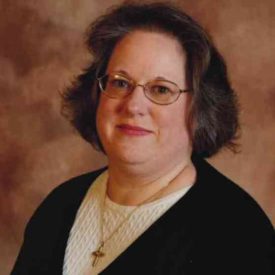 LYNNE A. PABST is a certified Christian educator, director of Christian education at Grove Presbyterian Church in Danville, Pennsylvania, and early childhood education faculty at Luzerne County Community College.