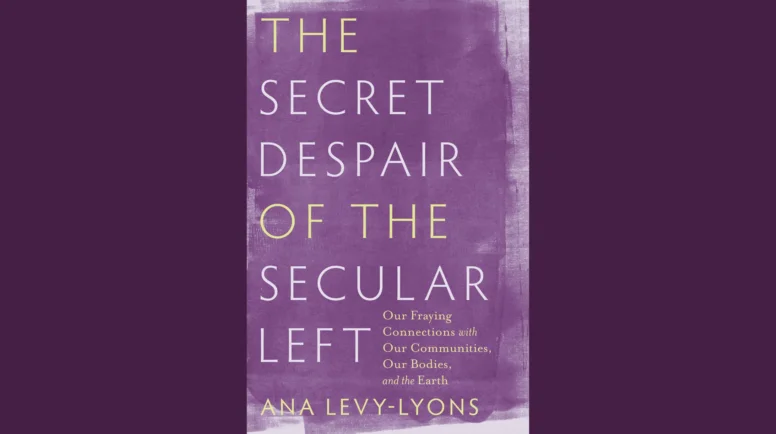
The Secret Despair of the Secular Left
Ana Levy-Lyons
Broadleaf, 219 pages
Published June 10, 2025
The title got me — with a name like The Secret Despair of the Secular Left, I was curious: was this a damning polemic? A wistful look back at simpler times? The answer lies somewhere in between, as the author tackles what she calls the “defining story of our time. It’s the story of disembodiment, disconnection, and dislocation,” and it impacts us all.
Rabbinical student and former Unitarian Universalist Minister Ana Levy-Lyons mourns the widespread loss of religious tradition, meaningful connections with our past, reverence for the miracle of our bodies and sense of infinite divine love. She cares deeply, and writes with great passion, often from a place of warmth and encouragement; her subtitle, Our Fraying Connections with Our Communities, Our Bodies and the Earth, reminds us that she sincerely wants all creation to thrive.
At other times, she writes with the zeal of a convert who is convinced that her way is the only way, and this is where her book is less effective, particularly as she creates and knocks down strawmen. In one argument, she describes a NYC Lyft ride where her husband accidentally plugs in the wrong address. The driver is unable to manually re-route; her husband must first update the app with a new address. “What happened next could only have happened in today’s strange, tech-distorted world,” she writes, imagining that “if we had hailed an old-fashioned taxi,” the story would have unfolded differently, as they learned the name of the cab driver and happily figured out the destination together. While this is a lovely image, my experiences with Chicago cab drivers in the “good old days” were never as cheerful or straightforward as she describes! Ride-sharing services with safety features that prevent drivers from taking passengers to unplanned destinations are technological improvements, not distortions.
The author is more successful when she simply gives voice to her grief. In a familiar situation, Levy-Lyons’ daughter questions her family’s Shabbat-keeping practices when she wants to compete with her school’s debate team on Saturdays. Her parents make their case, but recognize that their daughter now holds a “seed of resentment” toward sabbath practices that had previously been “joyful and fun.” For Levy-Lyons, this is further proof of “the secular gaze” that “pervades all our social institutions.” She writes, “The religious perspective that my husband and I offered felt frail and isolated, surrounded on all sides by society’s towering confidence in freedom, choice, and the fulfillment of individual desires.”
Parents with similar struggles will appreciate Levy-Lyons’ experiences, and yet they might prefer a tone of invitation, not judgment. She could have shown a healthy curiosity toward her daughter’s desires, permitted herself to simply sit with the inherent tension of a pluralistic society, or demonstrated openness toward secular practices that others find life-giving, modeling these for her readers. There are no easy answers, and The Secret Despair of the Secular Left doesn’t offer any – but it does invite us to acknowledge that our hearts yearn for more, and that’s a good start.
Presbyterian Outlook supports local bookstores. Join us! Click on the link below to purchase The Secret Despair of the Secular Left from BookShop, an online bookstore with a mission to financially support local, independent bookstores. As an affiliate, Outlook will also earn a commission from your purchase.
Sign up for Page Turners, our monthly email newsletter, to receive book-related content in your inbox once a month.