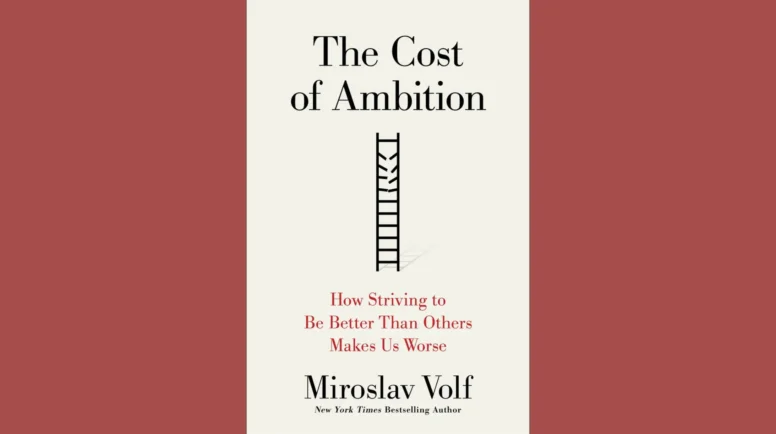
The Cost of Ambition: How Striving to Be Better Than Others Makes Us Worse
By Miroslav Volf
Brazos Press, 208 pages
Published May 20, 2025
The title alone sounds dramatically un-American. Ambition is, after all, the very heartbeat of the competitive American spirit. Be the best, strive for the top awards, let your accomplishments speak for themselves: this is the societal messaging ingrained in our psyche from as early as birth (e.g. proud parents of newborns already compare their child’s weight and length measures against other newborns). Respected theologian Miroslav Volf fights an uphill battle, arguing that competition and superiority over and against others are categorically antithetical to a Christ-like posture.
To build his case, he relies on the likes of Søren Kierkegaard and John Milton, alongside the familiar theology of the Apostle Paul. Volf skillfully summarizes these giant thinkers, making them accessible. The conclusion offers 24 theses, each of which can easily stand alone as a hook for a small group discussion starter — an ideal choice for Theology on Tap-style gatherings. In many ways, The Cost of Ambition speaks to the doubters and seekers among us as it draws on voices outside the traditional church to closely examine the moral value, if any, of competition and superiority over and against others. Take, for example, how Volf uses Kierkegaard’s view on humanity and Milton’s own professional life in striving to be the best poet of his time as the lens through which to approach the problem of comparison and worthiness. The intellectual nature of Volf’s argument is attractive to readers who long for a connection between the secular and the sacred.
To be clear, Volf differentiates between striving for superiority over and against another person and striving for excellence. The latter removes the nagging comparison of performance with another person or group. As Volf puts it, the distinction between the two is “being better at something versus being better as a person.” The problem lies within the value placed upon a person’s sense of worth. Volf invites the reader to consider, “Do we all have equal worth as human beings independently of our performances or possessions, or is our worth as human beings dependent on our relative status as performers and possessors of qualities or things?” It’s clear, then, how a posture of grace and redemption through Jesus the Christ does not fit a paradigm of competitive superiority.
I like both the nature and approach of Volf’s argument, and I am particularly drawn to his countercultural critique of our society. What is most challenging to imagine, however, is how to apply this way of thinking from an early age, thereby paving a different way of being in our highly competitive society. As an option for faithful living, families and educators could take a gander and consider ways to raise the younger generation in this alternative culture. That seems to be the greatest gift of this timely book — to offer Christians an alternative way to live as a beloved community in a suffering world.
Presbyterian Outlook supports local bookstores. Join us! Click on the link below to purchase The Secret Despair of the Secular Left from BookShop, an online bookstore with a mission to financially support local, independent bookstores. As an affiliate, Outlook will also earn a commission from your purchase.
Sign up for Page Turners, our monthly email newsletter, to receive book-related content in your inbox once a month.