When sanctuary becomes a security risk
Welcoming the vulnerable, the disenfranchised, and newcomers to sanctuaries across the denomination has become even more challenging in 2025, leading many churches to rethink safety and security at their facilities.
“We have a president who was elected by Christians, yet many Christians are afraid to worship,” said Chicago pastor David Black. He has recently been in the public spotlight for being shot repeatedly with pepper balls by federal agents outside the U.S. Immigration and Customs Enforcement facility in Broadview, a suburb about 18 miles west of Chicago.
This past Sunday, 11 security officers supported First Presbyterian Church of Chicago’s Sunday service, where Black was leading worship after appearing on both CNN and MSNBC to speak about excessive force by ICE and federal agents.
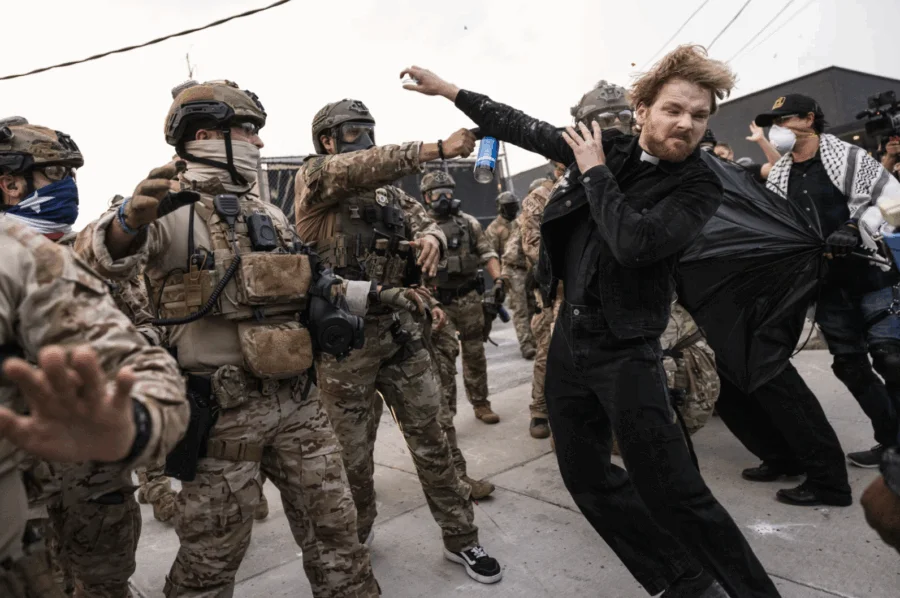
While Black has received no direct death threats, critics have accused him of being an outside agitator and questioned the legitimacy of his ordination.. Armed security will be stationed at his church for the “foreseeable future,” said Black, a 2018 Princeton Theological Seminary graduate.
“Apathy is authoritarianism’s best friend,” said Bruce Reyes-Chow, former Moderator of the General Assembly.
ICE rollbacks and the end of “sensitive locations”
A key government policy that protected churches was lifted earlier this year.
“Faith communities [are] beginning to ask how we keep our people safe,” said Beth Brown, pastor of Lincoln Park Presbyterian Church. The Chicago minister has been involved in immigrant advocacy work across Chicagoland for many years. Her group, Partners in Justice and Safety, was ready for rapid response beginning in November when President Trump was re-elected. Due to many other citywide calls, the group was suspended to conserve energies in September 2025.
Then, in January 2025, the Trump administration rescinded the Biden-era “sensitive locations” policy, which discouraged ICE and Customs and Border Protection (CBP) agents from conducting enforcement actions near places like schools, hospitals, or places of worship. Simply put, this means that ICE can now more freely enter or arrest in these spaces.
In response, the PC(USA) and a coalition of denominations and faith groups are arguing in a lawsuit (Mennonite Church USA et al. v. U.S. DHS) that the rescission violates religious freedom and interferes with congregations’ ability to minister to and protect vulnerable people. The lawsuit is still ongoing after a district court judge in April denied the plaintiff’s request for a preliminary injunction, ruling that they had not shown a “credible threat” of enforcement at their churches. The coalition of faith groups appealed that decision in May 2025. The case is now before the D.C. Circuit Court of Appeals and, as of October 16, 2025, is undecided.
Building a legal shield around sanctuary
To Jim Rigby of St. Andrew’s Presbyterian Church in Austin, Texas, church security is not a new idea. His church has sheltered a mother and son from Guatemala for the past nine years.
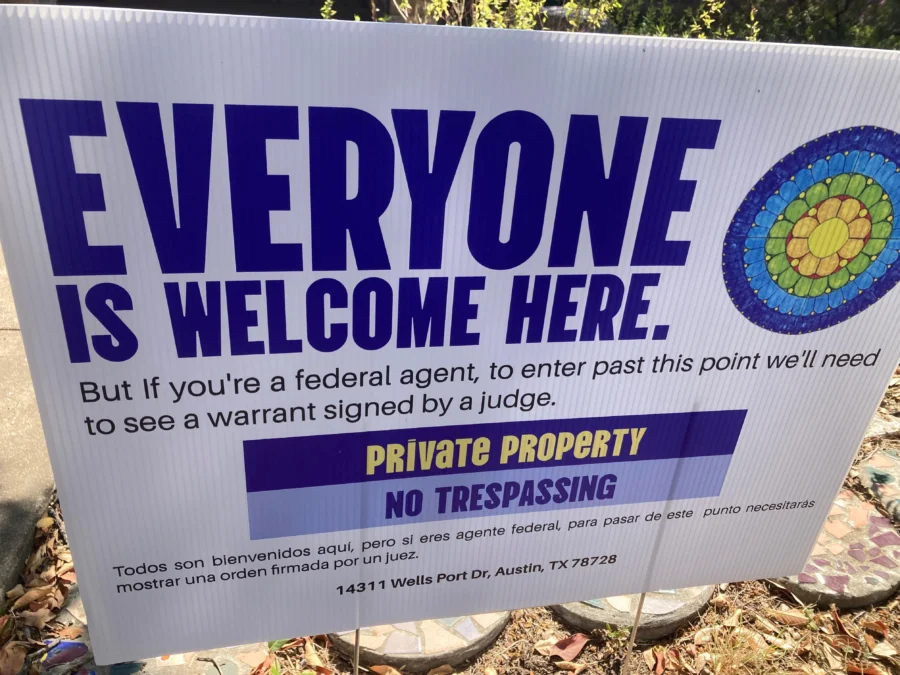
Rigby’s church has a sign outside that says, “Everyone is welcome here” in large letters. Underneath, in smaller type, the sign says: “But if you’re a federal agent, to enter past this point we’ll need to see a warrant signed by a judge.”
Rigby and St. Andrew’s session also work with immigration lawyers to maximize safety.
The Presbyterian News Service has reported that congregations are reviewing their liability, legal exposure, and safety protocols around hosting persons at a high risk of ICE enforcement.
“The church is stepping forward in a way they haven’t before,” said Rigby. “Our human family is at risk.”
The PC(USA)’s “Sanctuary” website page acknowledges that congregations are offering sanctuary to persons with final deportation orders, yet cautions that ICE is no longer constrained by the “sensitive locations” principle.
Brown has provided training for the denomination on how to respond when ICE enters a church building.
“We have learned that ICE does not care what is legal and what is not.” — Beth Brown
“We have learned that ICE does not care what is legal and what is not,” Brown said. Just because you ask for a warrant doesn’t mean they will cooperate, but we need to create a legal case against them if they violate rights.
Security measures meet theological convictions
Legal protection is one consideration, but safety and protection across the board is also a concern. Homicides and violence at places of worship, while relatively rare, have become part of the larger narrative. Statistics from the Violence Prevention Project show that there were about 380 instances of violence at houses of worship from 2000-2024, resulting in 170 injuries and 490 deaths.
In 2022, a shooter in Laguna Woods, California, killed one person and injured five at the Irvine Taiwanese Presbyterian Church. More recently, in August, two children were killed and 30 people injured while at Mass at a Catholic school in Minneapolis, Minnesota, and four people were shot and killed in September while at a Mormon church in Grand Blanc, Michigan. Not all instances of violence in places of worship are attributable to guns, the Violence Prevention Project site shows, and motives ranged from hate crimes to domestic violence or robbery.
“I don’t know that there is any way to protect churches from a White nationalist coming into your church to do harm,” said Brown. “Unless they hire armed guards … but very few churches’ budgets will sustain that.”
“Every church has to assess their risk.” — Beth Brown
“Nobody is equipped if somebody walks into your sanctuary with a gun,” said Brown. “Every church has to assess their risk.”
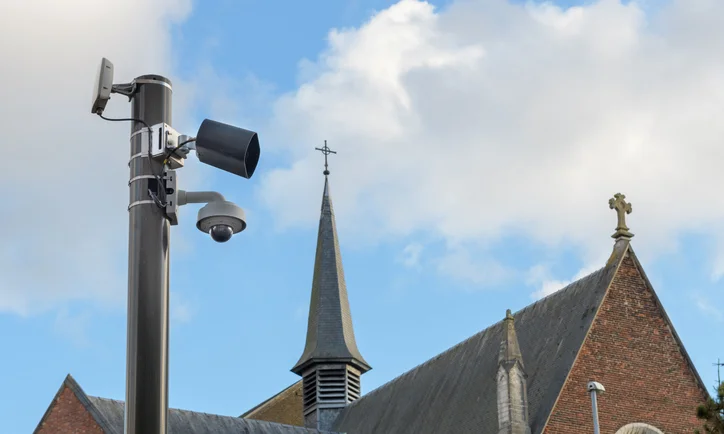
Churches can provide more security such as hand-wanding as congregants enter the church, locking all but one door during worship, installing more cameras outside as deterrents, watching safety videos, but mainly just paying attention to visitors to the church, Brown suggests.
“Deciding what [churches] are willing to do and what they are legally responsible to do are two very different questions,” said Reyes-Chow.
“This is the moment that the church can be the church and live into the gospel of liberation.” — Bruce Reyes-Chow
Reyes-Chow, who is on the board of the California-based social justice network Interfaith Movement for Human Integrity, said that urban centers being targeted by this administration especially need to be prepared. “This is the moment that the church can be the church and live into the gospel of liberation.”
“If the church isn’t in danger, we aren’t saying the right things.”
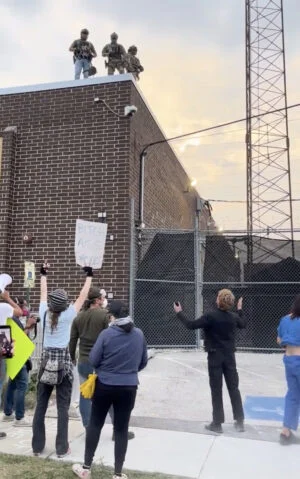
“Jesus was clear that following him is not a safe proposition,” said Black. “Violence will always be the empire’s response to the ministry of Jesus Christ.”
In the well-publicized encounter Black had with ICE agents on September 19, Black said he was “literally praying” with his arms outstretched and calling for ICE agents to repent.
“Our witness provokes people,” Black said.
“The PC(USA) is needed by the world now.” — David Black
“The PC(USA) is needed by the world now. This denomination has figured out so much. We are organized around our shared beliefs, and our roots stabilize us,” Black said. “God calls everyone and works through them.”
Rigby said, “If the church isn’t in danger, we aren’t saying the right things.”