Editor’s note: We’re proud to share that this article won an honorable mention in the “News Story — Long Format” category at the Associated Church Press Awards for 2025. To learn more about this award and the others we earned in that contest, you can read our press release.
“We call them ‘the kidnappers.’”
It’s strong language, but Beth Brown, the pastor of Lincoln Park Presbyterian Church in Chicago, says she has witnessed disturbing violence and aggressive actions as ICE agents continue to take immigrants to the Broadview U.S. Immigration and Customs Enforcement facility about 18 miles outside of Chicago.
Brown and other Presbyterian pastors were among those who stood on the front lines outside the detention center the last few weeks, praying, demonstrating and speaking out against what they saw as unjust enforcement tactics by federal agents.
Related reading: “After clergy arrests, religious pushback to ICE expands in Chicago” by Jack Jenkins
In August, President Donald Trump suggested he would send troops into the area for a variety of reasons, including immigration control and violence mitigation. In October, the federal government deployed about 500 members of the Texas and Illinois National Guards to Chicago and the surrounding areas.
From prayer to pepper balls: Presbyterian pastors on the front lines
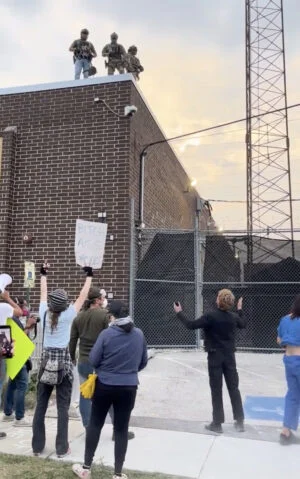
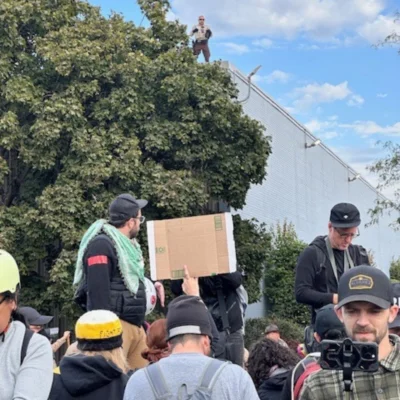
Quincy Worthington, pastor of Highland Park Presbyterian Church and a regular participant in recent protests at Broadview, said tensions have escalated in recent weeks as additional law enforcement agencies have joined ICE officers on site.
The Broadview facility, according to WBEZChicago, was not intended to be a detention site. It is a “service processing center,” the news report says, a short-term holding facility for those in immigration authorities’ custody. However, the hold time allowed for facilities such as Broadview has been expanded from a maximum of 12 hours per person to 72 hours, WBEZChicago reported in early October.
The scene outside the ICE facility is “the closest thing to hell on earth that I’ve ever experienced,” Worthington said.
“All of us have been shot by pepper balls, flash bangs, rubber bullets, tear gas. Sometimes it seems like they target people; other times it’s indiscriminate. Everyone has been targets — clergy, protesters, journalists, legal observers, even first responders.”
“Everyone has been targets — clergy, protesters, journalists, legal observers, even first responders.” — Quincy Worthington, pastor of Highland Park Presbyterian Church
Lawsuit filed over alleged excessive force by ICE and federal agents
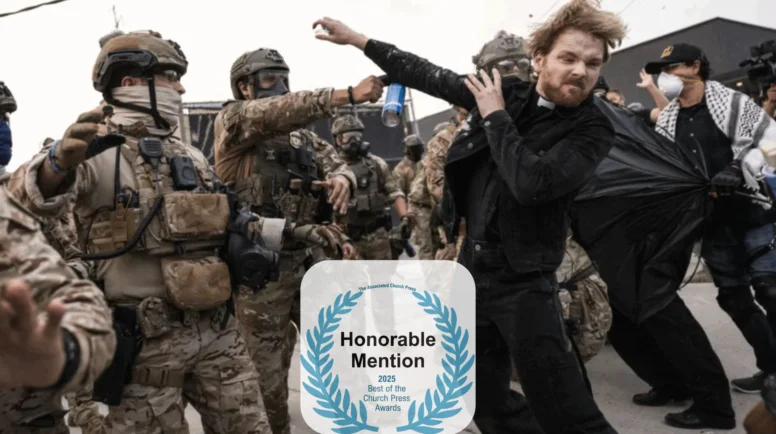
A photo and video of David Black, pastor of First Presbyterian Church of Chicago, being struck by pepper spray and pellets has gone viral and has been shared across multiple social media platforms since its publication in the Chicago Sun-Times in September. Black is among the plaintiffs in a lawsuit filed this week by the ACLU of Illinois and the National Immigrant Justice Center.
Related reading: “What happens when ministry becomes a security risk?” by Harriet Riley
The lawsuit, filed on October 6 against the federal government, alleges that ICE and other federal agents have used excessive and unlawful force against protesters and journalists at the Broadview facility.
“I extended my arms, palms outstretched toward the ICE officers, in a traditional Christian posture of prayer and blessing,” Black says in the suit. “Without any warning, and without any order or request that I and others disperse, I was suddenly fired upon by ICE officers. In rapid fire, I was hit seven times on my arms, face and torso with exploding pellets that contained some kind of chemical agent. It was clear to me that the officers were aiming for my head, which they struck twice.”
“I was hit seven times on my arms, face and torso with exploding pellets that contained some kind of chemical agent. It was clear to me that the officers were aiming for my head, which they struck twice.” — David Black, pastor of First Presbyterian Church of Chicago
I was hit seven times on my arms, face and torso with exploding pellets that contained some kind of chemical agent. It was clear to me that the officers were aiming for my head, which they struck twice.”In response to the lawsuit, Tricia McLaughlin, assistant secretary of the Department of Homeland Security, said in a statement posted on X on Wednesday that Black and other protestors were “blocking an ICE vehicle from leaving the federal facility — impeding operations. … If you are obstructing law enforcement you can expect to be met with force.
McLaughlin said in the statement that the footage was a month old, and that Black was the ‘pastor’ who made a flippant gesture to government officials who were on site the previous week. In her statement, McLaughlin used quotes to refer to Black, an ordained PC(USA) pastor.
On Friday, October 10, a federal judge in Illinois issued a temporary restraining order barring government agents from using a number of forceful tactics against faith-based demonstrators at Broadview.
A watershed moment for the church: “Where will we stand?”
Other local Presbyterian Church (U.S.A.) clergy have witnessed the situation at the ICE facility. Shawna Bowman, pastor of Friendship Presbyterian Church in Chicago, said, “The presence of ill intent and evil in that situation has shaken me to the core,” Bowman said. “The notion that there are human beings enacting this type of violence and using protesters for target practice is disturbing.”
Bowman, who is also executive director of Friendship Community Place, a non-profit located at Friendship Presbyterian Church, said people need to understand the gravity of this situation. “People are getting arrested for no reason.”
“Things are as bad as what you are seeing in the news, if not worse,” said Brown. “The ICE agents are aggressive and violent.”
Brown, who started the Faith Community Initiative to house and support migrants in Chicago, also said that ICE agents are masked, often not wearing standard uniforms and are in unmarked vehicles.
She said the ACLU lawsuit and others will work through the courts, but meanwhile, “so many people are suffering.”
“This is a watershed moment for churches. Where will we stand, and how will we use our enormous resources and spaces and people?” — Shawna Bowman, pastor of Friendship Presbyterian Church
“ICE is not being held accountable,” Brown said.
“This is a watershed moment for churches,” said Bowman of Friendship Presbyterian. “Where will we stand, and how will we use our enormous resources and spaces and people?”
“No Presbyterian church should be silent about what is happening,” Brown said.
PC(USA) Office of Public Witness calls for action on immigrant rights
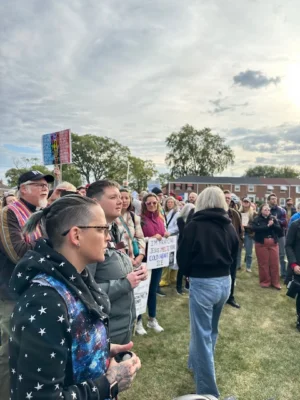
The PC(USA)’s Office of Public Witness issued a call to action earlier this week in which it addressed multiple issues involving “fundamental rights (i.e., due process, speech, assembly, conscience, etc.) of American citizens and non-citizens,” and it notes that “our Latinx members, friends, and neighbors are racially profiled and cruelly denied their rights to due process and freedom from arbitrary search and seizure.
“Many have been detained in facilities that lack basic necessities and are intentionally denied access to appropriate legal counsel,” the call to action reads. “Others have been unlawfully deported and imprisoned in other countries.”
Brown warned Presbyterians not to let fear stand in their way during this time. “If there is a time to take a risk, this is it.”
She said churches should consider housing immigrant families in their buildings, citing a tremendous need for direct housing and rental support. “Presbyterians need to be willing to use their buildings for good.”
“If there is a time to take a risk, this is it.” — Beth Brown, pastor of Lincoln Park Presbyterian Church
Protesters remain peaceful amid brutality: “It feels like the kingdom of God”
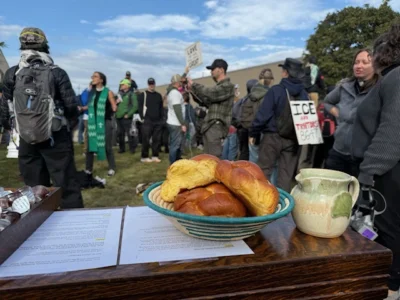
Even as clergy pressed Presbyterians to open their doors to immigrant families, the protests outside Broadview’s ICE facility remained a vivid reminder of the stakes on the ground.
“The thing that shocks me is not the unprovoked brutality, but that the protesters have remained peaceful,” Worthington said.
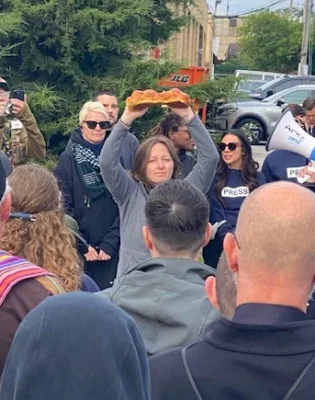
He said that in ways it feels “like the kingdom of God. Everyone takes care of each other and then goes back to protest.”
“It is a remarkable thing to be part of and witness,” said Worthington.
He called this situation a humanitarian crisis “where we are being called to love one another.”
In that spirit, Worthington, Brown and Bowman joined other faith leaders in an ecumenical communion service on the morning of Friday, October 10.
“We are inviting people to the table to remind everyone what we’re fighting for. Communion is like a steroid injection of grace,” Worthington said.
We’re proud to share that this article won an honorable mention in the “News Story — Long Format” category at the Associated Church Press Awards for 2025. To learn more about this award and the others we earned in that contest, watch our Facebook Live conversation.