Pastors step into the role of trained observers
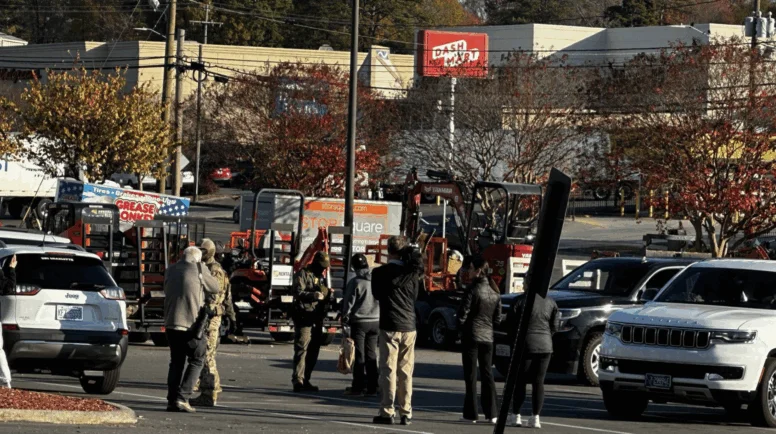
In addition to preaching, visiting the sick, and being the leader of a congregation, some Charlotte area pastors this week became official, trained observers of the Border Patrol agents sent to Charlotte as part of the federal government’s immigration enforcement. Pastors, some in their stoles and collars, rushed to locations in the Queen City where patrols had been sighted. There, they sat in their cars, observing agents, videotaping their actions, photographing license plates and blowing whistles, if necessary, to alert residents that agents were nearby.
Members of the clergy were among the hundreds of volunteers who showed up to protect people, most of whom were stopped because their skin was Brown or they spoke Spanish, during the immigration enforcement push called “Operation Charlotte’s Web.” The occupation began in earnest last week, and congregations in other parts of the state, including Raleigh, Asheville and Durham, have braced themselves in anticipation of the roving operation. About 250 people were detained, according to news reports.
Local television stations announced it is possible that some agents could leave the area as soon as Friday.
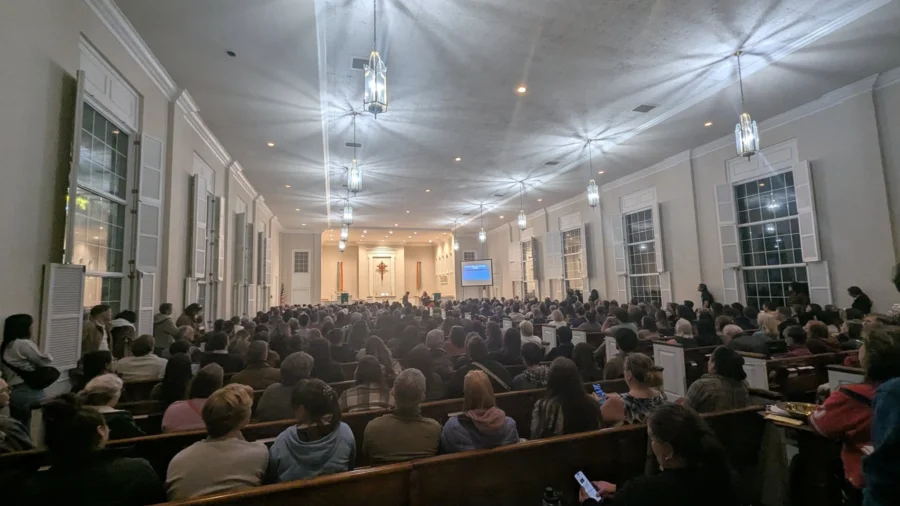
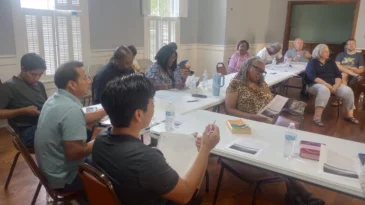
Many members of the clergy in Charlotte have attended online or in-person training conducted by Siembra NC, a grassroots organization that states it was “founded in response to Trump’s war on immigrants.”
Lori Raible, senior pastor at Selwyn Avenue Presbyterian Church, said the organization’s initiative aligns with her church’s mission.
“They say their mission is to help people get to school, work and church safely,” said Raible. “We have a long-standing relationship with a school of 500 kids; 300 of them were not there today.”
The Charlotte-Mecklenburg schools had reported massive absences, presumably because some children and parents were afraid of being harassed by Border Patrol. While Border Control was the predominant factor this past week, its presence was new and was relatively brief. ICE has had an ongoing operation in the area and will remain, according to Mecklenburg County Sheriff Garry McFadden. The sheriff’s department is not taking part in the ICE operations.
‘They are just grabbing Brown people’
“I feel it is my obligation to go witness, so I can let my congregation know what to do… where Jesus stands,” said Raible.
Siembra NC pre-emptively assisted a daycare in Durham in setting up a safety patrol network, and hundreds in the Raleigh-Durham area had already signed up to help protect the most vulnerable in their cities.
Raible, like many other volunteers, received alerts during her shift directing her to specific locations to observe and document any incidents involving agents.
“What I saw was terrible,” she said. “I watched a 19- or 20-year-old boy get snatched off the street by three carloads of men in masks. There’s no way they would know whether or not he was documented. He was just walking down the road.
“I have a 20-year-old son, and because of his Whiteness and who he is, he could not be that boy,” Raible said, adding that people should not align the actions of Border Patrol with immigration policy or reform.
“What I saw today had nothing to do with immigration reform,” she said.
“What I saw today had nothing to do with immigration reform.” — Lori Raible
What she saw reminded her of her grandmother, who is a Jewish Holocaust survivor who was forced to wear a yellow star to identify herself as a Jew.
Kate Murphy, pastor of The Grove Presbyterian Church in East Charlotte, is also volunteering to work four-hour sessions on the streets. Murphy said that while her church has only five Latino families, 80% of the people who attend their outreach and after-school programs are Latino. She said people in her programs and congregation had been stopped for months by ICE before the Border Patrol agents arrived. After the Border Patrol arrived in Charlotte, Murphy closed some of the church’s entrances, leaving only one open for Sunday service, with people stationed there to monitor it.
She agreed with Raible. “They (agents) are not differentiating between documented or undocumented people. They are just grabbing Brown people.
“I’ve seen carloads of agents in cars circling around,” she said. “We followed the protocol (from training). We stayed 15 feet away (from the agents).”
“Agents are not differentiating between documented or undocumented people. They are just grabbing Brown people.” — Kate Murphy
She has witnessed how frightened her neighbors and congregants are. Popular Latino businesses have closed temporarily, and people are staying home instead of going about their regular life activities. At the invitation of a school administrator, she has been a “friendly community presence” during mornings as parents drop off their children.
“It normally takes a half hour for all cars to move through the line. This week, it was done in five minutes,” she said.
Visibility as ministry: stoles, collars, and public presence
She discovered that people are comforted when she and her peers show up wearing their stoles and collars.
“Visibility is important. Lots of people are saying ‘thank you’ to us,” she noted.
Murphy also wrote an opinion piece for The Charlotte Observer in which she said: “The Hebrew Bible is full of commands to show justice and mercy to immigrants. In Leviticus, Deuteronomy and Exodus we find requirements that ‘The foreigner residing among you must be treated as your native-born.’”
Vincent Kolb, a retired Presbyterian pastor, calls himself an ICE verifier for the Carolina Migrant Network and describes his volunteer work this way: “I’m trained to bear witness where ICE is going, to document their whereabouts, take down license plates, and to observe their behavior to alert a population that is being terrorized.”
Kolb, who has served congregations in Colorado, Texas and Pennsylvania, said people call the network when they see patrol activity and he receives an alert.
“We can inform people of their rights,” he said. “A lot of people don’t know that even if they are here undocumented, they have constitutional rights.”
He uses his camera to document from “a secure position. We have seen ICE everywhere — in apartment complexes, places of business, large and small.
“I got into this because my maternal grandmother crossed the border undocumented 103 years ago this month,” he said. “She crossed the border in El Paso in 1922.”
His grandmother had no legal documents because her village in Mexico had been burned, Kolb said. “She was hungry, poor, escaping violence, and there was this hope and dream of a better life. She met a Punjabi immigrant – my grandfather – and they got married. She was naturalized in 1970.”
Kolb said he is to travel to other areas to help secure immigrants’ safety.
Volunteers sound the whistle — literally
Erika Funk, director of Cross Ministries at Myers Park Presbyterian Church, was among the hundreds who attended training this week at Dilworth United Methodist Church.
“I went because this is my city and community and I live in East Charlotte, where it’s pretty diverse and there are a lot of immigrants, especially Spanish-speaking. I care about my neighbors.”
Her first assignment was car patrol.
“You drive around neighborhoods where you know Border Patrol is present and just monitor and keep an eye out and report to the administrators if any Border Patrol agent is seen.”
Like other volunteers, she wore a whistle that was passed out at training sessions.
“You blow it three times if you see Border Patrol anywhere,” Funk said. “I think there is something powerful about the whistle as a symbol. We are here to draw attention, to call out bad behavior we’re witnessing. But also to wear your collar or stole signals to the community, the press and the government that this is the place where church and faith communities should be present to bear witness to God’s call to protect the innocent, the foreigner, and to say the church cares about them.”
“We are here to draw attention, to call out bad behavior we’re witnessing. But also to wear your collar or stole signals … that this is the place where church and faith communities should be present…” — Erika Funk
Loving the stranger
Rodney Sadler, associate professor of Bible studies and director of the Center for Social Justice and Reconciliation at Union Presbyterian Seminary, has gone to trainings and prayer vigils and tried to get as much information as possible on the activities of Border Patrol, partly so he can help educate people, those who in impacted neighborhoods and those who may want to offer assistance.
“I’ve run into an enormous amount of fear. I’ve seen people crying,” said Sadler. “I’ve talked to people who have shuttered their businesses.”
Sadler, who is also running for the N.C. House District 106, expects to help deliver food this week to people afraid to come out, even if Border Control has moved on.
“God has instructed us constantly in Scripture that we are to love the alien.” — Rodney Sadler
“This is a militarized invasion by a group we did not invite, to serve a purpose we did not need,” said Sadler. “God has instructed us constantly in Scripture that we are to love the alien.
“In Matthew 25, a Scripture of particular importance to Presbyterians, Jesus says ‘I was a stranger and you welcomed me.’”