Editor’s note: We’re proud to share that this article won an award of merit in the “Critical Review” category at the Associated Church Press Awards for 2025. To learn more about this award and the others we earned in that contest, you can read our press release.
In a Q&A after an early screening of “Wake Up Dead Man: A Knives Out Mystery” in November, writer and director Rian Johnson reflected on pivoting the “Knives Out” series toward something more grounded and personal: faith and religion. While he no longer considers himself a “believer,” Johnson admitted that he grew up “very Christian,” even into his mid-20s. “My personal relationship with Christ was how I framed the world around me,” he said — a relationship that remains, for him, “ very deep, very personal, very complicated.”
That framing of the world – and how faith shapes it – sits at the heart of “Wake Up Dead Man.”
The film opens with former boxer and Catholic priest Jud Duplenticy (Josh O’Connor) punching a deacon square in the jaw for saying something rude. Called before a trio of bishops to account for his behavior, Jud is told by a superior that priests are shepherds and the world is a wolf.
His immediate response? “No.”
If you start seeing the world as a wolf and fighting it, then soon enough everyone you don’t understand becomes a wolf in your eyes.
Jud rebukes this worldview, arguing that if you start seeing the world as a wolf and fighting it, then soon enough everyone you don’t understand becomes a wolf in your eyes. He admits that he made a mistake but also reminds himself – and his superiors – that Christ came into the world to heal the world, not to fight it.
So how do we abandon our fighting instincts and care for others in situations where people with more power and influence want us to fight so the eyes of the world are focused elsewhere?
This question frames everything that follows in the film.
Jud’s relationship with Christ has reoriented how he frames the world: not looking for fights, but for opportunities to help and heal. The problem is, not every character shares this worldview. In fact, more than a few people seem to enjoy fighting the world for their own vanity, glory, or benefit. They don’t seek to help or heal because they don’t care about other people — only about how they can come out ahead. Often, those people are in positions of power, control, and influence, and even after their death, the damage they’ve done lingers like phantom pain.
This tension comes into sharp focus in “Wake Up Dead Man” when Jud joins now-classic sleuth Benoit Blanc (Daniel Craig) to solve the seemingly impossible murder of Jud’s new superior, Monsignor Jefferson Wicks (Josh Brolin), during a worship service.
Monsignor Wicks — as he insists on being called — is a fighter. He preaches fiery, passive-aggressive sermons that take aim at specific visitors to his small congregation, pushing for walkouts that both isolate his targets and influence the people remaining in the pews. He talks about the world as if it’s his enemy, full of “harlots” and “defilers.” He plays power politics and hides his motives to get what he wants, manufacturing outrage as performance for the people he’s been called to serve.
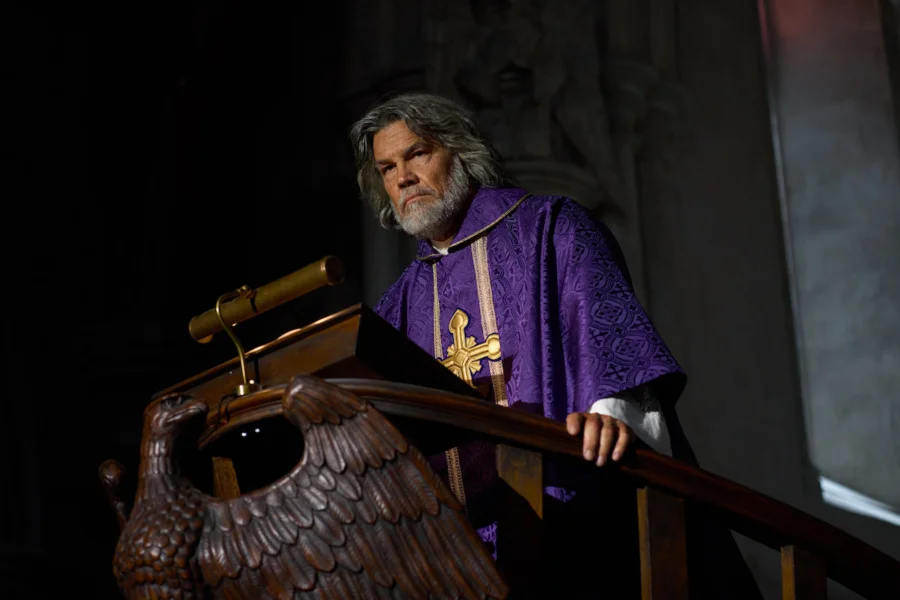
Ultimately, his behavior galvanizes a cult of personality: a small inner circle of parishioners who come searching for hope, a search he exploits to secure his own power and livelihood and to form a human defense against any “outsider” who might hold him accountable.
The film carefully balances this juxtaposition between Jud and Wicks. Where Jud acts through the lens of love, Wicks’ governs through fear and the desire for control. Jud has allowed himself to be changed by Christ’s presence; Wicks, by contrast, bends the congregation’s perception of Christ into his own image — punctuated by the conspicuous absence of a crucifix behind his pulpit, removed to “remind” the church of its past sin.
When Wicks is murdered in the middle of worship, suspicion immediately falls on the “outsider” in their midst. Jud becomes the prime suspect, both in the congregation’s eyes and those of the authorities. The members of Wicks’ inner circle are ready to fight Jud on behalf of their fallen monsignor. Yet the only other outsider in the story, Blanc himself, believes otherwise and recruits Jud as his partner in solving the case.
Throughout the investigation, Jud consistently places his pastoral calling above his usefulness as a detective’s assistant. He repeatedly interrupts Blanc’s process to tend to people’s needs. The most striking interruption comes during a phone call Jud makes to a local construction company while following a potential lead. As Blanc and Jud both grow impatient with the woman’s rambling explanations, her voice suddenly breaks.
“Will you pray for me?”
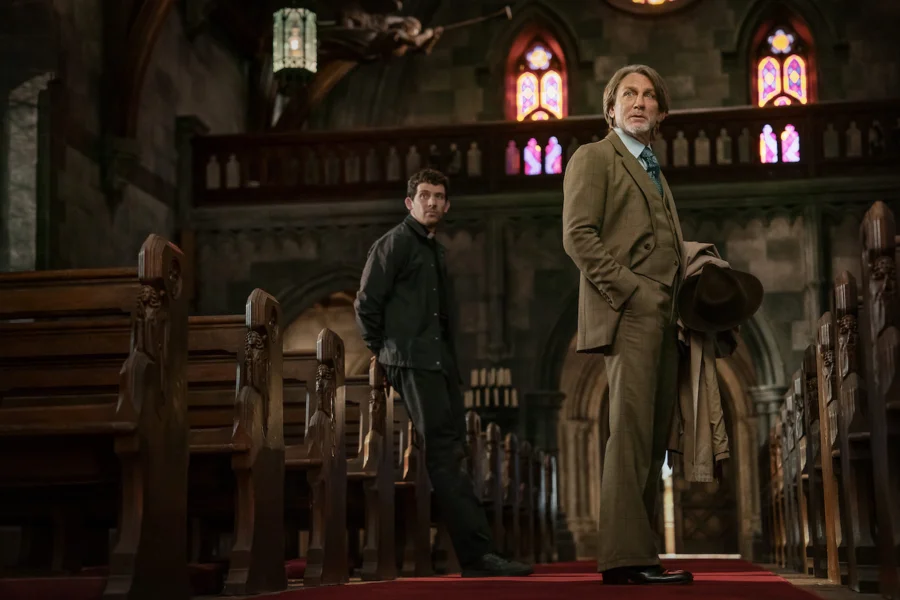
With this single question, Jud abandons the investigation. Accused of a murder he did not commit – pursued by police and facing prison – Jud chooses to be fully present with someone in pain, listening, praying and offering care. What matters is not clearing his name in that moment, but the vulnerable person on the other end of the line. Potentially sacrificing their strongest lead, Jud treats the woman not as a tool but as a human being worthy of love.
While the genre of “Wake Up Dead Man” remains a “whodunit” mystery, it is these interruptions to the plot that make the film unexpectedly impactful — and the strongest entry in the “Knives Out” trilogy. While the first film (2019) roasted inherited wealth and privilege and the second film (2022) skewered tech billionaires, Johnson takes a more even-handed approach to the churchgoing faithful here. He does not shy away from exposing ecclesial corruption, performative piety, and the exploitation of those who are desperately seeking meaning. And yet, through Jud, Johnson honors what the church can be when it meets neighbors in need with love and humility.
“Wake Up Dead Man” may be the most Christian movie released this year.
In this way, “Wake Up Dead Man” may be the most Christian movie released this year. It does not shy away from the contradictions of faith as it exists versus what it can be, offering a vision of love enacted in a complicated, broken world.
If we see the world as wolves, we will respond by fighting our neighbors. If we give in to fear or distraction, we allow ourselves to be pulled away from love. And if we care more about our own glory than about healing the world, we risk losing our humanity altogether.
The work of caring for others is not easy. Sitting beside those who are suffering requires time, vulnerability, and the willingness to abandon our own agendas — actions often dismissed as weakness. But if we allow ourselves to be genuinely changed by Christ’s call to reframe how we see the world, we may yet find ourselves renewed: speaking with kindness, walking in grace, and acting in love, even when the situation before us feels impossible.
Editor’s note: We’re proud to share that this article won an award of merit in the “Critical Review” category at the Associated Church Press Awards for 2025. To learn more about this award and the others we earned in that contest, watch our Facebook Live conversation.