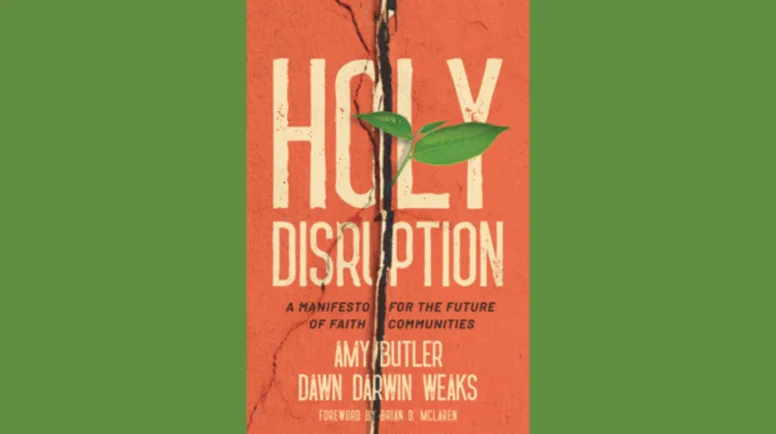
Holy Disruption: A Manifesto for the Future of Faith Communities
By Amy Butler and Dawn Darwin Weaks
Chalice Press, 144 pages
Published September 16, 2025
“Amidst questions of the church’s survival, we must not miss the essential question: Where is your congregation called to invest its spiritual and financial wealth in order to set its neighbors free?” This is the question that drives pastors Amy Butler and Dawn Darwin Weaks, and their work proves that there are as many answers to this question as there are churches.
These transformed churches, however, are low on stained glass with nary an organ in sight. Holy Disruption highlights faith communities that open pay-what-you-can cafés or transform dilapidated properties into low-income housing and green energy. One is led by a pastor who learned to brew beer (and taught isolated men to do the same), and another ministry was founded by a rapper-turned-pastor who built a worker-owned smoothie restaurant! The connecting thread between these disparate ministries is this: church leaders looked outward, investigated their neighbors’ needs, and ultimately invested congregational resources to address them.
Unlike Jesus, we operate within institutions built up over hundreds of years.
The authors tell a hopeful story rooted in the gospel and Jesus’ model of building relationships. “Faith community happened around (Jesus), seemingly organically, in all kinds of places;” they remind us. “(I)t always involved relationships, care for neighbors, and a challenge to move toward justice, more easily taken on together.” Like Jesus, “holy disruptors” are grounded in their love of neighbor; unlike Jesus, we operate within institutions built up over hundreds of years. The authors boldly and biblically describe the Spirit-led work of creating new economic models that subvert unjust systems as a faithful path forward.
Holy Disruption is a gift to churches that feel stuck, particularly those that feel pressed to double down on maintaining buildings and reinvigorating programs while asking, “surely there’s a better way?” There is — but it isn’t easy. A “holy disruptor” possesses a combination of skills; they must be an entrepreneur, community organizer, fundraiser, program manager and more. Some church leaders will feel incapable of building these skills, while others may firmly decide, “That’s not what I signed up for!” The authors are clear that they offer a “spark” rather than a “blueprint,” yet their optimism in the face of such daunting work will frustrate some readers. While there is no “10-step plan to thriving,” they include a series of pointers, as well as a guide to help small groups explore the concepts. These more practical chapters offer reassurance, as they describe ministries that started small and grew through partnerships, increased investment, and a whole lot of prayer.
Weaks and Butler’s wisdom isn’t for everyone, but the inspiring ministries they describe make it clear that the disruption is already underway. Perhaps their wisdom can guide denominational leaders and governing bodies to ask different questions: can they invest funds gained by the sale of closed churches in entrepreneurial ministries? Will seminaries of the future include this in their training? Can already thriving churches deploy more of their resources in this way? The possibilities are endless.
Presbyterian Outlook supports local bookstores. Join us! Click on the link below to purchase Holy Disruption from BookShop, an online bookstore with a mission to financially support local, independent bookstores. As an affiliate, Outlook will also earn a commission from your purchase.
Sign up for Page Turners, our monthly email newsletter, to receive book-related content in your inbox once a month.