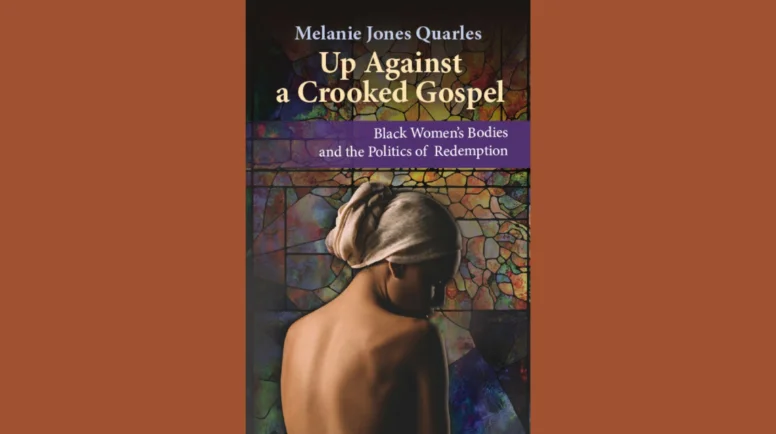
Up Against A Crooked Gospel: Black Women’s Bodies and the Politics of Redemption
Melanie Jones Quarles
Orbis Books, 236 pages
Published November 20, 2024
I am always deeply moved by personal narratives, especially stories about grandmothers. I was fortunate to have three grandmothers (in my blended family), and one great grandmother in my younger years. They all had an enormous impact on me, just as womanist ethicist and author Melaine Jones Quarles’ grandmother, Sweety Gertrude Foster, clearly had on her.
In Up Against a Crooked Gospel, it is Quarles’ epiphany that her grandmother’s back – which had been bent by her work as a hotel housekeeper – suddenly and miraculously straightened at the time of her death that informs her work. She recalls the moment of her awareness of this dramatic change, “When we walked into the intensive care unit during her final hour, I observed at the moment of her death that her once crooked body laid straight, signaling embodied transformation (healing-restoration-liberation).” Her grandmother had once experienced a disfiguring weight of responsibility as a young, Black, single mother, forced to provide for her family, but in the end she was made whole, body and spirit.
Quarles’ work explores the ways free Black bodies, women’s in particular, have been demonized as tools of White supremacy — their voices silenced or dismissed, their bodies exploited as commodities of a sinful capitalist and patriarchal society. She navigates the origins of the division between body and soul of Plato and Augustine of Hippo, who relegated the body to a less worthy status, favoring the soul’s more virtuous spiritual pursuits. The body was something to control and subdue, he believed, in order to dedicate time and energy to higher callings. This, of course, led to the subjugation of certain bodies (namely female, dark-skinned, disabled and queer), propping up the systems of patriarchal, supremacist power. Black women could not experience safety in their bodies, as Quarles witnesses in their stories of abuse, hyper-sexualization, heartbreak and exploitation.
As I enter the second half of my life, I realize that, like many women, I find embodiment to be an ongoing “re-membering.” The work of embodiment is healing, restoring and liberating, which makes me consider it through the lens of spiritual discipline, a reframe which I have found life-giving, even as it exists in direct opposition to the duality of Plato and Augustine. Quarles’ description of the divine nature of the straightened back of her grandmother, and the intense impact it left on her life and work touched me deeply. She writes, “(s)omething happened in that Chicago hospital room as I gazed upon her straightened body for the first time in 20 years that gave me profound clarity that Jesus touched my grandmother…”
Stories like Quarles’ invite us to be open to moments like these — to follow where they lead and then to share them, however raw, and however much we may think they do not have a place within “serious academic discourse.” As we gain courage and find voice for our own experiences of “profound clarity,” we extend that permission to others, beginning a virtuous cycle of naming and claiming God’s work in our lives.
Quarles addresses the complicity of the Black Church in taking Black women for granted and compounding their pain, specifically “the intracommunal oppression within the Black Church and voyeurism of Black churchwomen’s bodies and souls harbor similar characteristics of the White supremacist gaze that frames Blackness as non/subhuman and places the Black community in contempt.” She explores the ways T.D. Jakes’ ministry, “Woman, Thou Art Loosed” (WTAL) manipulates Black women in nefarious ways, shining a light on the flawed theology behind Jakes’ premise: “Seemingly, Black women are blamed and shamed for the oppression they endure while being charged to act as agents to save themselves through faithfulness to Jesus … The WTAL brand successfully sustains a crooked ideology that Black women are the problem while simultaneously casting a vision for women’s empowerment that eclipses the call to the Black church and its leaders to follow Jesus and confront the powers that wound.”
Examples like these illustrate how Scripture is easily weaponized against the marginalized, often in the service of capitalism. Quarles calls out “…some Black male clergy (who) invest in ministering to Black churchwomen only to magnify their platforms, popularity, sociopolitical influence, and spiritual capital.” Again, I recalled my grandmother watching the Crystal Cathedral Hour of Power, desperate to connect with her faith after she could no longer attend church in person. She sent a great deal of her meager paycheck to those preachers, saying that doing so eased her mind and made her feel less guilty, since they asked for money so often. The connection between church and a capitalist economy presents a challenge to those of us who feel called to speak prophetic truth to power. The worry is often that doing so will upset the wrong people (big givers), costing the church much-needed income.
Up Against a Crooked Gospel helped me widen my spiritual vocabulary considerably, as I paused many times to look up the meanings of words like ‘revivification’, ‘misogynoir’, and ‘dissemblance.’ Readers unfamiliar with womanist scholarship will benefit from spending time immersed in the work of Delores Williams, Kelly Brown Douglas, Katie Cannon and others, all of whom Quarles pays homage to, as those who paved the way.
Pastors and preachers will benefit from Quarles’ womanist lens by seeing passages (which may have grown stale) through a new perspective. When interpreting Luke 13 through her “bent body politic”, Quarles masterfully problematizes the way that the writer features more women than the other Gospels, but keeps them silent and nameless. We meet these women only where they encounter Jesus; Luke does not tell us how their stories end or the circumstances that led to their conditions. “Lukan theology is grounded in a Jesus who comes not just to offer compassion to those who are wounded but to speak to the evil of those who wound,” Quarles writes, referring to the way Jesus goes on to oppose the criticism of the synagogue leader for “working” on the Sabbath, justifying his choice to offer new life and re-membership into community to the bent woman, no matter what day it was.
The book ends with the aptly named chapter, “Turning the World Right Side Up.” Returning to her grandmother’s hospital room, Quarles connects the dots from that moment to this work of scholarship, tracing the path through the scholars who came before her, as well as Alice Walker’s coining of the term ‘’womanism.” The book’s powerful conclusion caught me off guard, as Quarles traces her grandmother’s prayers through her own life: “My grandmother prayed for me then, and I am confident that this book is a product of her answered prayers. Indeed, this book belongs to my ancestors’ wildest dreams.” Amen and amen.
Presbyterian Outlook supports local bookstores. Join us! Click on the link below to purchase Up Against A Crooked Gospel: Black Women’s Bodies and the Politics of Redemption from BookShop, an online bookstore with a mission to financially support local, independent bookstores. As an affiliate, Outlook will also earn a commission from your purchase.
Sign up for Page Turners, our monthly email newsletter, to receive book-related content in your inbox once a month.