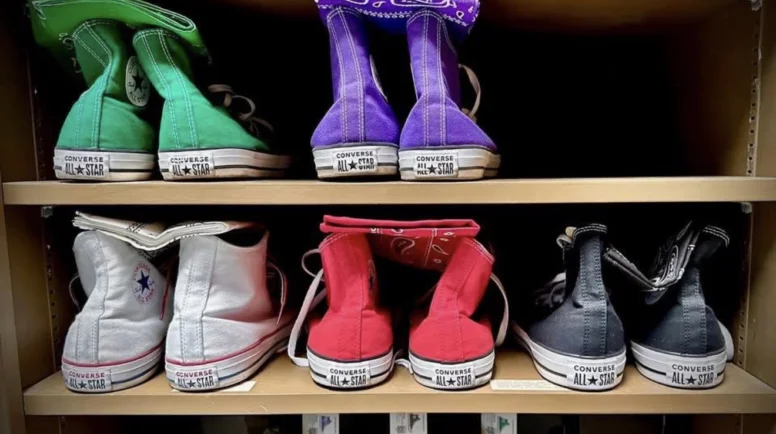
The question came six months after I started wearing them.
Before Maundy Thursday worship, a member in her 80s pulled me aside. I was vested in my black robe, clerical collar and purple stole — purple Converse sneakers on my feet. She asked, “Why are you wearing those shoes?”
I had heard that question before. In the early months, it often carried disapproval. One person even asked for my shoe size and said they would buy me dress shoes that afternoon. But this time, the tone felt different.
I explained my reasons. She listened, then asked, “So you don’t have a medical reason that compels you to wear them?”
“No,” I said.
She paused. “I can’t tell you how much it means to me that my pastor wears sneakers to lead worship. I do have a medical reason why I have to wear orthopedic shoes. For years, I’ve felt embarrassed wearing them to worship. But since you started wearing those, I don’t feel that anymore. You’ve helped me feel less ashamed. And while I would never tell anyone about my feet — nor would I ever have anyone wash them — if you are willing, would you wash my feet tonight?”
Vestments and approachability are not opposites but companions.
She came forward as the last person in the congregation. The hymns continued as she struggled with trembling hands to remove her shoes and socks. I knelt in my robe, fumbling with the cool water in the stainless steel basin. I ran my hands over her feet and spoke the words we had been saying all evening: “As your feet are washed, may your heart be cleansed, healed and made new.”
It was holy ground. Sacred trust. A pastoral privilege I had not anticipated when I first laced up those purple sneakers.
“Thank you,” she said, embracing me at the end. “I love you.”
In that moment, something became clear: readiness for the gospel is both liturgical and relational. Vestments and approachability are not opposites but companions.
Beautiful feet
In Romans 10:15, Paul writes, “How beautiful are the feet of those who announce the good news.” In Ephesians 6:15, he urges believers to put shoes on their feet so they are ready to spread the gospel of peace.
In Scripture, fastening sandals signals readiness and dependence on God. When the angel freed Peter from prison, he told him to put on his sandals before following. Footwear is not incidental; it marks movement, proclamation and obedience.
The church has long recognized this symbolism. In the Catholic tradition, bishops once wore Episcopal Sandals as part of their vestments, praying before putting them on: “Shod my feet, Lord, unto the preparation of the gospel of peace, and protect me under the cover of thy wings.”
“Shod my feet, Lord, unto the preparation of the gospel of peace, and protect me under the cover of thy wings.”
I did not know about that tradition when I began wearing what some now call my “liturgical sneakers.” I learned of it only recently, after our church organist and her daughter visited a cathedral along the Camino de Santiago and saw Episcopal Sandals displayed in a glass case. The daughter pointed and said, “Look! It’s Pastor Josh’s shoes!”
What had felt like a quirky pastoral instinct was, in its own small way, rooted in something much older. I have since added that prayer to my Sunday ritual.
The ritual
On Sunday mornings, I take off my street shoes and put on worship shoes. Like Mr. Rogers changing into his cardigan and sneakers, it is a deliberate act of preparation. These Converse are set apart, worn only when I lead the gathered people of God.
Like Mr. Rogers changing into his cardigan and sneakers, it is a deliberate act of preparation.
The act centers me. It reminds me that I am preparing to proclaim the gospel and to stand before the congregation as one sent.
But what do they mean to the people in the pews?
Belonging, not conformity
Most visitors want to know they belong. If we are not intentional, we can unintentionally communicate an expectation of conformity, alienating those who “aren’t like us.”
Worship spaces carry unspoken messages about who fits. Aesthetics and formality can subtly signal that certain bodies, certain clothing, certain ways of being are more acceptable than others. The woman who wore orthopedic shoes felt that weight for years.
My sneakers did not erase her shame. But they made space for her to name it. They signaled that her pastor was embodied and approachable — willing to kneel. And in naming her shame, she found the courage to let someone else see her feet and receive the love Christ offered in the upper room.
That is the pastoral work vestments can do when they complement rather than contradict accessibility.
Context matters
Some may wonder whether denim under a robe undercuts reverence, or whether intentional informality risks centering the pastor.
Context matters. In my congregation, one choir member wears Crocs with socks, a teenager wears a football jersey and a seasoned member wears a suit. Little attention is given to attire.
In this context, the shoes and denim I wear have enhanced belonging. They remove a barrier without discarding reverence.
Vestments are meant to redirect attention toward God. The sneakers do not disrupt that work. They deepen it by making the one who wears them more human — and more ready to kneel.
Each Sunday, I bind on those shoes and pray, “Shod my feet, O God; prepare me to proclaim the gospel of peace.”
The shoes remind me that ministry requires feet willing to go and hands willing to serve. The gospel is not abstract. It is carried by people who put on their shoes and show up.
I wear Converse sneakers because the gospel has beautiful feet. And sometimes, those feet need to be ready to kneel.