MILWAUKEE — Just a few blocks west of the convention center where the 227th General Assembly gathered, the steeple of Calvary Presbyterian Church rises above Wisconsin Avenue.
Constructed in 1870 in the Gothic Revival style, the church is known throughout Milwaukee as “the Big Red Church.” Its towers, arches and deep red exterior bear witness to another era, when downtown congregations were filled with the families whose names now appear on city streets. The church has been listed on the National Register of Historic Places since 1986. But the most remarkable thing about Calvary is not its historic architecture — it’s what happens inside.
When General Assembly visitors arrived for worship on Sunday morning, they were welcomed not by a pastor but by congregation members. One elder preached. Another presided at the communion table. Others offered prayers, read Scripture, provided music and extended hospitality.
Related reading: “A look into the Presbyterian churches of Milwaukee” by Outlook staff
This distribution of labor is not an emergency arrangement while Calvary searches for its next pastor. It is how this congregation has chosen to be the church.
When one pastor became many ministers
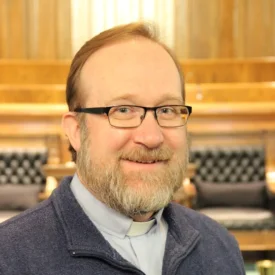
“In place of one minister, we are all ministers, and we minister to one another,” said Elder John Paul (JP) Kastner.
Calvary currently gathers for hybrid worship each Sunday morning, describing itself as an open and affirming community that creates “hand-made worship as the Holy Spirit leads us, in the tradition of the Acts of the Apostles.” That identity emerged from a season when Calvary’s future looked uncertain.
“In place of one minister, we are all ministers, and we minister to one another,” said Elder John Paul (JP) Kastner.
The congregation was established by Milwaukee Presbyterians whose roots in the city date to 1839. As Milwaukee expanded after the Civil War, prosperous Presbyterian families constructed the church in a growing neighborhood on the west side.
Over time, however, both the city and the congregation changed. Many of Milwaukee’s central-city churches closed. Calvary’s membership declined, and the descendants of the families who had built the church were long gone.
When its last pastor left in 2018, the congregation could not simply call another full-time minister. The building was also in serious disrepair; rainwater entered the sanctuary, plaster was crumbling and financial resources were scarce.
By many familiar measures, Calvary looked like a church approaching the end of its life.
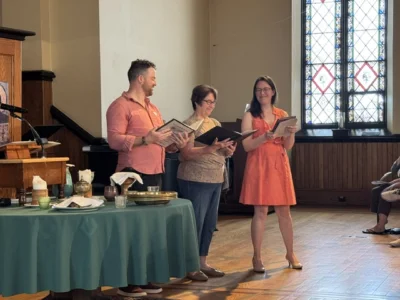
“However, God had other plans,” Kastner told the congregation Sunday. Calvary was compared to “a little red clay pot” that was chipped and cracked but still contained good soil in which a seed could grow.
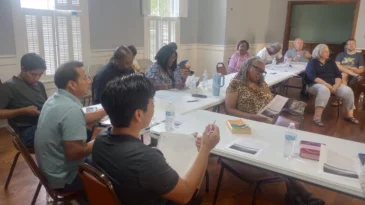
Working with the Presbytery of Milwaukee, the congregation began imagining a model that did not depend upon employing a traditional solo pastor. The presbytery trained ruling elders in worship planning and sermon preparation and authorized elders to preside at the Lord’s Table.
The result is not a pastorless congregation reluctantly filling gaps. It is an intentionally elder-led church reclaiming the Reformed conviction that ministry belongs to the whole people of God. The model requires significant work, responsibility and trust, but Calvary’s members speak of that shared responsibility as a gift.
On Sunday, Ruling Elder Carolyn McCarthy preached on Abraham’s near-sacrifice of Isaac, contrasting certainty with trust. A nurse practitioner, she said a modern claim that God commanded a parent to kill a child would be “a psychiatric emergency,” not an act of faith.
Related reading: “Aligning money with mission: The future of church space” by John Bolt, Outlook reporting
Connecting Abraham’s trust to the work of the General Assembly and the life of Calvary, McCarthy said faithfulness is formed over time through prayer and service. “We prepare ourselves with our lives,” she said.
Calvary’s elder-led ministry is one expression of that preparation. “Church leadership roles are changing, and the gifts in the congregation are blossoming,” said McCarthy.
A historic building with a new purpose
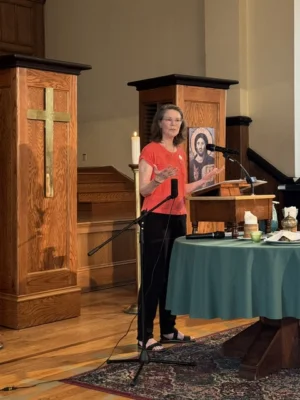
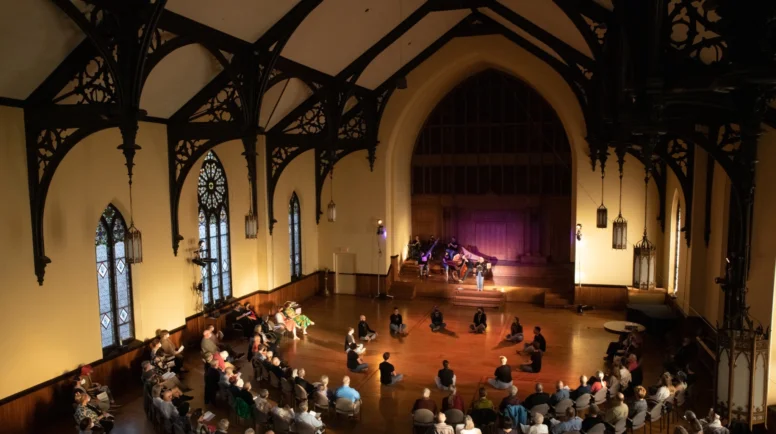
Calvary has also found a way to sustain its historic building by treating it not simply as property belonging to the congregation but as a gift to be shared with the city. The sanctuary has movable seating and serves as a home for art, music, theater, weddings and cultural events.
Its design includes a prayer labyrinth patterned after the labyrinth at Chartres Cathedral, and the space accommodates weddings with as many as 300 guests. Income from these partnerships helps maintain and repair the building. More importantly, it keeps the church connected to its neighbors.
This approach will not solve every challenge facing small congregations. Elder-led ministry requires significant formation, presbytery involvement, and members willing to assume substantial responsibility.
But the Big Red Church offers an important witness at a time when many churches are struggling to maintain buildings and afford traditional staffing models. The first question does not always need to be “How can we raise enough money to continue doing what we have always done?”
Calvary did not survive by finding enough money to recreate its past. It survived by trusting its elders, strengthening its partnership with the presbytery and sharing its building with the community.
A more faithful question may be, “What gifts has God already placed among us, and how might we organize our life around them?”
Lessons from the Big Red Church
Calvary did not survive by finding enough money to recreate its past. It survived by trusting its elders, strengthening its partnership with the presbytery and sharing its building with the community.
Near the end of her sermon, McCarthy reminded the congregation that God has always worked through imperfect human beings. “We, in all our humanness – our emotions, our fleshiness, our giftedness, our pettiness, our struggles, our strong wills – we are God’s plan for the world.”
On Sunday morning at this faithful Milwaukee church, those words were more than a theological claim — they described the church gathered in that room. A congregation that once appeared to be dying had not merely kept its doors open; it had discovered again what it meant to be the church.