“Go in peace, go in love, go with blessings from above. Help a friend, say a prayer for the children everywhere. Amen. Amen. A-a-a-a-a-men.”
Have you heard that one?
Or maybe: “Raindrops, oceans, lakes and rivers; welcome, child of God. Mothers, fathers, brothers, sisters; welcome, child of God. When the world feels wide around you, when the dark of night surrounds you, we are here to tend and guide you. Welcome, child of God.”
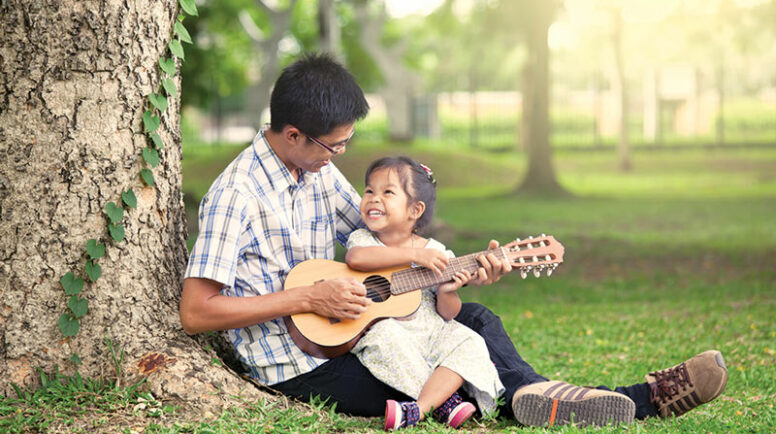
For our two daughters, Hannah and Catherine who are now seven and five, these two songs were as ubiquitous as the books “Goodnight Moon” and “Moo, Baa, La, La, La.” They were both a part of our regular nighttime routine: the first one at dinner, the second just before bedtime. “Welcome, child of God,” sung to the familiar AR HYD Y NOS hymn tune (“All Through the Night”) was introduced to us through a short children’s book given at Catherine’s baptism. It remains one that she pulls off of the bookshelf regularly for us to sing before going to sleep.
It might come as no surprise that two children with professional musicians for parents would have singing as an important ritual in their daily existence — but to what end? Does singing to our children matter? Likewise, does the practice of singing songs of faith to our children matter?
The benefits of regular reading to children have long been known and have been the subject of much research. A recent Washington Post article highlights this point, “Study after study shows that early reading with children helps them learn to speak, interact, bond with parents and read early themselves, and reading with kids who already know how to read helps them feel close to caretakers, understand the world around them and be empathetic citizens of the world.”
What about singing? Does singing to our children have the same effect? While there is less research, overwhelming empirical evidence and several important clinical studies would answer that question unequivocally: YES! The National Association for the Education of Young Children, the leading accreditation organization for preschools and early childhood education in the U.S., highlights their opinion on the importance of singing to your children with a number of blog posts, articles and curriculum connections focused on regular singing to your child.
Likewise, the reality that hymns reflect our theology is nothing new. Notable Methodist scholar, S.T. Kimbrough Jr., wrote in an article for Theology Today in 1985: “The hymns of the church are theology. They are theological statements: the church’s lyrical, theological commentaries on Scripture, liturgy, faith, action, and hosts of other subjects which call the singer to faith, life, and Christian practice.”
By extension, singing songs of faith to our children is an important part of faith formation. In a chapter on singing in “Practicing Our Faith,” Don Saliers noted: “When life is deeply felt of perceived, music gives shape and voice to the very pattern of our experienced world. … The tensions, resolutions, moods, convictions, and playfulness of everyday life are translated into the patterns of sound … the act of singing together of life lived and felt binds heart and mind together.”
In other words, music binds the community together and thus singing to our children, surrounding them with the music of our faith, should be an everyday way that we encourage the faith development of our young ones.
“Jesus loves the little children …”
“Jesus loves me this I know …”
“The B-i-b-l-e, yes that’s the book for me …”
Sing on parents. This is a great gift we can share with our children.
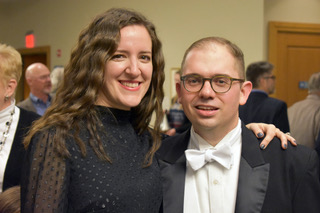 Diana and Joshua Taylor serve at First Presbyterian Church of Dallas in Texas, where Diana is the director of children’s choirs and Joshua is director of worship and music. Joshua is a member of the executive board of the Presbyterian Association of Musicians and Diana is the music specialist at Moss Haven Elementary School in the Richardson Independent School District. They are the proud parents of Hannah and Catherine.