Guest commentary by Aric Clark
I raised two fingers as I prepared to offer what would be one of the most sacred benedictions of my ministry career. I was going to mangle the Spanish, spontaneous translation that was well outside my skill level, but hopefully I would make up for it with sincerity. The couple standing in front of me in sweatshirts and jeans had recently walked over 3,000 miles from El Salvador to the U.S.-Mexico border and were preparing to climb into a van that would take them into detention. Though they’d been a family for 13 years, married in the eyes of their village, they lacked any paperwork that might prove to Customs and Border Patrol that they should remain united. Fearing separation, they asked me at the last moment to marry them there on the sidewalk beside the iron fence that separates this chunk of land from that one. A lawyer stood nearby hastily filling out civil marriage paperwork while I made my way, scrolling on my phone, through a Spanish-language wedding ceremony and other volunteers implored the van driver to be patient.
That was the midpoint of a week I spent in Tijuana this month doing accompaniment work as a volunteer with the New Sanctuary Coalition. Each day I would arrive by 7 a.m. at the place where migrants, refugees and asylum-seekers gather to submit themselves to the process that dubiously restricts the number allowed to cross into the United States. In that pentecostal gathering are people from different regions of Mexico, members of what the media has been calling the “migrant caravan” from El Salvador, Guatemala and Honduras, as well as people from many other Latin American, Caribbean and even African countries. Many of the people I encountered who were seeking entry to the United States had journeyed on foot thousands of miles and waited in the border region for months in unsafe conditions hoping against the odds that they will be treated humanely and permitted to make a life in our country.
My task each day was simply to be with these people: to hear their stories, to hold their hands, to weep with them sometimes, laugh with them sometimes, and frequently to pray with them and bless them on their journey. In the process I heard some amazing stories. Many of the people I met are fleeing violence or conditions of poverty so dire that making this perilous trek was the best of their few bad options. Due to their perilous situations I cannot share names or many details, but I carry their stories with me.
One couple I met fled their home in Guatemala because the husband was given an ultimatum by a gang: Join us or we will burn your house down with you inside. While journeying north, they were attacked at night and the wife suffered a head injury so serious that she couldn’t speak for a while and still has difficulty keeping her balance. She showed me pictures of the two adult sons they left behind in Guatemala. She sobbed on my shoulder because it was one son’s birthday and it was the first time in his life that she had not been with him to celebrate.
Another woman from Haiti tried for two years to run a hamburger stand in Mexico City, but found it continually vandalized. Customers refused to pay her because she is black. So she abandoned her business and brought her daughters to the border hoping to cross, only to find the border area to be dangerous place, with men seeking to prey on her daughters. “Children disappear here,” she told me, and so she doesn’t allow her daughters to leave her cousin’s house, where they are staying until their number is called, a process which often takes months.
Still another family made the heart-wrenching decision not to cross the border at the last minute, even as they were being urged to board the van to go into detention. One of their children was born in the United States and is an American citizen; it would be a near certainty that they would be separated by Customs and Border Control. The boy would become a ward of the state and the parents may never see him again, particularly if they were deported, which is all too likely.
With each of these families I sat, and I listened, and I prayed. I personally held the hands and blessed the feet of every single person who went into detention at that border crossing. Frederick Douglass once said that he “prayed for 20 years but received no answer until he prayed with his legs.” As an adherent of that school of prayer, I frequently criticize these types of pious behaviors as a substitute for more immediate and impactful action, but I can’t deny the importance of the moments I spent with these people.
One morning a few members of an LGBTQ+ caravan received their turn to go through border control. These are people who, in addition to fleeing poverty and violence, suffer the additional stigma and peril of being queer. This heightened risk caused them to group together for security on the journey, and they became each other’s life-support over months of incredible hardship. You can imagine the bonds they forged. Therefore, when some of their number were boarding the vans to be transported to detention, the rest waited outside the fence weeping and wailing in loud lamentation, the likes of which I’ve experienced only very few times in my ministry. When the vans departed, I approached this group and offered to pray with them. They pulled together in a close huddle, wrapping arms over my shoulders as with shuddering voice I pleaded that God would protect their loved ones, see them safely to their destination and reunite them one day. If ever there was a moment when I wished that the clerical collar I wore truly granted me some privilege in God’s hearing, that was it. As I contemplate the further hardships in these beautiful people’s future, it’s enough to elicit the most earnest prayers of my life.
There is a category of prayer that blurs the boundary between words and action. Sometimes words themselves become an action that call into reality the very thing they describe. The most famous of these is the speech-act at the end of a wedding service when the officiant says, “By the power vested in me I pronounce these persons married for life.” In that moment, the marriage described is also effected. It becomes reality. Every benediction belongs to this category of prayer; it both describes a hoped-for blessing and effects that blessing upon the hearer. When I say “the peace of the Lord be with you,” I am not just hoping that it will be so, but actually imparting that peace.
So it was as I concluded that wedding ceremony on a sidewalk in Tijuana. As I blessed that couple, and they joyfully kissed, and their children ran around them laughing and throwing leaves they had plucked from nearby bushes instead of flower petals, we spoke reality into a new shape, a more beautiful shape, a more loving shape. “Those whom God has joined, let no Border Patrol Agent put asunder,” I might have said. As they climbed into the van, waving to me through the iron cages over the windows, I had no way of knowing for certain that their hastily-prepared paperwork and my ineloquent liturgy would actually protect them from what lay ahead, but I know the people who just happen to be caught on the other side of these borders are my friends, my family. And so I must continue to speak that truth aloud until God’s reality overtakes this one completely.
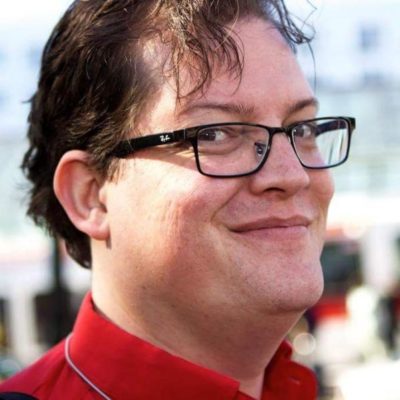 ARIC CLARK is a writer, a speaker, co-moderator of the Presbyterian Peace Fellowship and a Presbyterian minister who lives in Portland, Oregon, with his wife and two gremlins pretending to be his sons. He is the co-author of “ Never Pray Again: Lift Your Head, Unfold Your Hands and Get To Work.” He is a pacifist and he still can’t grow a beard.