 Jonathan Merritt
Convergent Books, 256 pages
Reviewed by Dana Hughes
Jonathan Merritt is worried. The Christian, writer and linguist is concerned that the rich language of faith is suffering from misuse and disuse in America. As a lover of words and the Word, Merritt is troubled by how infrequently sacred language is used beyond the Sunday morning hour of worship; how ignorance, indifference and avoidance still the tongues of believers and unbelievers alike; and how the lexicon of faith is appropriated by secular ambition.
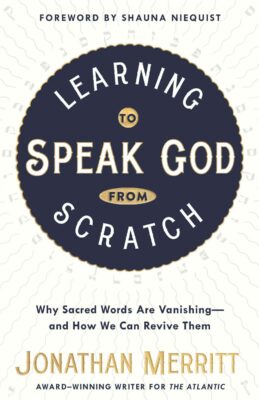
In his new book, “Learning to Speak God from Scratch,” Merritt addresses these issues with passion. He is like Jeremiah with a burning fire shut up in his bones, and weary with holding it in, he unleashes it as ink. “Words are the fires we carry to each other,” he writes, “but the embers do not originate with us. They were handed to us by messengers from generations past, and now we pass them on to others.” His is an urgent plea not only to keep the fire of transcendent speech alive, but to continue passing it from generation to generation. There are mountains of dead languages across the globe, and faith language need not – indeed, must not – be added to the pile.
The author’s anxiety is completely understandable. Those who are fluent in the Christian language may find themselves sharing it with ever-shrinking congregations who are conversant in words like “sin” and “hell,” but who are not able to pronounce words like “grace” and “mercy.” It may be that such folk are fearful of a lexical shift, or it may be that they are afraid to ask questions about such words; afraid to show ignorance or afraid that asking any question is a “sin” that will send them cartwheeling into “hell.”
Similarly, those who engage in the art of speaking of God and Jesus, saints and angels, miracles and transfigurations may find their tongues tied in knots by the power-mad who liberally dip from the well of hallowed words in order to serve their followers a shot of lies with a Jesus chaser. Such misappropriation leaves a bitter taste on the vocabulary of faith, making it impossible to savor and a chore to share with another.
Merritt continues his ruminations in chapters named for basic Christian vocabulary: fall, sin, grace and blessed. He examines these terms by holding them up to the light of his own experience and then further illumines them with history and culture. The result is a strong case for the continued use of such words as well as a delightful field trip through time.
For all the musing on mystery, though, I most enjoyed the revelation of Merritt himself. Almost every chapter begins with an autobiographical vignette that leads to the topic of faith covered in that chapter. These sketches of his childhood in Georgia and adulthood in New York reveal, bit by bit, the unfolding tale of a man in search of the right words to talk about himself as he talks about the evolution of the faith that shapes him. I’d love to sit down with him over coffee and simply say, “Please tell me more.”
Dana Hughes is the transitional presbytery pastor for Denver Presbytery.