The Presbyterian Mission Agency Board voted Oct. 7 to take the first steps towards implementing a plan that is expected to transform how the Presbyterian Mission Agency does its work — a plan calling the Presbyterian Church (U.S.A.) to live into its commitment to be a Matthew 25 church in new, decentralized ways.
That comprehensive restructuring plan, shaped by a year-long Vision Implementation Process led by CounterStories Consulting, calls for the Presbyterian Mission Agency (PMA) to change its structure and the way it allocates resources — with many employees assigned to “locally situated action teams” (known as LSATs), working within specific communities or regions to confront concerns such as systemic poverty and racism.
The consultants’ report calls for creating two new offices in PMA: one focused on innovation, and another on reparations and repairing harm to communities of color. And it recommends, as much as possible, finding more flexible ways to spend donor-restricted funds.
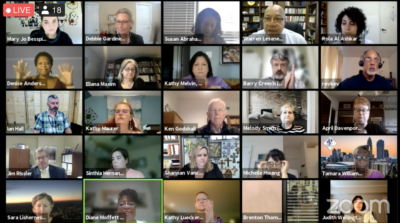
While the board discussed the broad report with consultant David Hooker during its Oct. 6-7 Zoom meeting, the actions it formally took were narrower. More detailed, robust recommendations are expected to come at upcoming meetings of the board beginning in February. Those recommendations could potentially lead to job loss or changes in responsibilities for some PMA employees.
The board voted Oct. 7 to send to the 2022 General Assembly as part of its Mission Work Plan:
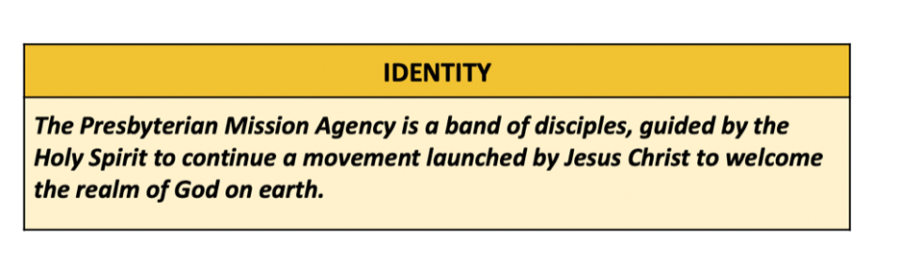
- This identity statement:
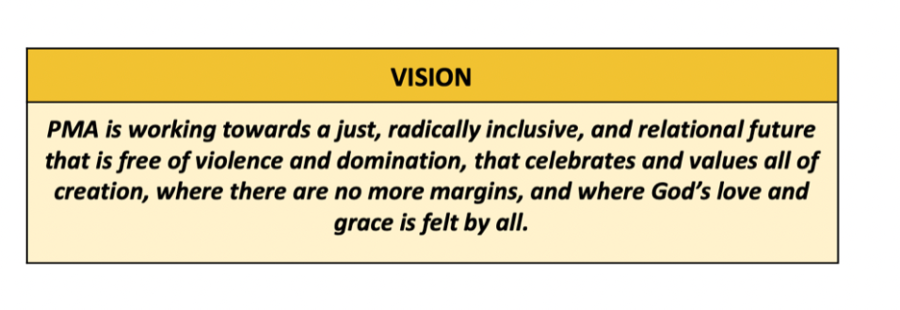
- This vision statement:
- This mission statement:
“As a convener of sacred spaces, the Presbyterian Mission Agency nurtures disciples of Jesus and inspires, equips, and connects congregations, mid councils, other entities of the PC(USA) and our partners locally and globally to do justice and to repair historical harms.
“The Presbyterian Mission Agency listens to, learns from, and co-labors with communities forced to the margins, and connects them to the relationships and resources needed to build congregational vitality, eradicate systemic poverty, dismantle structural racism, sexism and heteropatriarchy, end militarism, and address our climate crisis.
“To do this, the Presbyterian Mission Agency provides:
- Context-specific accompaniment;
- Assistance with the identification and development of innovative approaches;
- And funds to support local and regional initiatives.”
The language of dismantling “sexism and heteropatriarchy” was added at the request of the Advocacy Committee on Women’s Concerns.
Board member Rola Al Ashkar asked what the mission statement means by “end militarism.”
Diane Moffett, PMA’s president and executive director, responded that “all of these categories are very high-level and very lofty”
— giving PMA flexibility to live into General Assembly commitments and to work in partnership “to be creative and innovative.”
Despite the board’s votes of approval, it’s unclear whether the wording of the mission statement might still change. Some board members weighed in with concerns about the clarity of the language — and board member SanDawna Ashley presented a motion suggesting “that we form a study group to look at the mission statement and bring a recommendation to the February meeting.”
The board voted down that idea. But there was conversation that the board might still change the wording of some of what it had approved — perhaps revisiting the matter in February. “We’re providing some enabling action for the staff to move forward,” said board chair Warren Lesane. “I don’t see anything that we’re doing is written in stone today,” even though the action says these statements will be sent to the 2022 General Assembly.
If needed, “we can alter some of what we have done” in February, Lesane said. “It is not a done deal that we have stamped it, and that is it.”
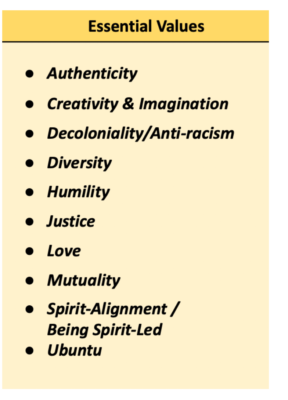
The proposed list of values.
The board also voted to affirm a list of 10 essential values that will guide PMA’s work — with the instruction that Moffett lead a process to narrow that list to perhaps 5 to 7 values and bring a recommendation for a revised list to the board’s Feb. 9-11, 2022, meeting.
In alphabetical order, those essential values are:
Next steps. The board voted to ask Moffett and what she is calling a staff “Change Management Team” to lead the process of discerning how to live into the consultants’ recommendations — and to bring some next steps to the board’s February meeting.
Moving PMA in a new direction will take time, and a willingness to unlearn dysfunctional behavior, board member Michelle Hwang said during an afternoon devotion — reading from the 16th chapter of Exodus, in which Moses led the Israelites out of slavery and oppression in Egypt towards freedom.
“It will be scary,” Hwang said. “We will be tempted to go back to the old ways of being” — she said every church structure has a “Let’s go back to Egypt committee.”
But Hwang challenged Presbyterians to move beyond white supremacy, wealth hoarding and gender injustice and towards a future built around a theology of abundance in which “the grain will be equally distributed. We will all have enough.”
Hooker, the consultant, described the plan as “a courageous act on behalf of the church, on behalf of the world,” saying “it is really exciting to know there are people who still have the courage to shake up the world.”
Hooker also said: “Change is really hard, and transformation is even harder than that. … There is much more hard lifting to do.”
Other business
Clerk’s report. The board also heard a report from the PC(USA)’s stated clerk, J. Herbert Nelson, who shared – as he often does – his vision for a church that’s flexible, open to new ideas, willing to risk and possibly to fail.
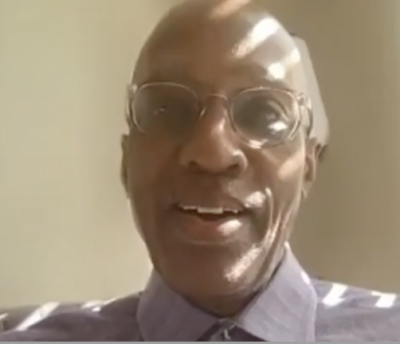
Nelson also said that the Office of the General Assembly is working to put together a Bible study for mid council leaders, who have done difficult work during the COVID-19 pandemic. “They have gone through trauma, they have struggled,” Nelson said of presbytery and synod leaders. “They have had to deal with anger, frustration” — backlash from people who disagreed with decisions about whether churches could worship in-person and who longed for clear answers. “Rather than curse God out,” Nelson said, “they curse out the leaders.”
The idea of the Bible study is “let’s get back to our faith,” back to fundamentals, he said. Back to Jesus — a source of calm during the chaos.
He also spoke of pressures surrounding the 2022 General Assembly, and the need to have options for hybrid participation. By June 2022, when the assembly is set to convene, “we could be in the midst of another variant,” Nelson said.
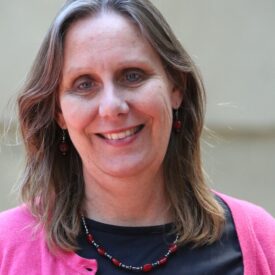
Responding to microaggressions. Rosetta Eun Ryong Lee, a teacher at the Seattle Girls’ School and a trainer on implicit and unconscious bias, continued her work helping the board think about its own power and privilege dynamics — this time focusing on microaggressions. (“Let the uncomfortable conversations begin,” Lesane said in welcoming her.)
Microaggressions, according to Lee, are not necessarily an example of structural bias. Rather, they are interpersonal and daily interactions that can cause distress and trauma, building over time. (“If you’ve taken a road trip with little kids, you know what accumulated impact feels like,” Lee said). Although the individual behaviors may not be intended to cause harm, they often are based on stereotypes — and their pervasiveness exacts a cost.
An example: white people often ask Lee, “Where are you from?” When her answer – Seattle – doesn’t satisfy them, they persist. “Where are you really from? Where are you originally from?” She’s Asian-American, and this question really is about ethnicity. If she tells them she was born in Korea, people have said, “Oh, Korea. I love kimchee!”
At one event, Lee graciously fielded the question with the first seven people who asked. By the eighth person, she had lost patience. “I’m originally from my mother’s womb,” she responded. “You?”
Blacks are told, “you’re so articulate.” White strangers feel free to touch their hair.
People of multiracial heritage are asked, “What are you?”

Lesbians are told: “You’re too pretty to be lesbian.”
The subtext, as Lee unpacked it, is that people who look like her are not really “American” – even though she’s a U.S. citizen. You are so articulate, and I didn’t expect you to be. The boundaries of your body don’t count, “so I can touch you when I want and where I want.” I don’t know what racial box to check for you, because you are too ambiguous.
Lee contends that communities professing respect and equality need to learn to address such microaggressions — both those they’ve experienced and those they have committed.
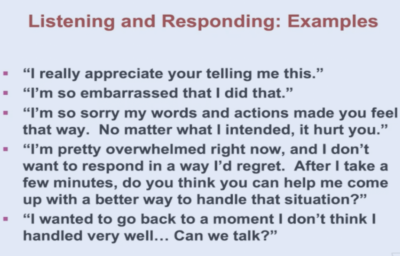
“It does require courageous conversations,” she said, to say “you hurt me or you offended me.” Or to apologize, and say: “I didn’t know. Can you help me learn?”
Lee, for example, has worked to change her own behavior after someone she knows pointed out how often she peppered her speech with casual references to mental health, saying things like: “I’m OCD about my office supplies” or “This day is so busy, it feels schizophrenic.” That person told her: “Rosetta, you say these things a lot,” and compared her remarks to the challenges people living with mental illness actually experience. “These are really big deal words,” the person said. “For you to use them so flippantly and so casually is deeply hurtful.”
Lee said that was an “aha” moment for her — and the beginning of a process where she began slowing down and being more careful with her language, intentionally using another phrasing until that became second nature. “I’m just now getting better at not saying, ‘That’s crazy.’ ” she admitted.
When someone does speak up, “often there’s a defensive posture” of, “that’s not what I intended,” Lee said. But the intent isn’t the point — the impact is. And we routinely apologize when we accidentally cause physical harm.
If you ran over someone’s foot driving down the street, you’d likely stop the car, jump out and apologize, ask if the person was hurt, she said. You wouldn’t say: “I think you’re being a little sensitive” or “it’s like you’re saying I’m a bad driver” or “I have nothing against pedestrians. Some of my best friends are pedestrians. I’m married to a pedestrian.”
Lee contends that many people do mean well — so intervening and speaking up when they say or do something objectionable can be “an act of kindness,” a public witness and a way of helping them do better.
And “if you messed up and you know it, don’t wait for the intervention. Just apologize.”