


What are we to make of the harsh master in Matthew 25:14-30, Carol Holbrook Prickett wonders?

In these times filled with perilous choices and consequences, Joshua 24 reminds us that God has brought us thus far and God has a purpose for us.
I thought I knew God. Then I went to seminary, writes Teri McDowell Ott. I thought I knew God. Then I volunteered in a prison.
Teri McDowell Ott reflects on Leviticus 19 through the lens of Netflix's true-crime series, "Murdaugh Murders: A Southern Scandal." Two women in the docuseries remind her of the cost of honesty.

When asked a loaded question about money and power, Jesus chooses to offer his audience hope — and an invitation to connect with one another, writes Carol Holbrook Prickett.
Who has influenced your faith? Who do you model Christianity to? Paul talks about these things in Philippians, John Wurster writes.
Brian Christopher Coulter encourages preachers and teachers to view the Ten Commandments as a communal gift.
You can't argue anyone out of their fear. You have to love them out of it. That's what we are reminded of in Matthew 21, writes Teri McDowell Ott.
You will likely be preaching the parable of the workers in the vineyard to a congregation of hardworking, rule-following people, writes Philip Gladden. This parable will offend them. What are we to make of it?
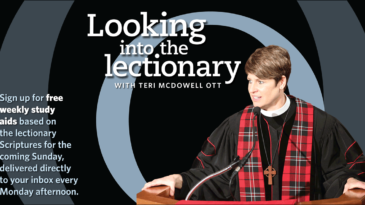
The writer of Psalm 103 sings for joy not only because he is gifted with steadfast love, but also because he is freed by it — free to shelter during life’s storms, free to flourish and grow as a child of God, writes Teri McDowell Ott.
Church is a team sport, writes John Wurster reflecting on Matthew 18:15-20.
How can you help challenge the common, negative assumptions? Brian Christopher Coulter looks at Paul and Howard Thurman for examples.
God is absent from the first two chapters of Exodus. But through the subversive and liberating activity of women, God is indeed at work. — Ginna Bairby
In Matthew 15, we see a Canaanite woman teach Jesus something about mercy. What does this mean for us?
Instead of focusing on Peter's ultimate sinking in Matthew 14, perhaps we should remember that Peter responded in faith, Philip K. Gladden writes.
Dana Moulds reflects on "willingness" and Jesus' feeding of the 5,000 in Matthew.
The kingdom of heaven allows us to see our ordinary lives in extraordinary ways, Jo Wiersema writes, reflecting on Matthew 13:31-33, 44-52.
Looking at the parable of the weeds in Matthew, Teri McDowell Ott discerns two calls for those who read the text.
Tara W. Bulger reflects on how Christians are to deal with "people-ee" people.
Looking at Romans 7:15-25, Tara W. Bulger reflects on God’s grace and the spiritual practice of self-examination.
It is not our faith, but God’s faithfulness that saves us.
Editor Teri McDowell Ott engages one of the notoriously difficult passages in Matthew where Jesus says, "I came not to send peace, but a sword."
In honor of Juneteenth, Stephanie Sorge weaves together multiple readings from the Revised Common Lectionary to reflect on God's liberating work.
There is room for everyone in Jesus’ community, but the marginalized get top priority.
Editor Teri McDowell Ott notes that the Great Commission calls us to go do — and to teach.
© Copyright 2026 The Presbyterian Outlook. All Rights Reserved. Privacy Statement. Website by Web Publisher PRO