Peace for predator and prey
The wolf shall live with the lamb,


The wolf shall live with the lamb,

As I have gotten older, I have shifted one hundred eighty degrees in my attitude toward the penitential seasons of Advent and..
In many waits —
I haven’t known what I wait for
or even that I’m waiting.
Standing at the bus stop, she’d say,

The Psalmist says, wait for the Lord. I have a hard time waiting for my toast to pop up. Seriously. Watching it doesn’t help either. “Hurry up”, I said to the egg, frying in the pan; taking my mind off the bread in the toaster. “Can’t you cook a bit faster?” The Psalmist says, wait for the Lord; be strong and let your heart take courage; wait for the Lord. I would like to do that but waiting for the doctor is tough enough. The other day I mentioned to my wife that the tree in our front yard just wasn’t growing. She reminded me that trees take years, ten or more, to mature fully. Just wait and watch. It will grow. Trees take time. Still, I want a tree now.

Text: Matthew 11:2-11
Whenever expectations meet reality, questions are sure to follow.
Years ago my wife told my son that they were going to do something very special to get ready for Christmas. She pumped up his excitement. She told him they were going to have fun. As a consequence, he couldn't wait until the day came -- to make a gingerbread house. I walked in just as the project was being completed. He was sitting there with his head in his heads, bored to tears and asking his mother if they were having fun yet.
Our expectations build a road leading us somewhere until we come to that stop along the way called reality. It happens even to the best of us!

In those days John the Baptist appeared. ... They had been waiting for him, in fact, for 400 years they had been waiting for him and suddenly there he stood in the wilderness of Judea and his message was like taking fingernails and running them across a chalkboard. Every Advent, we still find him standing there and we are told to listen to what he is saying, for after all this is the one preparing the way!
Come into the darkness
and sit quietly
with the dreams of this season.
Dreams of the Hebrew people ~
of lions and lambs laying together,
of justice rolling down like full streams of water,
of lands flowing with milk and honey,
of joy that comes in the morning.
Dreams of a carpenter ~
of being faithful to his betrothed in the midst of public scorn,
of taking the road less traveled
and journeying on the back roads.
Dreams of your own heart and mind ~ of the searching for and
claiming the masculine within and beside the feminine,
embracing the mystical and the logical,
the creative and the protective,
the carpenter and the birthmother.
Text: Matthew 24:36-44
A church musician first threw down the gauntlet for me concerning Advent. She had grown up as a Lutheran and came to the Presbyterian Church in her late twenties, able to direct a choir with expertise but also filled with boundaries about what should and shouldn't be sung during the days preceding Christmas. It made great sense to me theologically.
Ever since, I have had to deal with the inquiry of complaint, meant more as an allegation against my Christmas spirit, "Why aren't we singing carols, everyone else is?" There is no question that once you have been to Bethlehem it is hard to get back on the road again and do it all over. But here it is Advent and the texts we are asked to read and to proclaim put us on the winding road upon which we have walked before. How do we get there, again?
My Advent by Michael Nelms ... and on earth peace among those whom He favors! And those He doesn't?..
Looking at the birth stories in Matthew and Luke, Ken Bailey finds three startling revelations in the brief accounts of Joseph.

Ken Bailey shares how the original, intended audience of Jesus' birth story would have interpreted the text. This reading changes the traditional, Western nativity story.
Isaiah 9:2-7; Luke 2:1-14 (15-20)
We know how the story goes: Unmarried pregnant teenager; no room at the inn; baby born in a manger; Emmanuel, God-with-us. It's so familiar -- prompting one little boy to ask his pastor with that blunt, no-holds-barred, child-like honesty: "Do we have to hear that same story again?"
Over-familiarity is challenging for preachers, too, an occupational hazard for those whose job is to listen to ancient texts and proclaim a fresh message from God. It takes commitment. But it also takes courage. Presbyterian pastor James Lowry warns: "Any preacher who can sleep soundly on Saturday nights. ... Any preacher who has no form of gastrointestinal distress on Sunday mornings" -- or on Christmas Eve! -- "has not dealt with the texts ... and is not to be heeded."

Advent 4: Luke 1:46-55
I didn't grow up in the church. As a teenager my faith was incubated in the Jesus movement of the early 70s, culminating in several trips down the aisle to follow Christ. It took me awhile to learn that the gospel is bigger than personal salvation. And yet if this passage is any indication, it is certainly not less. In the first stanza of the Magnificat Mary sings: "My soul magnifies the Lord, and my Spirit rejoices in God my Savior ... all generations will call me blessed; for the Mighty One has done great things for me ..." The use of the first person singular pronoun indicates a very personal experience of salvation.
Entering a world remarkably like our own, marked by political upheaval, economic uncertainty, and religious conflict, the God who acts in Jesus Christ, notes Charles Talbert, "did not go to the top (to Caesar or Pilate) to get things changed; nor ... to the left (to the Zealots)," much less to the religious right (to the Pharisees, or the Sadducees). No, God made a beeline for the bottom. God went to the poor, to the oppressed, to the outcasts, beginning with a teenage peasant slave-girl from the boondocks of Nazareth, a nobody from Nowheresville we know simply as Mary. But Mary is also evidence that God goes to the center, straight to the heart, offering forgiveness and deliverance, and seeking to reign there as Savior and Lord. Blessed are you, Mary, and blessed are you and I, for responding personally.

Advent is a busy time in the life of anyone, let alone a pastor. A hospital was the last place I ever planned to be during the weeks leading up to Christmas, with the exception of visiting other people. But one year, my body decided otherwise. And so, in mid-December, I lay under the surgeon's knife for the second time in a year.
A hospital is not a haven of quiet and rest. It is anything but a peaceful place. I had a roommate who smoked in the bathroom and turned the lights and TV on in the middle of the night with no regard to my feeble attempts to sleep. Across the hall, an elderly woman with no idea where she was howled with pain and cried for help at least once every three minutes, day and night, day and night, day and night.

Advent 1: Luke 21:25-36
I was a tall, skinny, spindly-legged girl, gawky and uncoordinated. I recall my kindergarten teacher being alarmed when initially I could skip only on one side of my body. But all through my elementary years jump rope proved particularly challenging. Remember the schoolyard motion -- elbows bent at the waist, palms down, a slight rocking motion, hands pushing the air in time with the rope? I could do that for hours. Days. I never knew how to jump in.
I feel like that with a text like this. I'm not quite sure how to jump in here.
Scholars come along and try to give us a push: It's just apocalyptic literature, they say. So we jump in -- only to discover that apocalyptic is the double-dutch of biblical genres, and we collapse in a tangled mess of dispensational exegesis.
The fact that it's Advent, too, the beginning of the church's liturgical calendar, the Christian New Year, complicates matters as well. Because this text is more about an ending than a beginning, and it hardly evokes a sense of celebration. Yes, we're assured Jesus is coming again ... but not before we're bombarded with images of persecution and pestilence, cosmic disturbance and destruction. Don't let the prescribed lectionary boundaries try to soften the blow -- force yourself to go all the way back, at least to verse 12 and start reading there. Linger over these verses and you begin to get the sense that apparently followers of Jesus are not exempt from suffering. So much for a happy New Year.

Getting to Bethlehem this year has been rough. Immediately after last year's trek came the massive Indian Ocean tsunami. Since then we have endured the most active hurricane season ever on record, including the still mind-numbing devastation wrought by Hurricane Katrina. October brought the earthquake in Pakistan that killed a staggering 75,000 people. Meanwhile, fresh accounts of political corruption continue to fill newspapers, heating bills are up, and national morale is down.
How do we get to Bethlehem this year? A minimum wage worker must work almost a full day to fill his car's gas tank. Airlines are struggling in bankruptcy. Amtrak is plagued by equipment breakdowns. How do we get to Bethlehem? How do we get past the 150,000 service men and women who are in Iraq, separated from family and festivities, and for some, separated from new babies they have fathered but never seen? Amid suicide bombers and improvised explosive devices, their safety is anything but assured; their length of stay is up in the air.
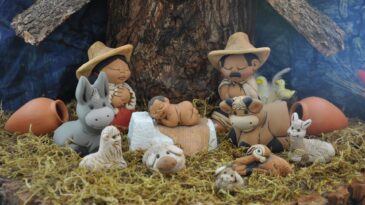
The National Cathedral in Washington, D.C. has a crèche collection gathered from all over the world. Various hands sculpted these figures from every conceivable material: stone, wool, glass, and even cow dung. The tropical regions portray Jesus under palm trees with very little cloth swaddling him, while cold climates show the holy family wrapped tightly, huddled and surrounded by snow. They remind us that we interpret this beautiful story in our own contexts; we pick up what the gospel writers leave out as we imagine the earthy smell of the hay, the rough texture of the feeding trough and the gentle sounds of the animals. These miniature mangers capture that crucial period after a baby is born, when the bonds of relationships strengthen as an infant is introduced to a family with care and attention. It is a time for welcoming, healing and wholeness.
In our culture, family leave policies enable this opportunity, yet within our church, that time off is often seen as an unnecessary benefit. Although sick leave after major surgery is expected, congregations can be unclear about the fair expectations of parents when a child enters their family. When I look at the adoring Mary and Joseph, a startling love bubbles up as I recall the birth of my own child. I also remember the confusion in our churches and Presbytery.

Scripture lesson: Mark 1: 1-8
Without sounding as melodramatic as Daniel did about his inner life, I recently had a dream. It went like this: We came home, opened the front door of the house, and discovered to our surprise that it was as empty as a gourd.
I do not mean just somewhat empty. When you are preparing to move and you are packing everything up you can say that it is empty when it is still half full of stuff. But this time I mean spic and span--astonishingly clean. If Hemingway had been there he would have said that it was the original clean well lighted place. It was apocalyptically bare.
Dreams are big these days. There is open season on them by both novelists and psychotherapists. Nevertheless, I am not so sure that the experts would do much with this one. It could be beyond the grasp of even that newly evolved profession, life coach/mentor. Sigmund Freud and Carl Jung could have met at Seattle's Best over it, flipped for paying the bill, and left shaking their heads.
Advent 2 - on Isaiah 40:1--11 and Matthew 28:16--20 "My way," at least Sinatra sings Or "by the way," as Jesus' last..

Lord, sometimes I feel like I'm always preparing to live but never living. Other times I feel I'm poorly prepared, so don't..

Scripture lesson: Mark 13
With all due respect to Holy Scripture, this is some great Advent sermon fodder. There is Isaiah 64's cry to come down; Psalm 81's plea to come to save us, and the thrice reiterated restore us," and, I Corinthians 1's invitation to patiently wait for the revealing of our Lord Jesus Christ.
But when it comes to interpreting Mark 13's imperatives to stay alert and keep awake from a Reformed theological perspective, we who live after the publication of some 62 million copies of The Left Behind series (not to mention some two-thousand Advents, more or less), have our work cut out for us. The mild-mannered Christianity Today once referred to LaHaye and Jenkins' series as a multi-"volume post-rapture, dispensational soap opera." But this stuff--page-turning intrigue and hair-raising climaxes notwithstanding--is not harmless entertainment. It's theology.
Wise men from afar, angels visiting shepherds in the night, a child cradled in a manger — through what lens shall these stories be viewed? Are they fact or fiction? Kenneth Bailey reflects.

Despite late November spring-like temperatures, the fiery red, golden passion of October's glory has fallen fast. From the mighty oak, maple and ash, the crippled stem and crinkled leaf have tumbled down to the hard, hard ground, where they are crushed like fodder under the hoof of the deer and the boot of the hunter.

The season is upon us when all our hopes are trained on the inexhaustibility of a particular event in time and space, the coming of Jesus Christ. It is a season in which we remember that the gospel is received in the mode of anticipating and awaiting a promise.
© Copyright 2026 The Presbyterian Outlook. All Rights Reserved. Privacy Statement. Website by Web Publisher PRO
