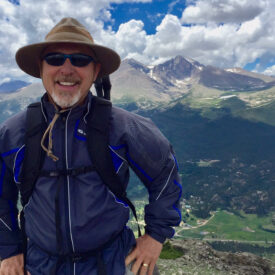
It was 5:30 in the morning when I began walking in the dark toward the west lawn of the Capitol to hear Pope Francis address a joint session of Congress. This predawn walk was not only to avoid the dreaded traffic snarl in the nation’s capital. It was a slight reprise of my pilgrimage along the ancient Camino de Santiago in Spain that I completed earlier in the summer. More than that, it gave me an opportunity to reflect upon Pope Francis’ remarkable world ministry that has stirred so much joy and, it must be said, consternation. I actually thought of Thomas Merton, whom the pope surprisingly lifted up in his speech, who said, “We must slow down to a human tempo and we’ll begin to have time to listen.”
As I walked I thought of an experience of just such listening earlier in the week during lunch with Father Timothy Daniel, a newly ordained Roman Catholic priest. We first met at an annual ecumenical service. Both of us saw this as an opportunity for a collegial friendship based upon our common vocation and shared interests. He was intrigued that a Presbyterian pastor would be walking a pilgrimage trail whose roots are deeply Roman Catholic (though now the trail attracts a wide range of religious and non-religious pilgrims). Our second conversation was a post-Camino follow-up and a chance to speak about Pope Francis. Father Daniel, a young priest who regularly reads the homilies of former Pope Benedict for his own homily preparation, is cautious about how the new pope is being received among North Americans. It is not certain to him that Francis’ theological perspective is understood as the reason for the pope’s political pronouncements. To Father Daniel, unhinging the political from the pastoral is troubling and he is concerned that the pope’s message will be distorted. On the other hand, he said, “the pope is speaking many challenging things to priests, including how we are to be out where the people are listening for their interests. That’s his message, get out among the people and listen to them.” The next day Timothy would be among the 900 concelebrant priests during the canonization mass at the Basilica of the National Shrine of the Immaculate Conception in Washington, D.C. His hopes and concerns were on my mind as I passed by the Vatican Embassy where the pope was still asleep. The security personnel encouraged me to keep walking and media paid me no attention. A few runners with headlamps passed me.

Massachusetts Ave is known as Embassy Row. The sun had not yet appeared as I strolled by the British Embassy and those of Saudi Arabia, Greece, South Africa, Tunisia, Sudan, Portugal, Philippines, Australia, Bolivia, Brazil, Peru and Paraguay, pondering the astonishing power of this one humble Christian leader of an ancient church stained by scandal and corruption to ignite the affection of millions. The contrast between the ordinary definitions of power and the power of Christian witness could not be sharper. Many would gather just to see a glimpse of this Christian leader who prefers the poor as the focus of his power. They would hang on every word from his mouth. A Presbyterian pastor mindful of Reformation Sundays thinly disguised as Roman Catholic-bashing and remembering fears among earlier generations of Presbyterians of “papists and popism” would be among the thousands listening for truth and inspiration.
When I reached Union Station the sun had begun to appear along with buttoned-up people bustling toward their offices. To my left I saw the stream of visitors moving swiftly toward the direction of the Capitol, flashing their coveted tickets and following the directions of dozens of security guards. My Presbyterian colleague met me there and we followed the crowds joining what seemed like a pilgrimage to an unlikely site but familiar figure. I thought of the pope’s encouragement in his homily the previous day. “Siempre adelante.” He said. “Always keep moving forward.” This phrase is similar to Latin-French word used by pilgrims along the Camino de Santiago. In response to the greeting, “Buen Camino” (good walking), pilgrims respond, “E Ultreïa,” which means “go further, go beyond.” This pope is relentless in his encouragement of the church to go forward, face the future and keep walking joyfully toward the Lord who summons us to proclaim the gospel. I prayed for the pope several times along the walk and again as I came nearer to the Capitol, hoping that his message would continue to resonate among Christians and especially among those looking for God who might hear the gospel through God’s messenger.
With the thousands of modern day pilgrims now walking with me, we passed through the security gates to enter the West Lawn. The last time I stood here with thousands of people was the first inauguration of President Obama. The atmosphere was similar… but different. This gathering was also ready for hope and courage, but much more chastened in their expectations that such hope would come from the politicians listening along with them to the spiritual leader of the largest body of Christians in the world. My Presbyterian colleague and I stood shoulder-to-shoulder with others in a group of Roman Catholics. Our small huddle included a couple born in Mexico now living in Milwaukee Wisconsin; a family from Columbia now living in Maryland, who spoke little English; a mother and her adult son who had traveled from a small town in southwest central Pennsylvania, which they described as “thick with Catholics”; and a single woman from Washington, D.C., wearing an “I [heart] the pope” baseball cap. Noticing my own cap inscribed with the words “Camino de Santiago,” they immediately wanted to talk about the Camino and a lively conversation ensued while we waited for the pope to appear.

The pope thoughtfully wove his Christian message into the narrative history of the United States. He spoke as a pastor to Congress and the American people, encouraging both to remember our roots as immigrants and not to fear welcoming the foreigner into our midst. Acknowledging that “no religion is immune from individual dualism and ideological extremism” he cautioned us to guard against “the simplistic reductionism which sees only good or evil; or if you will, the righteous and the sinners.” And in a message that is needed in the church and society, “The contemporary world, with its open wounds which affect so many of our brothers and sisters, demands that we confront every form of polarization which would divide it into these two camps.” It was then than I shouted “Amen!” over the cheers of thousands.
His speech included an unapologetic appeal to the Golden Rule, perhaps the most universal of Jesus’ teaching. This kind of appeal is the key to his popularity among the masses, which includes those who profess to be among the “nones.” They get it. “This rule,” he said, “points us in a clear direction. Let us treat others with the same passion and compassion with which we want to be treated.” I was not surprised that he called for the global abolition of the death penalty. This is standard Roman Catholic social doctrine. Nor was I surprised that he pointed to the witness of Abraham Lincoln and Martin Luther King Jr., both necessary to remember. I was shocked into tears when he spoke of Dorothy Day and Thomas Merton, two exemplars of the Christian faith that are not well known among the majority of Americans. Pope Francis highlighted Day’s radical concern for the poor and Merton’s capacity for dialogue and contemplation as pointers for a way forward that confronts the root causes of poverty and hungry, while remaining open to conversation with others about “our common home.” In Dorothy Day and Thomas Merton we see two faithful Christians whose lives were grounded deeply in prayer yet also committed to a common pursuit of a better and more just world especially for the most vulnerable. This combination of faithful practice exemplified by these two is the charisma of Pope Francis. People see his commitment. They see his humility. They hear his plain pastoral appeal to the joy of the gospel. It is precisely what is needed in our lives if we are to move forward. “Now is the time for courageous actions and strategies, aimed at implementing a “culture of care” and “an integrated approach to combating poverty, restoring dignity to the excluded, and at the same time protecting nature.”
There were tears in the eyes of the Columbian woman as the speech concluded. The Mexico-born couple were laughing. The woman from Pennsylvania gave me a high five and the woman from D.C. smiled widely. We slowly walked away into the bustle of the streets. Alive in a new way. The pope skipped lunch with the political dignitaries so he could eat with the homeless. Ultreïa!
 ROY HOWARD is pastor of Saint Mark Presbyterian Church in North Bethesda, Maryland, and book editor of The Presbyterian Outlook.