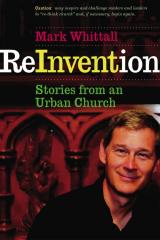
 by Mark Whittall
Wood Lake Publishing, Kelowna, British Columbia, Canada. 110 pages
Reviewed by Jeff Krehbiel
Some years ago at a NEXT Church conference, Deborah Wright and Jim Kitchens (of the consulting group Pneumatrix) spoke about the importance of lifting up examples of positive deviance before the church. We all know examples of negative deviance: those leaders and congregations mired in dysfunction and crisis. We also know all too well the norm in the North American mainline church: aging congregations in decline with decaying buildings and lackluster ministry. Fortunately, that’s not the whole story.
“ReInvention” is a story of positive deviance: an urban congregation that is bucking recent trends. In 2011, Mark Whittall, a second-career priest in the Anglican Diocese of Ottawa, Canada, was called to launch a new congregation in the abandoned building of the historic — and now shuttered — St. Albans Church in downtown Ottawa.
As a former executive in the tech industry, Whittall had entrepreneurial chops but little church experience, which may have been to his benefit. With little direction from the diocese other than to see if he could engage the growing young adult population that was moving back into the city, Whittall jumped at the chance to experiment with being church in a way that “wasn’t constricted by years of habit, tradition and the cultural influence of previous generations.”
The only problem was that the Anglican Church of Canada had almost no experience launching new churches. Whittall and the small-but-growing group of young leaders were essentially on their own to figure things out as they went along. They did have two important assets, which makes at least a part of their story unique and non-replicable: The diocese would help with renovation of the building, and a vital and impactful ministry with the homeless called Centre 454 would relocate to their building. Other than that, whether a new worshipping community could emerge in that space would be entirely up to them.
The story that Whittall tells is the step-by-step (along with missteps) trial by fire experiment of engaging largely unchurched young adults in an effort to become a church where they would want to participate. Influenced in part by the Emerging Church movement, the only rule was that there would be no cookie cutter approach to their ministry. They would do what seemed right in their context with those that were at the table — and those they hoped to reach — all while seeking to be faithful to the essential elements of the Anglican tradition.
At an important moment in their development, their staff was reading recent literature about why millennials don’t come to church. Instead they decided to ask their millennials why they were coming. Their answers were instructive: It’s all about relationships; we talk about stuff that matters; we can ask questions and explore answers together; my LGBTQ friends are welcome here; social justice is part of our DNA; we get to participate and contribute; this community engages my culture; I feel welcome here; this is a Christ-centered church.
As pastor of another downtown urban congregation that is growing with young adults, those answers resonated — and they give me hope.
Jeff Krehbiel is pastor of Church of the Pilgrims in Washington, D.C., and author of “Reflecting with Scripture on Community Organizing.”