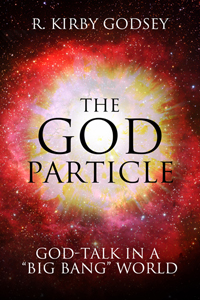
 by R. Kirby Godsey
Mercer University Press, Macon, Ga. 112 pages
In 2012 scientists discovered the Higgs boson. What is the Higgs boson? Named after scientist Peter Higgs, it not only confirms that all things have mass (including people, galaxies, etc.), but demonstrates how this is even possible. This is the astonishing discovery that the author builds upon to frame a conversation about science and faith. It’s a good conversation explaining how the latest developments have a profound influence on how we think of God, the universe, humans and all creation.
Godsey’s larger project is an argument for faith with reason. This is not a new idea for many Outlook readers, but it is for large numbers of Christians who feel compelled to abandon reason when it comes to their faith. Godsey argues that scientific discoveries, primarily in physics, have altered the way we understand the working of the universe. Some Christians have embraced the challenges of this new understanding while others have either abandoned their faith or ignored the challenge. He urges his readers to adjust their religious practice and faith claims in light of the new discoveries. For instance, “everything that exists on this planet came from an exploding star. So, in the final analysis, we are all made of stardust.” Carl Sagan famously made a similar claim, but Godsey pushes the implications further, insisting that everything is connected in vast fields of energy, including the human person; therefore, “relationality” is scientific fact. What we do with this fact becomes the practice of faith in the real world. He argues from science, “Relatedness or relationality is the reality underlying all things, whether they be stars or electrons or persons.” Anyone interested in systems theories, all of which are grounded in biology, will applaud this affirmation.
I had hoped that Godsey would engage the biblical texts to undergird his argument about relationality as the heart of the universe. While he describes it as fact, he does not plumb the depths of that conclusion. He might have discussed the stunning assertion in Colossians that in Christ all things find their coherence (Colossians 1:15-17). Teilhard de Chardin made a similar claim about the deep structure of relatedness and the divine Spirit moving all creation forward. Godsey devotes several chapters to the use of language, particularly poetry and myth. This is not new, but it is helpful especially for those Christians who remain locked in oppositional thinking with regard to science.
What I found most helpful in these essays is the patient explanation of scientific discoveries and their implications for faith in God. I wanted a more creative theological engagement with the facts of science and the various biblical texts that Godsey entirely ignores in the effort to sustain religious tolerance across the religious traditions. The tolerance is much needed, of course. It is not surprising that he stands with Albert Schweitzer who abandoned Christology in his quest to live courageously with reverence for life. With doxological exuberance, Godsey proclaims, “I fall in love with the depth and wonder of our world and, for me, the image of God means being captured by speechless wonder.” Whatever theological differences I have with the author, he ushered me to the threshold of speechless wonder. For that I am grateful, because the heart of doxological life is wonder.
 Roy W. Howard is the Outlook book editor and the pastor of Saint Mark Presbyterian Church in North Bethesda, Maryland.