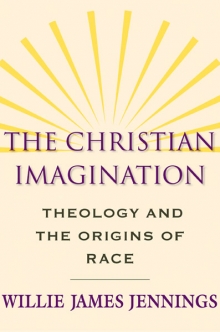
 by Willie James Jennings
Yale University Press, New Haven, Conn. 384 pages
Reviewed by Joseph D. Small
This is a hard book to read. The difficulty does not lie in dull subject, abstruse argument or tedious prose. The trouble lies in the questions it raises about our conventional ways of understanding the intersection of Christianity and race. Predictable condemnations of racism and comfortable notions of post-racialism held by enlightened 21st century Christians and our churches are exposed as naïve. “The Christian Imagination” is not an indictment of them; it is a book about us.
We are warned at the outset. Jennings alerts us that the book will argue that “Christianity in the Western world lives and moves within a diseased social imagination.” But our problem is not merely inadequate awareness of the past, for “Christian theology now operates inside this diseased social imagination without the ability to discern how its intellectual and pedagogical performances reflect and fuel the problem, further crippling the communities it serves.”
Jennings’ purpose is not merely to expose and critique, but to “paint a portrait of a theological problem in order to suggest a way forward.” He paints the portrait in beautifully written chapters that narrate the stories of four men who, together, provide entrée into racialism’s origins and enduring character. “Zurara’s Tears” relates an early moment in African colonialization and its attendant slave trade, the supplanting of “place” by “race” as social identifier. “Acosta’s Laugh” looks at a figure in the establishment of racial gradation and hierarchy during the Spanish conquest/evangelization of South America. “Equiano’s Words” illustrates the disjunction between orthodox-liberal-conservative Christianity and contextual African, Asian, feminist and womanist responses.
Probing racialism’s origins and consequences through sensitive narrations of formative moments gives texture and nuance to Jennings’ analysis. Although the stories he tells lay bare the deforming of Christian imagination, Jennings aims to analyze and understand, not to blame and berate. He avoids easy abstractions and crass demonization, making his identification of the many “missed opportunities of Christian intellectual life” even more telling.
Jennings shows that what was missing in “the origins of race” during the colonialist moment was “the central social reality that constituted a new people in the body of Jesus — their joining to Israel, and the power of that joining on” the Christian life. The concluding chapters of “The Christian Imagination” engage fundamental questions for the church. How might we restore one of the Christian faith’s most powerful imaginative possibilities, the deepest and most comprehensive joining of peoples? How are the people of God constituted?
In 2015, Jennings received the prestigious Grawemeyer Award in Religion for this book. In 2016, as the PC(USA) adds the Belhar Confession to our Book of Confessions, we should accompany our self-satisfaction with probing recognition of the continuing reality of our “diseased social imagination.” Reading Jennings’ book together would be the right place to start.
 Joseph D. Small is an honorably retired teaching elder and the former director of the PC(USA) Office of Theology and Worship. He lives in Louisville, Kentucky.