 R. Paul Stevens
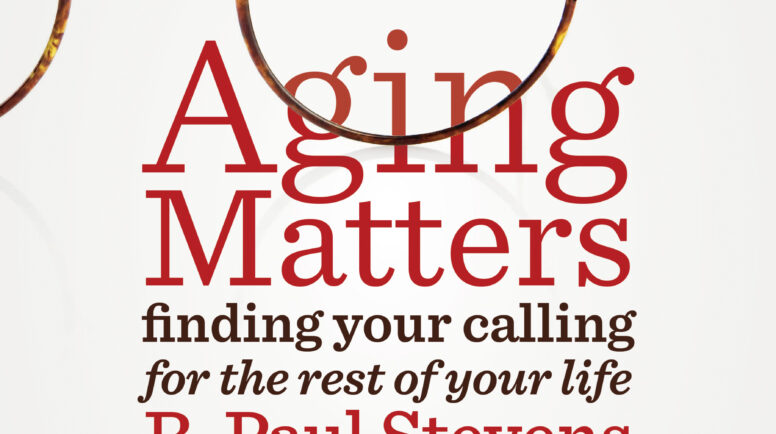
Eerdmans, Grand Rapids, Mich. 160 pages
Reviewed by Ted Wright
R. Paul Stevens is a grandfather, pastor, tradesman and professor emeritus at Regent College. He proposes from the outset that you and I should work until we die on meaning and vocation.
Assembling a mix of biblical, philosophical and sociological resources, Stevens presents an anthology organized in three parts: calling, spirituality and legacy. He draws heavily on the work of Eugene Bianchi (“Aging as a Spiritual Journey”), along with Stanley Hauerwas, James M. Houston, Richard Rohr, Paul Tournier and Zalman Schachter-Shalomi/Ronald Miller (“From Age-ing to Sage-ing”). If you enjoy wise sayings, look no farther. This book is replete with quotations – so much so that at times it feels like the author’s own voice can get lost. On the other hand, you’ll discover precious gems, including this example from Cicero: “Can anything be more absurd in the traveler than to increase his baggage as he nears his journey’s end?”
Each of the nine chapters opens with citations and closes with a two-page study/reflection guide. The work lends itself nicely to small groups, book clubs and adult Sunday school classes. Sometimes these chapter-ending study guides introduce new content or new emphases. Hence, they may strike a reader as tangential. Still, I recommend skimming through. You could miss valuable nuggets.
Stevens’ approach is systematic. He sets forth questions, addresses them sequentially and lists concepts in numerical outlines. His methods for addressing the various questions differ from section to section. Sometimes he delves into deep Bible study, sometimes personal narrative. Portions of the text are explicitly theological, others just as clearly practical. Sometimes his shifts feel rather abrupt. Chapter 7 in particular (“Leaving a Multifaceted Legacy”) seems stylistically out of tune with the rest. Yet the study guide there is especially good, concluding with a reflection on the death of Jacob (Genesis 49-50) and Stevens’ challenge: Is there late-life work you need to do? If so, what is it?
The presumed audience is Jewish or Christian. It’s hard to imagine this book succeeding in any other context without adaptation. It begins with “Reframing Retirement” and concludes with a chapter on death and new life. Consistent throughout is the author’s desire to present aging as a time of potential fruitfulness. “Aging is a paradox,” he writes. “Everybody wants to live longer, but none of us wants to get old.” His answer to the paradox can be summarized in one word: purposefulness. Or in three words: Focus on God.
As a long-term pastor about to retire, I find “Aging Matters” timely and useful. I would like to read it again – not cover-to-cover, but selectively now, as I know the layout. There’s a marvelous chapter on “Vices of Aging” that I’ll dread to revisit. The corresponding chapter on virtues will help keep me centered, especially its closing prayer. But the sheer wisdom of the quotes may be the part I treasure most. Stevens has brought together a great deal of insight in less than 200 pages.
Ted Wright is the pastor of Gaithersburg Presbyterian Church in Gaithersburg, Maryland.