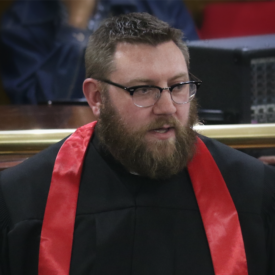
Guest blog by Jeffrey A. Schooley
Editor’s note: This month we invited our bloggers to share their experiences of welcome and hospitality in the church. Here are their stories.
My parents divorced when I was eight years old. In the length of time it took to hold our first – and ultimately last – “family meeting,” my otherwise idyllic, sun-burnt-and-scraped-knee Americana boyhood was washed away in the legal dissolution of my parents’ marriage.
It is probably worth noting that on the outside, I looked like I was doing great. My parents divorced, but also arranged their post-marriage relationship as a form of co-parenting – even before such a concept was as trendy as it is today. This, indeed, may have been the first and last time my parents were on the cutting edge of any cultural phenomenon. So I kept my grades up, played soccer (which my dad coached and my mom brought orange slices for), fought with my little sister, cheered for Hulk Hogan and watched scary movies at friends’ sleepovers. I was completely normal. On the outside.
Inside, however, I was languishing. I spent a lot of time grasping to re-make what was lost on that hot summer evening when the basis of my sense of security and belonging cracked into two, then four, then countless fragments. I doubled down on my friendships and found in them a refuge from a lot of the vulnerability that comes from being a child of divorce. But asking my fellow pre-teen friends to create a sense of home for me proved both illogical and unfair. And so I wandered on.
I don’t know if I can accurately describe my emotional state when Josh and I first became friends, but I do know that I had irritable bowel syndrome, was self-medicating/rebelling with pot and was constantly angry – even beyond the normal rage that attends to most adolescent males when their bodies start dumping testosterone into their system. So, I think it is safe to say that I wasn’t doing well. Worse yet, my mom had remarried and I wasn’t much of a fan of my step-father. My mom seemed to think that at least some semblance of a family had been re-created, but I begged to differ.
Josh, it should be noted, could not have been more different. He was from a warm, loving home. His parents were happily married. He had three siblings. They had some affluence, but were even richer in love. They were also tall, athletic people of Swedish descent with svelte bodies and various shades of red and strawberry blond hair. In short, Josh and his entire family was different from me in almost every conceivable way. And that might be what makes this such a great story of welcoming.
Over the years that Josh and I were friends, I slowly integrated myself more and more into his family. We were never best-friends-who-sleep-over-every-weekend, but I got to know his family in various ways and at various opportunities. And then, in December 1999, I asked Josh if I could go to church with him. I can’t say why entirely. Blame it on the Y2K bug, millennium paranoia, or – more likely – just Josh’s consistent prayers. Whatever the reasons, Josh responded like any good Christian should and enthusiastically welcomed me to First Presbyterian Church in Mansfield, Ohio (now, regrettably, an EPC congregation).
Josh and his entire family took me in. Introduced me to others at church. Stationed me in the middle of their pew so that I was surrounded by their love. They politely ignored my singing off key (they are all accomplished musicians both instrumentally and vocally). They showed me where the Lord’s Prayer was printed in the front of the hymnal because I had never learned that. They indulged me when I leaned over mid-gloria and asked, “What does ‘gloria in excelsis deo’ mean?” And they did this week after week after week.
Let’s not forget, the parents not withstanding, we’re talking about five teenagers occupying a pew. We’re talking about the potential for pettiness to take over. Yet if they ever had an eye-rolling inclination toward me, if they ever rued that I was sitting in the midst of their pew, if they ever wished I might just grow bored of church and allow them to return to their happy status quo, they never gave into those temptations. They just kept pouring the welcoming on.
The best example of their welcoming, however, does not occur in church. It occurs after the service. It occurs when they invite me to pile into their crowded van with the plea that we have lunch together. So off we go to Taco Bell and I blush when I order twice the amount of food as anyone else (see: svelte Swedes vs. my dumpy, Germanic build), but they never bat an eye. And then we are in their kitchen, eating in a little breakfast nook that was probably tight for the six of them and now contained a seventh. And then I sit and learn to pray over a meal. Week after week, this happens. I learn to pray and I hear each member of that family pray for me.
I hope I don’t tempt an accusation of heresy, but I suspect my first communion came in the form of a taco shell broken for me and Pepsi poured out for me. I suspect my first communion table looked very much like the one in your parents’ kitchen right now. I suspect the first time I received the body of Christ and felt a part of the Body of Christ came over those meals.
Does the church need radical hospitality that extends to immigrants, refugees, people of color, LGBT folks and any other marginalized individual? Absolutely. But let’s be clear. That sort of hospitality is big league stuff. And those best suited for such a high, holy calling are those who’ve first learned to invite the awkward, pimply, depressed teen into pew and home.
 JEFFREY A. SCHOOLEY is the teaching elder at Center Presbyterian Church in McMurray, Pennsylvania. In his spare time he binges the best of Netflix, goes to the gym, reads 20th-century dystopian literature and cuddles with his old dog, River.