If often we in the church don’t have much to say about economics, Jesus sure does. The sermon on the plain, a conversation with the rich young ruler, a parable about talents, admonitions about building barns, instructions for what disciples should take when they go on the road — Jesus doesn’t shy away from conversations about money and possessions. Why, then, are we so reticent to talk about them?
 Perhaps for pastor-types like me, part of our unwillingness to talk dollars and cents — tithes, taxes and fair wages — comes down to feeling ill-equipped to talk intelligently. I remember sitting in a meeting of the church trustees, looking at spreadsheets, line graphs and stock market reports and thinking, “This is Greek to me.” (Except, if it had been Greek I could actually have discerned some meaning.) Returns on endowments, draws on reserves, funds in which to invest, bonds, stocks, money markets, blah, blah, blah. Acronyms with which I was unfamiliar — ROI, P&L and AR — were tossed back and forth while I sat trying to look interested and thoughtful, rather than confused and bored. Where were letters like COM, PMA and OGA?
As is often lamented, they didn’t teach us this in seminary. (If we compiled that list and tried to incorporate all the subjects into the curriculum, an M.Div. would take the same number of years as a Ph.D. and post-doc.) That, however, is no excuse for pastors and other church leaders to opt out of looking at issues of money through the lens of our faith. Jesus is Lord of all, our pocketbooks and economic polices included.
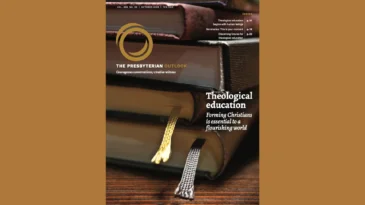
This issue of the Outlook attempts to facilitate a conversation between two worlds that for too long and for far too many have been viewed as mutually exclusive: economics and theology. Jesus certainly made the connection and therefore we are called to do so, too. The articles within require careful reading, but that close attention will bear fruit. We’ve included a list of resources for further reading and study. We hope our writers spark your curiosity and the Spirit drives you to go deeper. Why? Because matters of money, possessions and economic policy impact people — daily and profoundly.
Here is just one example. I live in a part of the world that is dotted with wineries. The vineyards require a great deal of pruning and that pruning requires many people doing difficult and careful work. Machines cannot tend gently or with discrimination to fragile branches. The story on my local radio station detailed winemakers’ worries about potential changes to current rules for guest worker visas. Wineries rely heavily on guest workers, permitted to come into the country for 10 months a year, to do this job. The men and women who come to my neighborhood to do this work rely heavily on the money they earn during those 10 months to support their families. Consumers assume a particular price point for the product, based on the ability of producers to make the wine at the current cost. There is a robust tourist industry driven in no small part by visitors to the many wineries that have sprung up within a 100-mile radius of my home. Economics equals people.
Now, while I don’t understand the nuances of our current guest worker policies, I do understand how those policies impact a great many people not only in my community but also in the communities where these workers live. And I understood this part of the story on WVTF Public Radio: “The winery covers round-trip transportation from Mexico, housing, food, weekly trips to Wal-Mart and pay of $10.72 an hour. Horton’s does advertise for help as required by the Labor Department before H-2A visas are issued, but [Horton Winery winemarker Michael] Heny says they haven’t had much luck attracting skilled locals.”
Global economics is at work right around the corner from my house, at my local Wal-Mart (in more ways than one) and every time I make a purchase from gas to green peppers. That is why, as a Christian, I must work to understand economic policies, what they are, how they work and if they hold up to the scrutiny of Scripture and the love of Jesus Christ.
Grace and Peace,
Jill