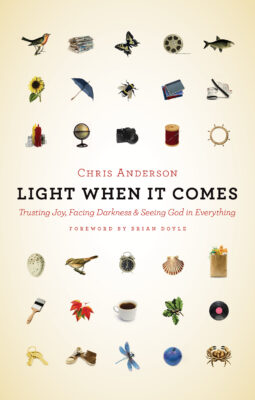
 Chris Anderson
Eerdmans, Grand Rapids, Mich. 181 pages
This is a remarkable book. Part memoir, part prose poetry and part theological reflections, Chris Anderson offers an introduction to the spirituality of St. Ignatius. Early in this extraordinary book he describes an experience of seeing stars against a glittering back sky. The bright belt of Orion is shimmering. The beauty is palpably present. Anderson says, “we all have moments like this, moments that move us somehow, but we can’t quite put into words” and so we let the moments pass. Thankfully, Anderson does find words to describe the occasions of light and darkness that serve as portals to experiencing God. Anderson, who is a Roman Catholic deacon, poet and professor of English, explores of the way of St. Ignatius using examen. At the end of each day:
“we remember the light and give thanks
we remember the darkness and ask for forgiveness, refuge and strength
and we let it all go;
we ask for grace to follow the light.”
This simple prayer forms the structure of Anderson’s book. His numerous stories are gathered in three parts: trusting joy, facing darkness and seeing God in everything. There is rich theology here and reflections about Scripture, both conveyed with brilliant language – much like the poet Emily Dickenson, Anderson tells all the truth but tells it slant. For instance, the opening chapter recalls an experience when Anderson was called upon to bless a bathroom following the suicide of a young college student. This moment becomes a poignant pastoral exploration of how light appears clothed in darkness and how we find the capacity to live with both. Later on the same day he offered the Eucharist to a woman in the ICU who railed against the church standing ready to bless her. The author invites us to ponder these moments when light is enclosed in darkness and darkness is enclosed in light.
In exegeting Jesus’ miracles, Anderson invites the same openness to belief in the possibility of God appearing to us in the manner Jesus appeared to Peter daring to walk on water. He suggests we are always walking on the water, nearly drowning and being saved. The light is shining through all of it if we have the capacity to perceive it.
What makes this book remarkable is the subtle way in which the Ignatian way of spirituality – whose goal is discovering joy – is woven into the stories that Anderson tells. The three-fold movement of the book becomes a structure for understanding, but more importantly, experiencing the examen. In the section on facing darkness, He weaves a theology of the cross by exploring what it means to die to ourselves as a way of service. “The cross is a lens. … Love is a great emptying out and losing.” Quoting Augustine, he says, “My mind to me has become difficult ground.” The examen is about experiencing God in everything; this occurs when we pay attention to the movements of our lives and what occurs within us and around us every single day. When we pay attention, we discover the presence of God in light and darkness. This is the joy that overflows.
 Roy W. Howard is the pastor of Saint Mark Presbyterian Church in North Bethesda Maryland, and the book editor of the Presbyterian Outlook.