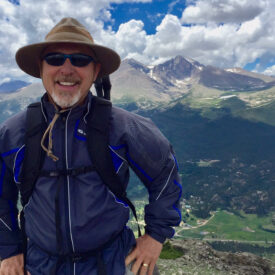
During a sabbatical from my pastorate in 2015 I walked a pilgrimage of faith that radically altered my life.
Nothing I have done in nearly 30 years of pastoral ministry influenced my life as dramatically as walking the Camino de Santiago. I attempted to describe what happened in a book called “Walking in Love.” One of the consequences of that first pilgrimage was a bewildering sense of disorientation and an intense desire to return to the Camino. That disorientation is akin to spiritual dislocation and a fresh, though uneasy, relationship with the church. Some refer to this as liminal space, where the past is comfortable but not satisfying and the future is calling but not at all clear. Through the encouragement of my wife and the kindness of the congregation I serve, during the Spring of 2017 I returned to Spain to walk another route called the Camino Primitivo.

A little history first
There are many paths to the shrine of the apostle St. James the Great in the Cathedral of Santiago de Compostela in Galicia in northwestern Spain. According to tradition, the remains of the saint are buried here. Pilgrims follow these routes as a form of spiritual practice for their spiritual growth. In the ninth century, King Alfonse the Chaste was king of the Asturias region of Spain and Oviedo was the capital. He established a pilgrimage route to Santiago to confirm the authenticity of the recently-found bones of St. James. As the king made the journey over the mountains, he established the oldest pilgrimage route in the world. This route is now known as the Camino Primitivo (or The Original Way).

But today many people, when they hear about the Camino de Santiago, think of the pilgrimage from St. Jean Pied de Port in France over the Pyrenees Mountains to Santiago that was made famous in the movie “The Way.” But this route was actually established later in the 11th century by the Kings of Leon and Burgos, after King Alfonse fell from power and the capital was moved to Leon. They wanted pilgrims to travel through their territories on the way to Santiago.
Many pilgrims eventually walked to Finisterre on the coast, a place known as the end of the earth. Pilgrimage in those days was undertaken to gain indulgences, which were granted by the pope for remission of the punishment in purgatory still due for sins after absolution. The unrestricted sale of indulgences was widespread during the later Middle Ages.
In due time, hospitals were established along the way to treat the pilgrims who often traveled with only a few belongings, a walking staff and a shell for drinking water. The Knights Templar was created to defend the pilgrims from bandits along the way. Thousands walked this way. But like many medieval practices, it fell away.
In the 1970s, a priest decided to renew the Camino de Santiago. From that time forward, it has become the most popular pilgrimage route in the world, known across Europe as the path of human solidarity as well as a place for religious awakening.
Nowadays over 250,000 people walk with a variety of motivations. Today the shell carried by pilgrims on their backpacks is a symbol that links them to the past. For Christians, it is also a symbol of baptism. Many contemporary pilgrims walk with a single staff because it links them to history.

Why did I walk again?
In addition to following an intense call to return – a calling that is common among pilgrims, but nearly impossible to comprehend for whose who have not walked – I specifically wanted to walk alongside the pilgrims who identify as religious “nones.” Members of this group, particularly millennials, are not necessarily atheists or even agnostics, but they have no positive experience with any religious institution – especially the church. My purpose was to listen to their stories, learn from them and share my own stories. I walked this pilgrimage something like an embedded journalist, sharing fully in the experiences of others without the screen of pastoral privilege. I didn’t immediately identify myself as pastor, which brings a certain filter to conversations. Rather, I established a relationship first and then, in time when trust was created, I shared my pastoral vocation.
I am constantly learning how to be in authentic relationships with those who are outside the realm of church. I must let go of all privilege, all assumptions, all parochial language. I must assume the posture recommended by Dietrich Bonhoeffer and others: Be fully human in world where Christianity has lost respect and personal meaning for vast swaths of humanity. As a pastor, I learned from these millennials how insular the church seems and how its practices appear designed to maintain an institution rather than to speak to the heart. And this is why I walk among nones without privilege and often without the security (and assumptions) of the pastoral office.

Camino community
The Original Way begins at the Cathedral in Oviedo, the heart of the region of Asturias. It travels across mountains to Santiago, making it a much more arduous route than the more popular one. Hence there are fewer pilgrims, and many on this path have already walked other pilgrimages. I also discovered fewer English speakers, which challenged for my limited Spanish. Nevertheless, as I walked I met many pilgrims and enjoyed the community that forms along the way.

The small, simple albergues (pilgrim hostels) reminded me once again that life consists not in possessions, but in the relationships we form. As one fellow pilgrim said: “Knowing the Primitivo was the original Camino felt like I was walking to honor the true friend and disciple of Jesus … a humble man of simplicity. The Primitivo was beautiful, more wild and raw.”
In a few days, as is the common experience of the Camino, I met a few pilgrims with whom I walked closely most days. The four of us became a Camino family: three from Germany, one from Spain and myself. They were young and walking alone until we decided to travel together. I called them our merry band of pilgrims. They were astonished to be walking and talking with a pastor because none of them had a positive experience with church.
Toward the end of our pilgrimage, I gathered them together and gave each member of my new family a written statement of my gratitude for them and a personal prayer, along with a playlist of songs I had selected for each of them. I invited my pals, these nones, to pray. Something occurred there that is far beyond the bounds of religion or church. This is the reason I walked this Camino. I believe I fulfilled my purpose.
We walked into Santiago the next day and together we worshipped in the cathedral with pilgrims from around the world, many in tears of exhaustion, gratitude and joy.
I believe my purpose was fulfilled, and to this day I remain in conversation with my new Camino friends.
ROY W. HOWARD is the Outlook book editor and the pastor of Saint Mark Presbyterian Church in North Bethesda, Maryland.