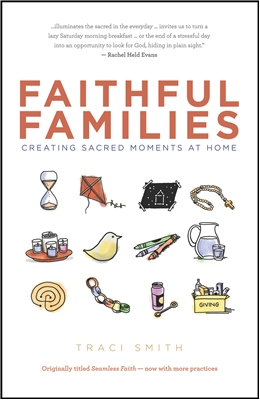
 Traci Smith
Chalice Press, 256 pages
Reviewed by Michelle Sumption
Time is a precious commodity. Frequent are the meetings when significant time is taken to schedule the next meeting, because inked full-to-brimming in the calendars and planners are activities and commitments that give evidence to a full personal or family life. Especially prone to this full, well-rounded itinerary are the families of the church – with children and youth busily pursuing activities and opportunities that will provide them with important experience and preparation for their promising futures.
Time is also a constant orientation. The prevalence of timepieces on our wrists, phones, walls, dashboards and bedstands are marked evidence of our society’s proneness to a time-oriented culture. Those same meetings that end with significant time spent scheduling are the same meetings where I, personally, can find myself easily captive to a timetable in which business items are efficiently discussed and time is appropriately used. Meanwhile on my mind, and in my notebook, is the multilayered to-do list of things that require my attention and, therefore, my time.
Into this blitz of activity and doing, Traci Smith’s work “Faithful Families” provides a meaningful, yet practical, guide for busy families who desire to integrate spiritual practices of prayer, tradition, Scripture and ritual into their routines. Redeeming the routines into sacred practices that are less about being perfect or accomplished and more about being faithful, Smith provides a potential rubric for how a family could feel led to transform their days into meaningful expression of worship and spirituality.
In the introduction, Smith writes, “Faith is learned as it is woven seamlessly into the fabric of daily life.” From this core belief, the book launches into over 50 ideas, practices and traditions that can offer families a resource for their spiritual practice. With each practice comes an explanation or description with a genuine personalization from the author that clues the reader in to the vast discernment and experience that went into each uncomplicated, yet profound practice. Reading Smith’s beautifully simple yet profoundly thoughtful work, the Greek terms chronos and kairos came to mind. Chronos is defined as measured time (the term from which “chronological” is derived). Chronos is a steady, time-oriented mindset: seconds lead to minutes to hours to days to weeks to months to years. But then there is kairos: God’s time – time that cannot be measured because it is sacred, God-appointed time.
This book is a wonderful guide that can be of service to families and faith communities who wish to embrace the kairos in the midst of their chronos. Use stickers to mark the day God has given. Establish ceremonies for new pets or first days of school. Develop a prayer life using such simple items like candles or common experiences like taking a car ride to just sit still and listen. These practices that Smith brings forth are profound in their simplicity, and nurturing to frantic families yearning to be faithful.
Michelle Sumption is pastor at York United Presbyterian Church in York, New York.