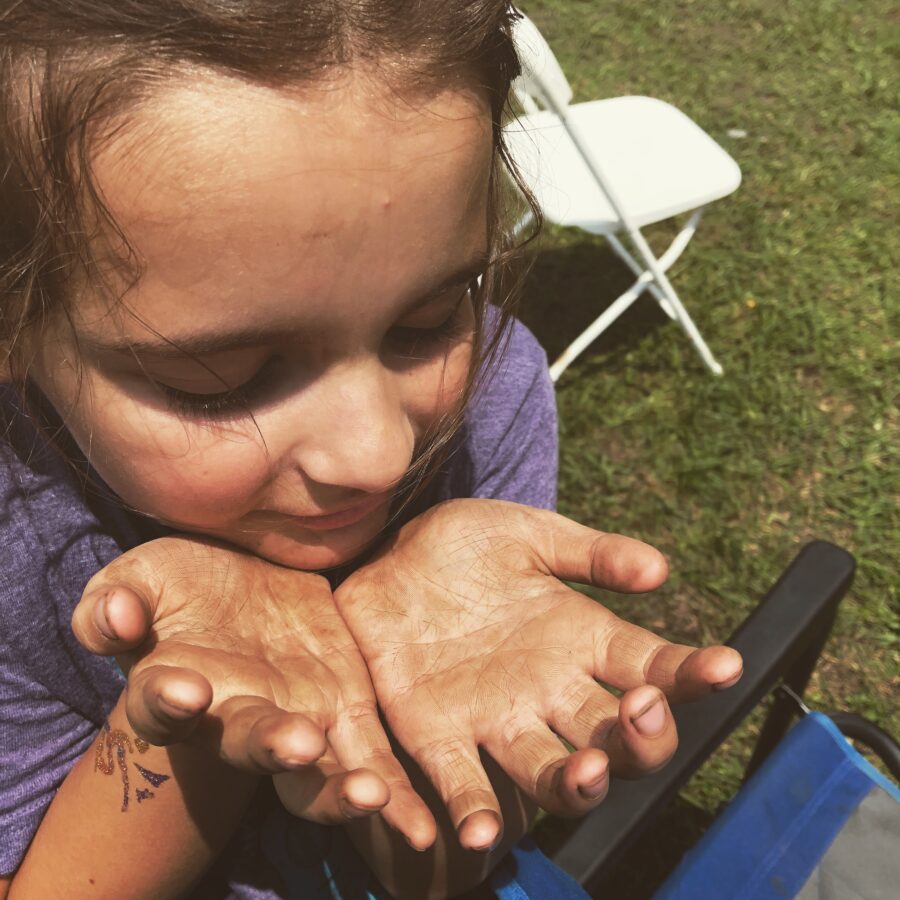
Our house has a resident theologian with dirty hands. Her age hasn’t even reached the double digits yet, but she attended seminary classes before she attended kindergarten. These filthy hands belong to my daughter, and these hands have been teaching me about the depth of the sacrament of communion since she was 2-years-old and toddling up the center aisle of my field education church to partake. As Presbyterians, we allow parents to make the decision as to when their child is ready to participate in this meal. We were comfortable with her earliest understanding: This is a special meal we share at church and everyone is welcome.
As she grew and I moved into my first call we found ourselves in a congregation without many children. My husband was out of town the second Sunday I presided at the table, so my daughter sat with her Sunday school teacher. She was not served the bread because the child near her was not yet partaking in communion and the server assumed the same of our child. As I served the elders and distributed the juice a shout came from the back of the church: “Mom! I didn’t get any bread!” Discreetly as possible I made my way down the side aisle and delivered her bread as the juice was being passed around. She was served the juice with no yelling for mom.
What I didn’t see when I walked away was that my daughter, horrified that her friend did not get any bread either, broke her tiny morsel in half and shared it. When the juice came she did the same, sharing the tiny cup with her companion. That’s right: The pastor’s kid served another kid her first communion like Jesus-contraband in the back of the church.
As both a parent and a pastor I was blown away and quite proud that she knew it was to be shared. I was also horrified that my child unceremoniously served another child their first communion when that child’s parents had not yet felt their child was ready to partake in the sacrament. I apologized profusely and there was plenty of grace from the other parent involved. I am convinced that particular Sunday morning there was no one (pastor included) in that church who understood the beautiful mystery of the table better than those two children.
A few years later at this summer’s Wild Goose Festival, closing worship happened outdoors where much of the weekend was spent. Near the main stage was a small playground where my daughter played happily in the dirt while we worshipped. Recognizing the words of communion and seeing the people start to move toward the serving stations, she came running over and took it upon herself to douse her hands in hand sanitizer before taking the bread with now muddy but “sanitary” hands.
I snapped this picture of her hands because it occurred to me she was helping me learn again. This time she was teaching me about how we approach the table. More often than not we approach the table thinking we already have to be clean. Even our liturgy intentionally puts confession before communion — we cleanse our hearts to approach the table. This is not problematic. Reconciling with God before we partake is a good practice; it helps us acknowledge we fall short and that grace abounds. Sometimes we even find ourselves getting dressed with extra care because it is communion Sunday. We take time to remember the cleansing waters of our baptisms as we approach the table.
Yet, as I looked at those filthy hands I was captivated. Communion is for us all, even when our hands are dirty. Then I began to ponder something else: Are we ever supposed to approach the table with clean hands? In baptism we talk of the symbolic washing away of sin. In worship we confess. Yet in Scripture, we are constantly called to love and serve one another. It seems simple enough until you try to love someone who is actually human and has flaws and shortcomings. Then, you might realize you are also human and have flaws and shortcomings. We are to serve the widow and the orphan and the least of these. Jesus hung out with all the people who found themselves on the fringes; he was never with the in-crowd. Jesus also asks us to feed his sheep. It all sounds so perfect, ideal, maybe even utopian — until we try to do it. Loving people is so messy. Serving people is messy. Feeding people is messy. We cannot respond to the call of God upon our lives as followers of Jesus and keep our hands clean!
Perhaps we are all supposed to approach the table with filthy hands, not because we have sinned and need reconciliation but because we are answering the call to serve the people of God and we need to return from time to time for sustenance to help us remember Jesus whose radical grace came in and messed up our lives in the first place. We open our hands filthy with the mud of discipleship-induced service and reach out for that tiny meal that sparks our memory, offers us grace wrapped in mystery and sustains us to continue doing the work of the kin-dom.
 REBECCA GRESHAM-KESNER is pastor at Faith Presbyterian Church in Medford, New Jersey. Outside of church and family life, you can find her in nature, finding fun ways to be creative or asking awkwardly deep questions of people she just met.