Guest commentary by G. Wilson Gunn Jr.
Editor’s note: In the weeks following the 223rd General Assembly, on Fridays we will publish commentary expressing opinions on and responses to the actions of the assembly.
Congregations increasingly are working with flat or shrinking budgets. Many presbyteries are minimally functional due to insufficient cash flow. When a presbytery fails to provide the fundamental services required by the Book of Order, in short order the congregations will suffer. In the absence of adequate oversight, congregations are more exposed to financial malfeasance, sexual abuse, imprudent encumbrances and the erosion of our essential standards for teaching elders. When a presbytery system erodes to the point at which it cannot aid a congregation in conflict, intervene in the event of a lawsuit or adequately oversee the comings and goings of teaching elders, the congregations are an inch away from trouble. The presbytery I serve, National Capital Presbytery (NCP), is not in trouble, but a preponderance of presbyteries are. Much of it is because the congregations don’t give like they used to — often because they don’t have the resources they used to.
Into this financially strained system comes the General Assembly (GA) decision, with far too little consultation, that decides to assess the churches almost 16 percent more per member for the support of the Office of the General Assembly (OGA) systems. The initial proposal was for something closer to a 40 percent increase that was then reduced after conversations about the stress that increase would produce across the churches and presbyteries.
While congregations are expected to pay the per capita assessment, presbyteries have no leverage to compel that payment. The presbyteries are compelled to pay the per capita assessment whether their churches pay it or not. NCP pays the full per capita with no argument. This is the cost of being a Presbyterian. Congregationalist polities such as those of the Baptist, United Church of Christ and Disciples of Christ denominations have no per capita and have a more associational connectiveness. Authoritarian episcopal systems could run cheaper than can more egalitarian representational systems that insist on broad-based decision-making involving both elders and pastors. Most of these episcopal systems assess their churches double or more the amounts Presbyterians offer their upper governing bodies.
Even so, with flat budgets an increase one place dictates a decrease somewhere else.
The impact of the recent per capita changes on NCP is reflected in the chart below:
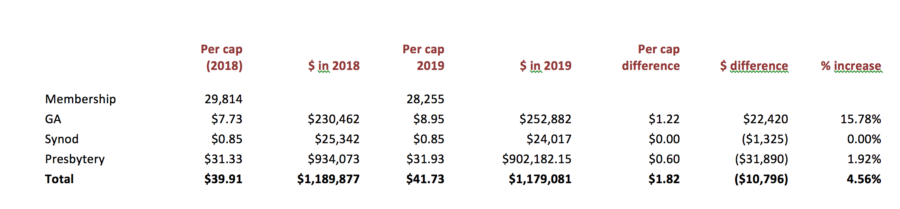
NCP will be expected to pay over $22,000 more to the OGA. Presbytery leaders are proposing a 4.56 percent overall per capita increase believing even this will be difficult for our churches. This will result in almost $32,000 lessavailable for presbytery operations. We do not yet know how this will be accommodated. It will certainly be sacrificial and stressful.
Observations and 1uestions:
- Will the congregations increase their per capita giving and maintain their unified mission giving? What we experience when the assessment goes up often is a corresponding decrease in the unified mission giving.
- Presently, almost all NCP churches pay the per capita and appreciate the services the presbytery, synod and OGA provide. But will congregations balk at this substantial increase and not pay it leaving the presbytery to pay the balance?
- If the presbytery must bridge that gap, will it reduce presbytery mission initiatives, or will it reduce the unified giving to the Presbyterian Mission Agency (PMA)? I would predict that the reduction would reduce giving to PMA, which is a shame because they are doing wonderful work on our behalf.
- Presbyteries that have been unable to contribute to PMA will be making decisions then as to whether to decrease support for presbytery ministry or short the OGA per capita assessment.
- Presbyteries already reduced in functional scope will have little latitude but to underpay the OGA per capita assessment.
Other questions I would ask:
- Does the per capita assessment correspond to our philosophy that this assessment is to pay for the required essential constitutional functions, or has the OGA assessment been broadened to include other ministries beyond the constitutional functions? My observation is that yes, they have been diverted to extraconstitutional functions.
- Might we be able to reduce costs by overhauling the OGA system? I am not close enough to those functions to offer concrete suggestions. However, I see dozens of ways to save in the way we do General Assembly meetings that would also make those meetings more productive. As in any change, one’s perceived gain is another’s perceived loss.
- The way a General Assembly makes decisions is backwards. The assembly should start the Wednesday plenary with a projected income amount and the projected expenses from the committees — pairing expense with anticipated income. The assembly would then decide priorities across budgetary constraints. Instead, we add and add and add — then on Saturday morning, a sleep-deprived assembly quickly votes for anything they can to make the airplane home. The churches are assessed the expense and if they don’t pay, then the presbyteries are obligated to pay. Often PMA has to fire people just to take care of the impulsive GA mandate.
- Perhaps a presbytery will advance an overture at every assembly that the projected income and expenses for OGA and PMA will remain flat. Then, the assembly will just have to work inside that constraint. Even “flat” is optimistic.
Leadership in the context of diminishing resources is challenging. I can understand the GA’s need for more resources. I can understand the synods’ and presbyteries’ need for more resources. I can understand a congregation’s needs for more resources. It would be nice to have the 1960s cash flow again. That is not our reality. This General Assembly did not (and most do not) make decisions with this reality in mind. That could change purposefully, or it could change reactively. We get to choose.
 G. WILSON GUNN JR. is the executive presbyter of National Capital Presbytery.