Guest commentary by David Garth
On July 8 this summer we drove into the heart of Dixie: south from Charlottesville, Virginia, almost 800 miles until we reached Montgomery, Alabama. Ninety-five pilgrims signed up to tour civil rights museums and memorials on our way to the National Memorial to Peace and Justice, also known as The Lynching Memorial. We wanted to add a jar of soil from the site of a Charlottesville lynching to more than 300 jars at the memorial.
The larger purpose of our trip was to seek reconciliation and healing after the alt-right, KKK and neo-Nazis invaded our city for a rally in Charlottesville on August 12, 2017. The aftermath of that event left three dead and shattered the self-image of Charlottesville as a quiet, progressive university town. Those of us who are white are embarrassed by the failure of law enforcement to maintain public safety and by the exposure of an angry divide between ourselves and our black neighbors. Through the pilgrimage, we hoped to better understand our history spanning from slavery to Jim Crow to the civil rights movement and to the present-day turmoil regarding people of color.
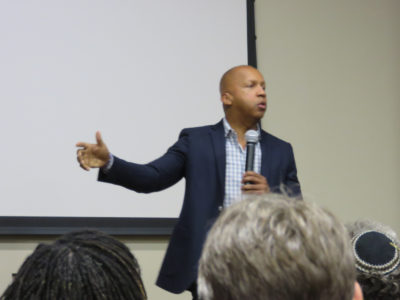
On a more personal level, I needed to grapple emotionally with a checkered family history. Like many middle-class whites, I think of myself as open-minded on race, even liberal. However, I have only a few black friends. Furthermore, my ancestors were slaveholders near Charlottesville. At least one was known to be a harsh master. I went on this pilgrimage to Montgomery to see and hear firsthand how race relations in general have soured and how I have slipped comfortably into white privilege. It was a jarring education.
The August 12, 2017, rally was provoked by a proposal from city council to remove the statues of Robert E. Lee and Stonewall Jackson from two parks. After August 12, the time seemed right to revisit the uglier side of race relations: violence toward blacks and the back pages of our history that led to white supremacy and privilege. Two black scholars and the local African American Heritage Center raised $165,000 for a carefully designed trip for high school students, teachers, University of Virginia staff, activists and local residents. The group was impressive with its diversity of ages, races, religions and education. All of us were local.
We began with Appomattox where a park ranger lectured colorfully on the military actions leading to Lee’s surrender to Grant. My eyes moistened at her description of the ceremony. Back in the bus, however, our leader Jalane Schmidt reframed the surrender. Appomattox was more than the end to a bloody conflict, more than the beginning of reconciliation. She pointed out that it was the climax of the anti-slavery movement, concluding almost 250 years of brutal captivity and persecution; and the National Park Service had almost ignored the significance of April 9, 1865, for black people. I thought about the contrast between these narratives for the rest of our pilgrimage.
Our next stop was Danville, Virginia, the last capitol of the Confederacy. A video told us that W.T. Sutherlin, a prominent leader in town, voted at first against secession before signing the document and declaring, “I’ve always been a union man, but I’m not a submissionist.” Activists in our group complained bitterly that the video whitewashed slavery and was irrelevant to us. Another black woman forcefully reminded us to be respectful to our hosts. The bitter exchange captured the work remaining for Charlottesville. How do we confront a history that has been usually interpreted through the eyes of proud white people eager to avert their gaze away from injustice toward black people?
Greensboro, North Carolina, incarnated that work in a Truth and Reconciliation Commission, which was modeled after one in South Africa and was the first of its kind in the United States. Nelson and Joyce Johnson told the story of Bloody Sunday, November 8, 1979, when five people were killed for marching against the Ku Klux Klan. Police had failed to appear for the march despite the fact that the FBI had embedded a Klan informant who knew the KKK planned an attack. An all-white jury found no one criminally guilty. Hanging in the air is a question for both civic and Christian communities: “How much truth is required for reconciliation to be genuine?”
In Greensboro, Charlotte, Atlanta, Birmingham and Montgomery, we visited civil rights museums displaying gruesome pictures and stories of the price paid mostly by blacks for laws that have moved us closer to the ideals of American democracy. The Woolworth’s lunch counter in Greensboro is now the Civil Rights Center and Museum. A movie recreated the friendship of four black students who began the sit-ins. They were determined to do something to assert their “manhood” as well as their rights. “I was too angry to be afraid,” said Franklin McCain in an interview. Alone on the first day, they were joined by hundreds of men and women from surrounding colleges.
In Charlotte, North Carolina, we toured the Levine Museum of the New South. Like every other site, this museum demonstrated an undercurrent of boosterism about their role in the movement. A massive exhibit of photos and facts laid out the brutality of poverty and racial discrimination in the not-so-distant past. Other exhibits told the story differently: how a farming/plantation economy grew into the financial center of the New South. I wonder, just what is the defining character of the “New South”?
Waking up in Atlanta, we began the day at Sweet Auburn Historic District. More images of the fierce battle between civil rights protestors and police, supported by angry whites. Martin and Coretta King are entombed across the street. A few doors away stands the Victorian frame house where his mother and father birthed and raised their family in a thriving middle and upper middle-class neighborhood. I did not know that Atlanta had nurtured black entrepreneurs and executives early in the 20th century. How many others share my ignorance?
At the National Center for Civil and Human Rights, three floors illustrate the breadth of human rights. The middle level includes a small lunch counter where we sat-in as protestors while headphones pummeled our senses with the threats and noise of angry white hatred. One black student cried. The upper floor expands human rights to show global leaders struggling fighting for free speech, feminism, LGBTQ rights, etc. The price they pay for their work is often imprisonment, torture and death.
Birmingham was called Bombingham by civil rights leaders because of frequent attacks on their attorneys and churches. The deaths of four little girls at the 16thStreet Baptist Church shocked nation and world. An impromptu dialogue between our docent and a local physician broke out in the sanctuary. The retired physician declared that white people repulsed him with their savage and uncivilized behavior. This is my South.
A display of demeaning ads and cartoons reminded me of a blackface fundraiser I attended in my boyhood. Those misrepresentations of African-American culture combined with Jim Crow segregation to create many present-day stereotypes about blacks.
From Birmingham we detoured down US 80 to Selma and the Pettus Bridge, a thoroughly unpretentious setting for another Bloody Sunday on March 7, 1965. We walked across where Sheriff Jim Clark used tear gas, batons and rubber hoses wrapped in barbed wire to drive men, women and children back into Selma. TV footage that same evening ignited the outrage that resulted in the August 1965 Civil Rights Act. A price was paid for freedom. After our crossing, we prayed soberly beside a cluster of formal and homemade memorials.
In Montgomery we started at the Southern Poverty Law Center’s Civil Rights Museum where Susan Bro, mother of the woman slain in Charlottesville last year, stood in front of a picture of her daughter as a reporter interviewed her. Photographs of other victims of violence against civil rights advocates adorned the walls to give them a place in history. At the Dexter Avenue King Memorial Church, an animated docent entertained us with speeches and songs from Martin Luther King Jr. The 15-year-old son of Charlottesville’s new black mayor played Chopin as we entered, a fitting reminder of the youthful and brilliant pastorate of King in Montgomery.
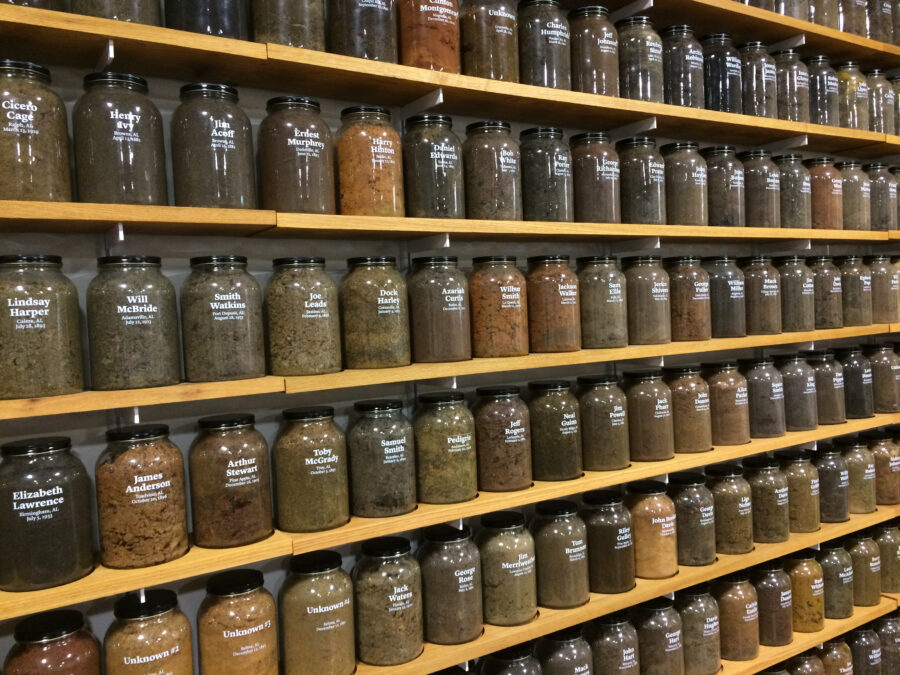
That afternoon, we entered the Equal Justice Initiative offices and Legacy Museum where a wall made up of jars of soil from some of the counties where over 4,300 documented lynchings took place during Jim Crow. We gathered first for a solemn presentation of the soil where John Henry James was lynched outside Charlottesville. Then we were each invited to trowel a little soil from one jar to another. This was my Albemarle County soil, perhaps from land once worked by the slaves of my great uncle. I sifted a few grains through my fingers as I counted four antebellum farms owned by Garths.
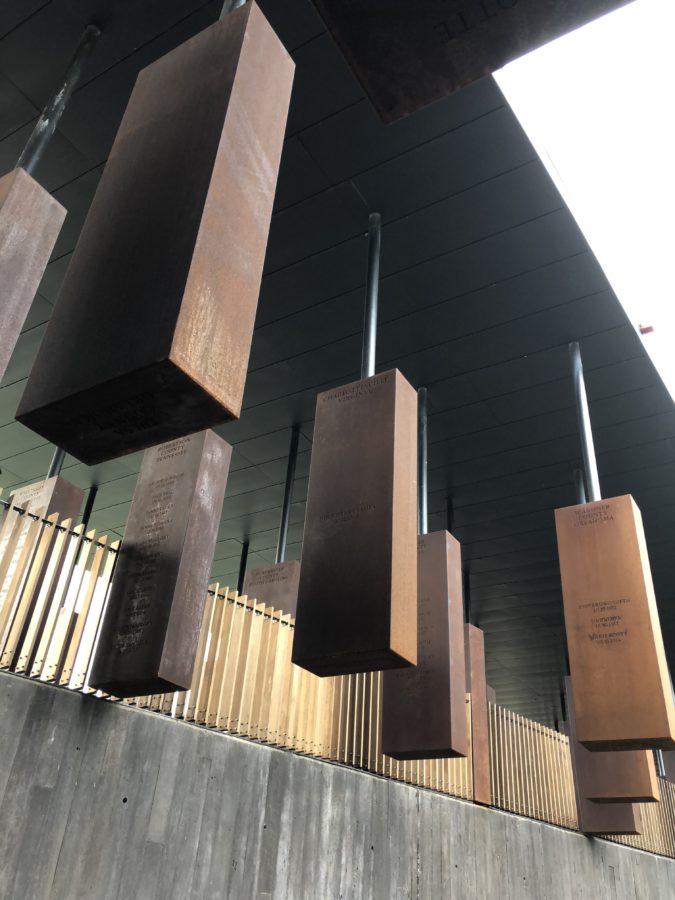
After a pause we moved to the National Memorial to Peace and Justice, a roofed building open on the sides where hang dozens of steel modules, each inscribed at the top with the name of a county and state; along the body of the steel the name or names of those men and/or women lynched in that municipality are inscribed. I searched for counties where I’ve had pastorates, pondering the names of once forgotten men and women, now incised in steel.
A spiritual pilgrimage eludes a neat summary because it works on mind, body and soul over time. My immediate aim is to keep in touch with my companions, not just to relive the experiences we shared in six hard days, but to deepen and expand those relationships, insights and the transformations in me.
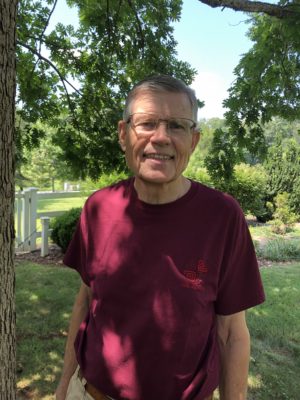 DAVID GARTH retired outside Charlottesville, Virginia, where he lives in an old farmhouse. He and his wife have five chickens. He served churches in North Carolina, Virginia, Florida and Tennessee