Guest commentary by Edward J. Thompson
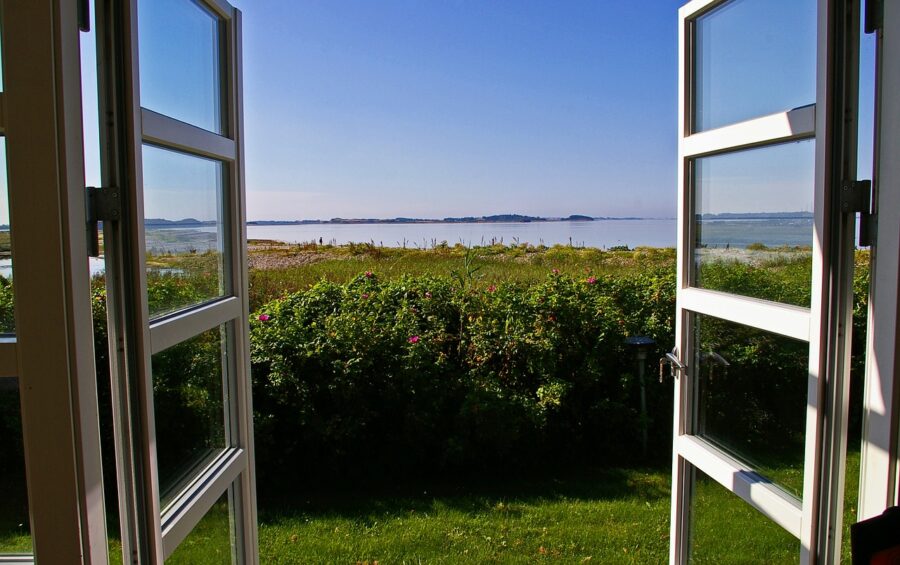
A good few yesterdays ago I grew up amidst fathomless harbors and fantastic castles. Today I live amidst wide horizons and waves of wheat. I will soon mark 25 years with the Presbyterian Church (U.S.A.) since my move from The Church of Scotland in 1995. I think of my faith journey and life pilgrimage as one shaped by harbors and horizons. Harbors, if they are doing their job, offer shelter and prepare you for a journey that will take you to those wide majestic horizons. Horizons, if they are doing their job, extend an invitation. They beckon you to venture out and crossover to a new place. Jesus’ call –“Follow me” – is a call with no end date; it is as fresh as the morning sun and as comforting as the setting sun. It’s a call from harbor to horizon.
My journey “across the pond” has been completed by so many before me. Although life altering, my journey could be likened more to a Sunday afternoon walk when compared with those who risked everything to venture into an unknown, amidst unmeasurable uncertainty in the previous three centuries!
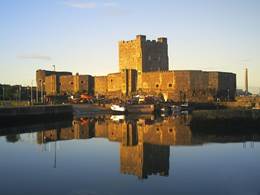
As a boy of 6 or 8, I remember Sunday afternoon family walks. Down past the railway station and on through the large iron gates into the town park. A park for Sunday walking and not a lot else as ball games were “prohibited” and the swings were padlocked on Saturday nights in fear that any child should dare enjoy the Sabbath! The walk through the park would take me to more large iron gates exiting to the waterfront. On the horizon, some sailboats and large freight tankers made their their way to and fro the city of Belfast some 10 nautical miles due south. On a clear day, one could believe that you could see the southwest tip of Scotland to your left and to your right the tall yellow crane known affectionately throughout Northern Ireland as “Goliath” towering over the distant city landscape, bearing testimony to the shipbuilding of Belfast. Years earlier, of course, the air of the shipyard was filled by the muscle and music of wood and metal giving birth to the Titanic. As that ship was barely wet, just minutes from Belfast on its way to the Irish Sea, those on board looking to the port side enjoyed the majestic site of my place of birth Carrickfergus, with its deep harbor and towering Norman Castle — a castle in as good a shape today as it was when it first had overnight guests some 900 years earlier.
As we walked closer to the castle and harbor, my parent’s grip on my hands became tighter! As close as I could get to the harbor edge was the goal. It was over the edge where all the music was. Some 10 feet below, if the tide was out, one could find folks busy on their boats. Sweeping and sorting, fiddling and fixing, preparing and planning for a sail, but still firmly tied to land. Sunday by Sunday I would hear the same music, see the same folks, see the same boats, which never looked like they had been anywhere since last week! My walk continued, this time past St. Nicholas Church, which seemed as old as the castle. If we were good for time, we would walk through the graveyard and dare to try to peep in through the long narrow window of the church, the only one not composed of stained glass. This particular window had an amazing story. The window was so angled that looking through from the outside, one had a view of the The Lord’s Table. The window was known as The Lepers’ Window, through which the sacrament of Holy Communion was passed to those of the town’s leper colony who gathered outside. In its own beautiful way, this window was both a harbor and a horizon. A harbor of grace and mercy and a horizon of hope of holiness, as bread and wine were passed through.
Carrickfergus with its tall castle and deep harbor was also a place that, in the 1970s, offered those fleeing the violence and terrorism of Belfast a safe place to rest a while, a harbor of peace from the war of bigotry raging just miles and minutes away.
As a teenager I sat upstairs in church close to the windows, which offered a good view outside toward that lepers’ window of the neighboring church and beyond to castle and harbor and to the park where, it being Sunday, the swings would be padlocked so no innocent child could scrape a knee or stir the wrath of God. My window view also offered glimpses of elders on duty, whose task was to keep vigil on the outside, so while, we on the inside prayed, we would not become prey to a random car or fire bomb. My window was so very different from that window of grace and hope of harbor and horizon of centuries earlier.
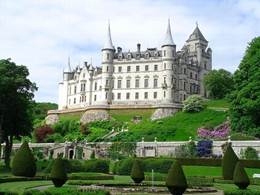
As teenage years gave way to adult life, my journey continued to be marked by places of harbors and castles. To university, to castle and cathedral of Durham, then on to New College Edinburgh University in the shadow of Edinburgh Castle. The gates of my childhood park were now replaced by the gates of New College. High on The Mound in Edinburgh, these gates offered a harbor of learning in the Reformed faith, and as I exited each day through those gates I passed the tall statue, not of Goliath, but of John Knox with his arm outstretched to the world beyond. This view through the gates offered a breathtaking look across the cityscape, the Firth of Forth and the wide horizon beyond. From there I exited to serve a highland parish in Sutherland on the east coast in the shadow of Dunrobin Castle and then a parish on the west coast, in Troon, with its harbor and horizon.
In 1995, I left harbor to venture forth to fresh horizons on the edge of the Kansas prairie. Yes, this journey could not have been any more different from those who years earlier had crossed by ship and became homesteaders, tilling the baked soil of summer and wrestling the frozen soil of winter. Replaced was the “red sky at night a shepherds delight and a red sky in the morning a sailors warning” with a sky lighting up with the fireworks of a thunder and lightning storm. Torrential rain was now replaced with tornados, castles were now replaced with storm shelters, fields of sheep were replaced by waves of wheat.
You and I share this harbor of Reformed faith. A harbor at its best provides a place of rest and replenishment of the soul. In this harbor of faith, we find God’s mercy and grace in abundance, and hear God’s gentle whisper — even, at times, a loud and disturbing voice in the night, moving men and women to venture out in faith. Sarah and Abraham, Ruth and Naomi, Samuel and David, Mary and Joseph, Peter and Paul, St. Joan and St. Teresa, John Knox and John Calvin, Bonhoeffer and Barth, the child with loaves and fish and the folks lowering a friend down through the roof — all these lives and more speak of faithfulness and following. Their faith shaped by harbors and horizons.
After nearly 25 years in the PC(USA) I served as a commissioner to this summer’s General Assembly. It is significant to me in many ways, and deep in the harbor of my soul it represented a horizon of continual service to God and to the church. As we gathered in St. Louis, we were grateful for the past and for the shaping of those ancient creeds, themselves harbors and castles of our faith. However, we also gathered to find a window through which grace and mercy can reach in and touch our souls and hope and holiness can reach out and touch the world.
The church is often likened to a ship. Ships were not built to clutter up harbors, but to venture out toward the horizon with purpose and possibility, with mission and meaning.
I am grateful for those who have helped shape my soul as I continue the never-ending act of following. I am thankful that my “inscape” has been touched by the landscape of harbors and horizons, which have shaped my sense of who I am and where I am going. My challenge is that in the midst of harbors and horizons I can become a window through which grace and holiness touch me and I in turn with goodness and hope touch the world.
 Edward J. Thompson is a church consultant with the Board of Pensions. He lives in Kansas City, Missouri.