This week we asked our bloggers what younger pastors are thinking about and what they think the rising generation of Presbyterian leaders sees different than previous generations. Here are their answers.
When asked what younger leaders are thinking about, one phrase comes to mind immediately: bivocational ministry.
As a recently ordained pastor, I know it is on my mind and is often a topic I discuss with other young pastors. There is no way seminary could ever prepare a person for all the things that come to our attention or get added to our do lists. I am positive most pastors have a story about a plumbing problem and very few have taken a class on plumbing repair. As I have transitioned from seminary to ministry out in the world, I have come to understand that seminary prepared me to serve two churches. The first is the church that existed in the booming days of church life with full budgets, countless volunteers and thriving committees doing all sorts of ministry. The second is the church that is coming into being as culture and church life shifts. I was well prepared for innovative change and dreaming toward the future with groundbreaking ministry. What I was not prepared for was to be serving neither of these churches. I serve the church in transition. I do not mean the particular congregation where I serve, I mean the larger connectional church of the Presbyterian Church (U.S.A.). From local congregations to our General Assembly, we are a church in transition — or perhaps more appropriately, we are a church in the midst of continued reform.
There are days when I sit on the edge of my seat, eager to see who we will be as a church in the future. And there are days when I am terrified because all that newness is unnerving. One thing stands out as I dream about the future: The way we do ministry is changing, what it means to be the church is shifting and with that budgets are tightening. I imagine a future with fewer buildings and more hands-on ministry serving alongside our neighbors. I imagine communities of people living life together, worshipping together and serving together. I see worship that is more participatory. I see all ages gathering around the table together, but the table might be a picnic blanket. I see reflections of the early church that met in people’s homes. I envision people living their faith with new depth.
Yet the reality with all this grand visioning is that it would take a change in how we handle church finances. Many congregations are already in a position where it is a struggle to support a full-time pastor. The new communities and vision for ministry I describe would also have difficulty supporting a full-time pastor. So, I ask myself often, what else can I do to support my family? I do not ask this from a place of panic; I ask it as part of my ever-unfolding call to serve the people of God. I know I am not alone in this wondering. I have fellow sojourners dreaming and questioning alongside me.
In years past, the expectation was that one would graduate seminary and enter into a 30+ year full-time ministry with congregations. It seems to me that this can no longer be the expectation as we enter into the life of ministry. That is not to say it won’t happen, but the norm is changing. I recently attended the Board of Pension’s CREDO conference for newly ordained ministers. When I returned home, I was chatting with a friend about the conference and that we had addressed the reality that pastors are burning out as fast as five years (or sooner!) into ordained ministry. My friend asked: “What has changed? Pastors used to stay 20 years with one church.” I have spent a considerable amount of time considering that question.
What has changed? The role of the church in our culture has certainly changed, but there is more than that. Twenty years ago a pastor could potentially stay with a congregation for a decade or more. She would work with healthy sustainable budgets. She would have people volunteering to serve on committees to do the work of being the church. People made church events a priority. The landscape of the church is different these days, budgets aren’t as robust as they once were, some pastors could get people to sign up for a root canal faster than they can get folks to volunteer on a committee or ministry team, congregations are aging and there are countless organizations competing for what little free time exists in a person’s life. Pastors have gone from being the conductor of the symphony to conducting, playing the piccolo and being the percussion section all while knowing we really need new drums to make the symphony sound just right. It can be exhausting! This is not to blame church members — the folks who are showing up are beautiful, faithful people who are working hard to do the work of the church! If you pay attention, in any given congregation you can look around and see Jesus working through the people who show up. Yet, those folks get tired too, and the cycle continues.
Pastors are one of the largest expenses (if not the largest) in church budgets and pastors do need to be compensated fairly. As a pastor, I want to see the community of believers I walk with thrive! I also know that at some point in my ministry, I may have to let go of full-time pastoral work so that whatever community I walk with at that time can thrive. One of the ways we can cultivate thriving worshipping communities is to allow people to take ownership of the work, hand over our piccolos and cultivate the other gifts God has given us.
As I dream about the future of the church, I am hopeful that even if I am conducting fewer songs, the music they produce will be the extraordinarily beautiful product of community and have profound depth that inspires us all to love and serve one another.
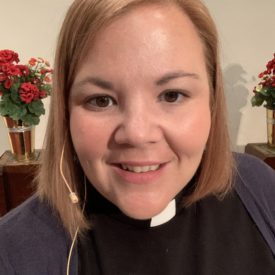
 REBECCA GRESHAM-KESNER is pastor at Faith Presbyterian Church in Medford, New Jersey. Outside of church and family life, you can find her in nature, finding fun ways to be creative or asking awkwardly deep questions of people she just met.