Guest commentary by Will Berger
I’ve spent the better part of my 25 years in Nashville being a preacher/musician and a musician/preacher. It’s not as easy as you might think.
I remember spending an afternoon with a well-known Presbyterian musician and composer. He’d played for the wedding of a friend and I was giving him a ride back to the airport. At that time I was being a preacher who happened to be a musician. It was some decades ago and Presbyterians were just getting the hang of things liturgical (some still are). He exclaimed of the pastor with whom he worked and how they were now following the liturgical year, which allowed him to plan — for the year. I hinted that I might not be able simply to stay with the liturgical year in my preaching, to which he quickly asked, “Well, why can’t you?”
Well, why can’t I? The relationship between preacher/pastors and musicians/worship leaders is an essential one. In smaller churches, such as those in which I’ve served, often the preacher/pastor and the musician/worship leader are the two professionals in the congregation, deeply involved in and committed to the worship life of the congregation.
It’s essential that there be respect and regard between the two. There are church rules which state the lines of authority, and I guess that’s fine, but it solves little. Most of us want it to be a good and thoughtful working relationship. Having been a member of a presbytery as well as a past member of our local chapter of the American Guild of Organists, I can attest that is not always the case. I hear musicians frustrated with pastors, and pastors frustrated with musicians. For me, being both, the apostle’s words in Romans 7 come to mind: “I do not understand my own actions. … Who will rescue me?”
Proof texting aside, I suggest that we as pastors want to have a good working relationship with our musician/worship leaders. Holding off Christmas carols until “after Christmas” is frustrating to many a person in the pew, and sometimes in the pulpit. The promise of Emmanuel, God with us, is an essential part of their daily living. Yet, singing them “too early” is unsettling to those waiting in Advent, working with people for whom the saving presence of God seems hardly with us. They’re not ready for “Jesus Christ is Come Today,” when working in homeless shelters, or among stranded immigrants, or in the midst of the cold harsh poverty that still inexplicably exists in today’s world and in our nation.
So, I’ll offer my humble connection of the two through our music. Our hymnal in the Presbyterian Church (U.S.A.), “Glory to God,” has many wonderful Advent hymns. That’s an improvement from the hymnal I loved throughout my childhood from 1955 (published a year before I was born), which contained eight Advent hymns, half of which are singable. Our “Glory to God” hymnal has 25, many of which are singable (in part thanks to Stephen Colbert singing “Lift Up the Gates Eternal,” which actually is not in the Advent section of the hymnal, but it’s fun!).
I offer some stanzas of Christmas carols with Advent themes that can be sung during Advent — perhaps without a crisis of disassociation for those who feel the season every bit as much as those who hum along with the Christmas songs in the mall well before Christmas. We want our hymns to connect, and so we need to connect with each other to find how they can connect with us.
I will also gently suggest that choosing stanzas from hymns is legitimate. Often hymns contain many stanzas chosen by gifted and dedicated hymnbook committees, so that, might I suggest, we are not obligated in the freedom of the incarnate Christ, to sing every single one of them. We Presbyterians have already made our redactions from the hymns. Other traditions, more liturgical, might still feel the need to keep and sing every. single. one. of. them.
But, for us, I offer these selected Christmas hymn stanzas/verses that can be sung even in Advent. I only choose from our Presbyterian hymnal, “Glory to God,” but I’m guessing the hymns are familiar enough to be appreciated by the larger fellowship of churches.
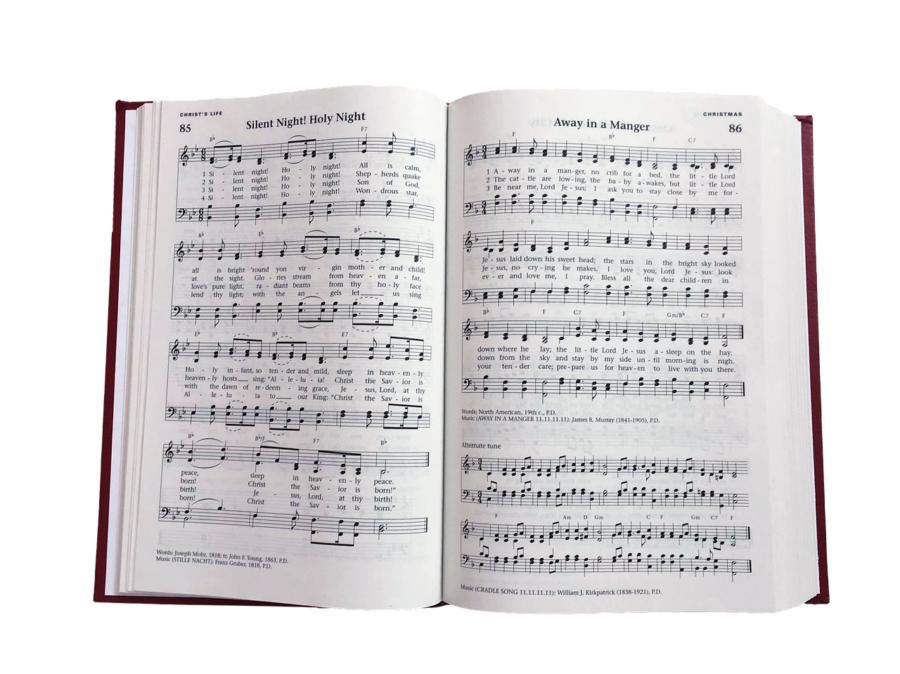
#114 “Away in a Manger” Really? Yes. See verse 3, especially the prayer to our risen Lord, “And fit us for heaven to live with thee there.”
#119 “Hark the Herald Angels Sing” Verse 3 reads: “Light and life to all he brings, risen with healing in his wings. … Born to raise us from the earth.”
#121 “O Little Town of Bethlehem” This hymn contains many echoes of the Gospel of John, which takes the future and makes it present. Consider verse 4: “O holy child of Bethlehem descend to us we pray, cast out our sin and enter in, be born in us today. … O come to us, abide with us, our Lord Emmanuel.”
#123 “It Came Upon the Midnight Clear” Verse 5 reminds us: “For lo, the days are hastening on, by prophets seen of old, when with the evercircling years shall come the time foretold, when peace shall over all the earth its ancient splendors fling, and the whole world give back the song which now the angels sing.
#132 “Good Christian Friends” Verse 3 proclaims, “Now ye need not fear the grave. … Calls you one and calls you all to gain the everlasting hall: Christ was born to save.”
#134 “Joy to the World” In fact, Psalm 72, upon which Isaac Watt’s hymn is based, is used as an Advent lectionary psalm. So, this one could be used in its entirety (and doesn’t even mention Jesus, despite Watts’ Christological interpretation of the psalms). But go to stanza 4, “He rules the world with truth and grace, and makes the nations prove the glories of his righteousness.”
#140 “Once in Royal David’s City” Verse 4 says, “And our eyes at least shall see him, through his own redeeming love, for that child so dear and gentle is our Lord in heaven above; and he leads his children on to the place where he is gone.”
#147 “The First Nowell” The last stanza declares, “Then let us all with one accord sing praises to our heavenly Lord, that hath made heaven and earth of nought, and with his blood our life hath bought,”
#150 “Born in the Night” This hymn has become familiar to many. It is placed in the section under Jesus’ life and ministry in our hymnal, and ends in verse 4 with, “Hope of the world, Mary’s child, you’re coming soon to reign.”
To quote the popular Christmas song (or is it an Advent song?), “We need a little Christmas” — not just at Christmas or after Christmas, but maybe all year long. How often do we hear it plaintively and tritely asked, “Why can’t every day be like Christmas Day?” Well, it can’t. So, maybe we need a little Advent, too, a little waiting, a little realizing that though “the days are hastening on” we still sometimes live “beneath life’s crushing load.” I’d like to keep the two together. I’d like to keep pastors and musicians together. So, merry Christmas, or joyful Advent, or, just happy holidays, but that’s another discussion for another day.
 William (Will) H. Berger is minister of music at Trinity Presbyterian Church in Nashville.