
We are living in a time of constant transition in the church.
I see this at the denominational level and the local level. For better or worse, we are having to reimagine what it means to be the church. Yet even Calvin nodded to a church that would be forever reforming. There is something about church that is forever in motion: always growing, stretching, changing. It was never meant to be stationary. All this sounds lovely doesn’t it?
However, when we are living in this fluidity, there are huge challenges. Growing pains are real and we are so often forced to face these challenges without our consent. We rarely say, “OK — let’s move the church into this challenging time so we can bear new fruit.” Transition comes at us most often with an element of surprise.
Surprise! You need all new plumbing.
Surprise! Your long-time pastor is retiring.
Surprise! You must make steeper budget cuts than you anticipated.
On rare occasions, we are prepared for these surprises or we have cast a healthy vision that allows us to adapt to an ever-changing world. When suddenly a church finds it self waist-deep in transition, it can be incredibly hard to lead.
I am currently leading through a time of transition and it is difficult. Emotions run high as we are asked to evolve into our ever-unfolding call as the Body of Christ. We all bring different experiences to the table, especially in our church leadership. The ways we are able to adapt, cope and respond vary with our experience. What has worked for us outside of church doesn’t always work inside the church. It means we are stretched until we feel like we might just break. We are already a broken people and we know that in the deepest places of our hearts, we desire God’s grace. When broken people (aka “humans”) are stretched so far it hurts, it can be hard to remember we are the church. I’ve found transition comes with a boatload of grief for us to endure and work through. Yet, we all grieve differently.
I do not need to point out that when a church is grieving and everyone comes to the table it can be intense. It is the one thing I have learned leading a congregation in transition (and in a denomination in transition). We have to make room for the all the emotions and skillfully coax them out into the open. We must name that we are grieving, tired, frustrated, angry, sad, despondent. Whatever it is, we have to own it, name it, acknowledge it.
If you have ever been deep in grief, you know that hope is hard to cling to — even as a person of faith. In leading through transition, I try to remember that everyone is grieving or hurting. What I see may not be a person’s best during these times. I am called to walk with my fellow leaders and, at the very least, try to help them name the complex feelings underneath all we experience.
Most recently I have made space to grieve in our regular time of worship. I have named some of the feelings we are experiencing, included a tangible letting-go exercise. I’m working hard to sow seeds of hope. If I can be brave enough to name it, perhaps people will come along with me and we can spend sometime in grief together and then let go so new fruit can spring forth!
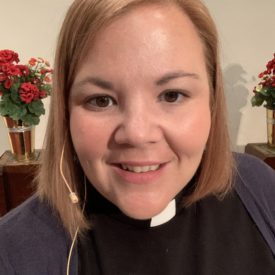
 REBECCA GRESHAM-KESNER is pastor at Faith Presbyterian Church in Medford, New Jersey. Outside of church and family life, you can find her in nature, finding fun ways to be creative or asking awkwardly deep questions of people she just met.