In preparing for Advent, a colleague shared a quote from theologian Thomas Merton that was included in a collection of devotionals, “A Year with Thomas Merton.”
“It is beautiful Advent weather, greyish and cold, with clouds of light snow howling across the valley, and I see it is really winter. I put some bread out for the birds. I feel closer to my beginning than ever, and perhaps I am near my end. The Advent hymns sound as they first did, as if they were the nearest things to me that ever were, as if they had been decisive in shaping my heart and my life, as if I had received their form, as if there could never be any other melodies so deeply con-natural to me. They are myself, words and melody and everything.”
I agree with Merton. There are some songs that we learn so early and know so deeply that they seem to be a part of us. I sang these songs at school to learn the alphabet and about the process of a bill becoming law. At home and church, I learned songs that taught me the stories of faithful people of God, and what it means to be claimed and loved by God. So many of the songs in that latter category are even closer to me than I realized as a child because they are traditional Negro spirituals, born of the experiences of my ancestors.
Many of these songs were handed down to me from my family and church leaders. W.E.B. Du Bois described the same inheritance of musical heirlooms, particularly spirituals, as Merton in his work, “The Souls of Black Folk,” writing: “The child sang it to his children and they to their children’s children, and so two hundred years it has travelled down to us and we sing it to our children, knowing as little as our fathers what its words may mean, but knowing well the meaning of its music.”
Now in my work I pass them on. Most often that means playing, singing and leading music of the African American sacred tradition in worship services with people of all ages. But it also means singing them with young children in children’s choir. The faces I share this history with are not brown like mine and don’t share the same lineage of struggle and oppression, but they are loved and claimed by God, just like me.
Such was the case one Wednesday evening.
 It was one of those weeks when the plan made weeks ahead needed to be altered. Because of the greyish and cold weather, several of the children were battling colds and wouldn’t be coming to that evening’s rehearsal. My original plan wouldn’t work with only a few children. After years in church work I have learned to always have a plan B, especially when children are involved. So I sprang into action.
It was February, Black History Month, and I had recently acquired a book I wanted to share with my little ones about a song that was an important part of my life and the history of the civil rights movement, “We Shall Overcome.” I grabbed the book and readied myself for our time of singing and exploration through art and games.
I look forward to the time I spend each week with children primarily ages 3 to 5. My favorite part of working with them (actually when I’m working with any group regardless of age) is the look in their eyes when a lightbulb clicks on or wheels of thought begin to turn. With this group, that often happens in the most surprising ways and at the least expected times.
There is one 6-year-old in the mix and, depending on the activity, she can be completely engaged and a great helper, or because the activity is geared to younger minds, she chooses to entertain herself other ways. I fully expected that the second option would be the case with tonight’s plan B.
As the children gathered sitting crisscross applesauce around me in my rocking chair, we began with our familiar song, “Jesus Loves Me.” I asked the children where they had first learned that song and all of them responded that their grandmothers had sung it to them at home and in the car. I shared that I too had a grandmother who sang with me at church and home and in the car, and that I wanted to read them a story and sing a song that she taught me when I was around their age. After we wondered a bit and asked several questions about what I was like at that age, I began to sing.
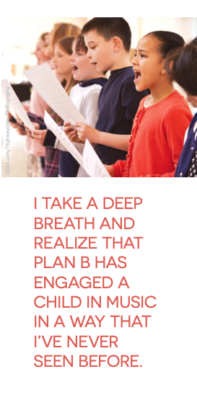 The song wasn’t totally unfamiliar to the kids. I know that they have had the chance to hear it in worship from time to time. My most musical 5-year-old catches on very quickly, and when he likes something he sings in a big booming voice. Sometimes when we are learning a song, I can hear him imitating mannerisms of my own singing. He closes his eyes and sings with a deep, rich sound full of vibrato that’s far beyond his years. It’s the sound in my own voice given to me by old black men who were generations closer to this song. I don’t realize the voices of the old black men are there until I hear it echoing back to me from the child who is simultaneously singing and untying my shoes.
After singing the first verse several times, I pick up my book and read. The book does a fantastic job of tracing the history of this iconic song that was created by a group of people fighting for equality in a manner that is reminiscent of their ancestors. During a protest in the 1940s, a group of factory workers in Charleston, South Carolina, took the refrain of a traditional spiritual, “I’ll Be Alright,” combined it with the text of a familiar hymn composed by Charles Albert Tindley, “I’ll Overcome Someday,” and blended them together to become what we know today as “We Shall Overcome.”
As I read, I’m aware that everyone is still and focused — especially that 6-year-old. About halfway through the book, among the beautiful illustrations on each page of people singing, we see a picture of a group of African Americans with a white person playing a banjo and singing along. She interrupts me.
“That’s Martin Luther Jr.!” She’s right, in her own way. Right there in the corner of the page is Martin Luther King Jr. I must admit that I noticed that the illustrations were well done and beautiful, but I hadn’t paid much attention to them. She tells me she learned about him at school. After she tells the younger children who he was, with a few additions from me to help fill in some bits of the brief explanation, I lift the book to continue. She interrupts again.
 “Why isn’t he singing?” Right again, and this one is a challenge. She has correctly noticed that this is the first page where a person isn’t illustrated as singing. I don’t have an answer, so we wonder about it together as a group. “Maybe he has a cold.” “Maybe he doesn’t like to sing.” I offer the response that maybe he is so moved by everyone else singing that he’s too emotional to sing. They collectively decide that having a cold is probably more accurate. I take a deep breath and realize that plan B has engaged a child in music in a way that I’ve never seen before. I fight back tears, lift the book and began to read. This part of the text is just the lyrics of the song so I sing them. She interrupts again.
“Mr. Phillip, can that man with white skin sing this song?” WHOA! After the last nine pages of this book talking about the struggle of African Americans for equality and the song that has led them through, what does this image of a white man singing it mean? Is that right? Is he allowed?
This question literally takes my breath away. I look at my faithful volunteer helper and our eyes lock with the same astonishment that this child has named so clearly one of the biggest obstacles in including the music of African Americans in the larger body of sacred music and hymnody!
I am often asked profound questions informed by history and the will to do better than those that came before us about cultural appropriation and sensitivity on the part of descendants of oppressors. But the question ultimately has the same heart and earnestness as my precocious 6-year-old: Can people with white skin sing that song? The simple answer is yes.
Reimagine your childhood without the following songs: “Kum-ba Yah,” “Who Built the Ark?” “I’ve Got Peace Like a River” and “We Are Climbing Jacob’s Ladder.” Imagine your worship services without “Let Us Break Bread Together” or “Were You There?” All of them are traditional Negro spirituals and an important part of Christian hymnody.
These songs are an important part of the Christian life and our faith formation. We teach them to our children because they impart something about the mysteries of our faith that seems to be only captured in the act of singing. When we teach our children to sing spirituals and songs crafted out of the groans and laments of enslaved Africans, we relive their testimony and move ourselves to appropriate acts of repentance and repair. Singing such songs becomes a lifelong practice in our worship and as we gather around table and font and sing “Let Us Break Bread Together” or “Wade in the Water,” we remember and wonder.
We wonder how the oppressed can know and sing about peace.
We wonder how much faith is necessary to believe that God will trouble waters for the miracle of safe passage.
We wonder what it will be like when we feast together at the table with our faces turned to the rising sun.
When we sing spirituals and find the echoes of those who first sang them, we are formed even as adults. Such an experience happened for me at the Just Worship conference at Austin Seminary this past October. I have been trying to explain the experience since then and am continually left only with wonder.
As the piano began to play strains of “Take Me to the Water,” an old spiritual that is in my bones, Kim Long made her way down the narrow chapel aisle to the baptismal font where she submerged sprigs of rosemary into water. Then we started to sing. The singing was tame at first, but gradually the singing soared. It rang out from one voice in particular.
Directly behind me, a young African American woman sang boldly. She sang like those who I had first heard sing the song years ago. The people who first taught me about the Christian life. Those who sang it at my baptism.
As we stood, I felt my body begin to sway. My grandmother used to sway as she held me in her lap and sang. Remembering her and almost feeling her arms around me, I felt my voice begin to break as memories flooded my heart of saints past glorifying God for the gift of baptism.
As the aromatic water hit me and I heard Tony McNeil prompt us to sing “I love Jesus,” I began to feel not only the water from the font but the water of tears streaming down my face as I wept. I heard Paul Roberts softly whisper “Yes!” behind me. It was that same spiritual response I often heard in my childhood when we sang these words and rejoiced at the promises of the sacrament. In that whisper I felt God’s claim on my life.
I was overcome. The voice behind me became prominent again. She had begun to accompany the congregation’s vibrations by clapping her hands, a practice that recalls the drumming my ancestors brought to this land from another continent. I could feel our bodies swaying together, our voices bending in the same direction at the same time, adding variances to the tune that a printed page in a hymnal will never quite be able to capture. We were living a tradition handed down to us accompanied by handmade artifacts and approximated recipes.
I wondered if the voice behind me had a grandmother like mine who wept and praised God for every baptism she witnessed.
I wondered if she too had known old men of faith (known as deacons) who had led singing, and in doing so taught us about living a life devoted to Christ.
I wonder if she too felt the undeniable presence of the unknown slaves in bondage who had sung that song into being at such a moment. Unknown slaves who had gathered with the same Spirit who was with us now, trusting in the same truth and covenant promises of our baptism. Unknown and often uncredited composers of songs who have accompanied us all of our lives.
I wonder if the people with white skin around me in that small chapel were being molded and shaped by that Spirit as they sang the song of my ancestors.
I wonder if the song was forming them for lives of Christian service and discipleship. Was this song changing who they were? Was it becoming a part of them too? Words and melody and everything? I wonder.
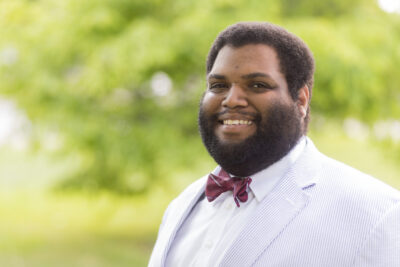
Phillip Morgan is the director of music at Central Presbyterian Church in Louisville, Kentucky. He is the southeastern representative for the board of directors of the Presbyterian Association of Musicians.