In the early 1990s a savage war broke out in the streets of Serbia. Fear and anxiety spread like a virus. Schools shut down. Churches ceased worshipping. People lost their jobs and children lost their innocence. Food was scarce. One day in the city of Sarajevo, a crowd of people swelled around a local bakery that had remained open to fill the empty stomachs of its neighborhood. Just as a long line formed, a military mortal shell was launched, killing 22 innocent people and leaving a small crater where the bakery once stood. The suffering was inestimable.
Just down the street lived Vedran Smajlovic. Vedran was the principal cellist of the Sarajevo opera. He had heard the mortar strike. Buried in the ground were his brothers, sisters, neighbors and friends. He felt helpless. Vedran was not a soldier; he could not join the fight. Vedran was not a politician; he could not craft a policy to move his beloved country toward peace.
But Vedran was a cellist. A few days after the bakery bombing, Vedran put on his best suit, brought out his favorite cello and began to play in the crater that marked where his neighbors once stood. For 22 days he went back and played, one day for each life lost.
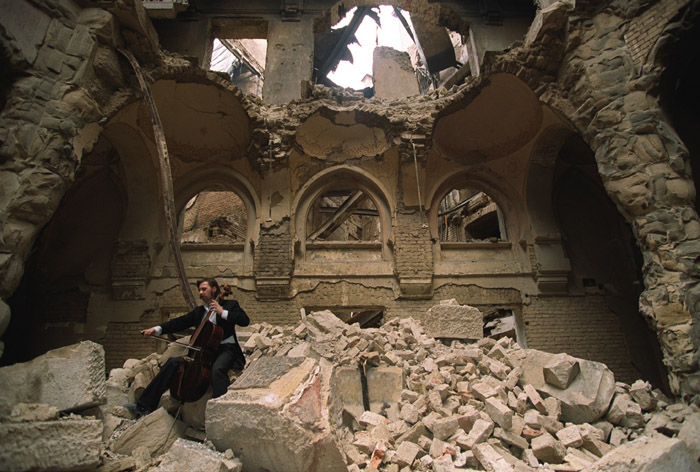
For months after, where there was death, Vedran and his cello would not be far behind. He played at funerals, at graveyards. He played in the unclean places, the forbidden alleyways, the street corners caked in dust and ash. Vedran and his cello were a symphony of stubborn hope amidst a chorus of collective grief and despair.
The enemy we are currently fighting is more quiet than Bosnian bombs. The enemy is in the air we require to breathe. The enemy is on the hands of our loved ones, our neighbors. Everywhere there is wreckage. Everywhere there is rubble. There are a million crater-sized losses calling out to be named: loss of lives, loss of jobs, loss of security, loss of normalcy, loss of being together, loss of traveling to the beautiful places we have in this world, loss of community, loss of control. I wonder what you have lost?
As I survey the wreckage in my own life, I find myself not only lost for words, but lost for actions. What am I to do? Who am I to be? What does it mean to be human in the age of pandemic? I don’t know the answers to the new questions we are now living. And if I am honest, I am afraid.
So often the question we raise in these kinds of times is “why?” Why, God! Why have you forsaken us? Why have you left us alone? Why has this happened to our world? But today as I join the chorus of “why” I also ponder the question of “where?” Where are you, O Lord? Do you stay far away? Has this world returned to the void from which you first formed it? Have you quarantined yourself off from us?
Right now, we are looking to many people to answer our questions. We are looking to politicians to enact policies to slow the spread. We are looking to epidemiologists to explain the reality of this invisible plague. As I ponder what role I have to play in this, I understand Vedran’s frustration. I am not a politician. I am not a scientist. I am not a soldier. But I am a pastor. I am a human being. I am made in the mystifying image of a steadfast-loving God. And because I am those things, I am able cling to a story about the dynamic God of Moses who exists in the world of active verbs. From within the bush that will not cease its burning, God tells Moses, “I hear, I see, I know, and I am coming down” (Exodus 2). Lovers of the Hebrew tongue will tell you that the word know in Hebrew holds within it a world of meaning. God does not know Israel’s suffering merely intellectually, God knows it within God’s very self. To know something or someone biblically is to know them experientially and bodily. That is why the ultimate knowing in the Bible is how lovers know one another in bed. God’s knowledge of our predicament is that intimate, that immanent.
So in this time of harrowing pestilence, in the throes of this inestimable quake, ours is a God who knows, experientially and bodily, the fear and anxiety you feel. I wonder if you’ve met this God before? Today, I see God in Vedran. Today, my God plays the cello. While I do not know why this virus is spreading, I do trust that God knows the pain it takes to ask that question. I do not know why, but I do know where my God is. I know that Jesus is dressed up in his best suit, playing his cello in the midst of our million crater-sized losses, playing in the hospital rooms of the sick, on the street corners of the poor, in the lonely houses of the rich, in the confused minds of the young, in the empty sanctuaries of the church and in the tired heart of this pastor. Christ is playing, so softly that I can barely hear it. Christ is playing: “I love you. I am with you. I will never leave you nor forsake you. I know how this feels. I know you.”
 JOSHUA MUSSER GRITTER co-pastors First Presbyterian Church in Salisbury, North Carolina, with his wife Lara. They watch movies together with their dog Red.