I heard on my favorite movie podcast that Brad Pitt does “three films for us and one for him.” I think about preaching much the same way. The ratio may not be the same, maybe it’s “five for them and one for me.” It’s one surefire way to keep preaching fresh— preaching those wonderful stories that got you into this wild world of ministry in the first place.
Recently, I did one for me. It’s always been my favorite text — Exodus 3, the calling of Moses and the burning bush. I joked with my wife and co-pastor, Lara, that I’d love to do a sermon series where I preach a sermon on each verse of that chapter of the Bible. It’s just plain rife with insight. There’s Moses’ identity crisis. Born a Hebrew amidst Pharaoh’s demonic infanticide, reared by his slave-mother, becoming an adult in Egypt’s throne-room. Twist of all twists, Moses then becomes an ex-murderer vigilante. When we meet Moses in his adult life, he’s taken up the great cliché biblical pastime: shepherding.
As I delighted in the text in preparation to preach, something caught my eye that I had not noticed before. The text says Moses was “beyond the wilderness.” Knowing the biblical writers aren’t in the business of wasting ink, I wondered, where exactly is this place? In the wilderness within the wilderness, the nothingness within the nothing, in a galaxy far, far away, Moses stumbles upon a flaming bush that won’t extinguish. Jewish readers find a world of meaning in the next verse: “And when Moses turned aside to see the sight, he saw that bush did not burn up.” Notice the repetition of the verb “to see.” The rabbis say this is a text first and foremost about sight, about paying attention. If Moses had not paid attention and turned aside to see the bush, then what would have become of the enslaved people of Israel? It’s an arresting question. Liberation’s antecedent is paying attention, is seeing.
When Moses sees the sight, a voice from the bush tells him to take off his sandals, “for the place you are standing is holy ground.” Having visited the Sinai wilderness, I can tell you that there is no commemorative plaque denoting the sacredness of this place. This may seem like an odd observation, but has not holiness come to be defined by specific place and space in our imagination? Ancient religions (like that of the Egyptians) erected stone monoliths, pyramids reaching to the stars that symbolized the sacred of that particular plot of land—Pharaoh’s burial place. Within the modern world we have come to believe in the sacredness of our church sanctuaries. If we didn’t know we believed those spaces were holy ground before the pandemic, our time apart has reminded us of our attachment to space and place. And this is a good thing. The incarnation means space and place matter. Matter matters.
The slippery slope of our localizing of the sacred is found in how it causes us to quickly compartmentalize and dichotomize the sacred and the secular. Church = sacred, culture = secular, Christian = righteous, non-Christian = unrighteous, etc. But Moses’ meeting with God beyond the wilderness decentralizes and deinstitutionalizes the sacred. Burning bushes, it turns out, are everywhere, if one only has the eyes to see them.
It doesn’t take much cultural criticism to notice that our world is currently living in the liminal space beyond the wilderness. The whole world burns, and the flames are far from letting up. Our sacred spaces once filled with children and families, with communion and baptisms, are empty. Are we to believe that Zoom is holy? Has the sacred been absorbed by the secular? It’s made me wonder if one of the chief pastoral questions facing us right now is: What do our people need when their world is ceaselessly burning?
Our outdoor weekly vespers service has been an answer. As decentering as the pandemic has been, one upshot has been that it has pushed and pressed us to consider the sacred in new expressions. Maybe right now people don’t need a technologically savvy and visually cool and brilliant church service. Maybe, more than anything, what our people need (and what I need) is to sit in the presence of the one who is present in all things. Maybe our people need a pause, a rapturous quiet, that causes them to see themselves and the world more clearly. It was, after all, out of silence that God created the world. Our service is simple. No call and response. No singing — just the notes of local musicians, the sounds of Scripture’s hope, the echo of poetic phrases and the resting pulse of stillness. (Below, you will find our first week’s bulletin as well as our safety procedures. You’re free to use them it if they’re helpful.)
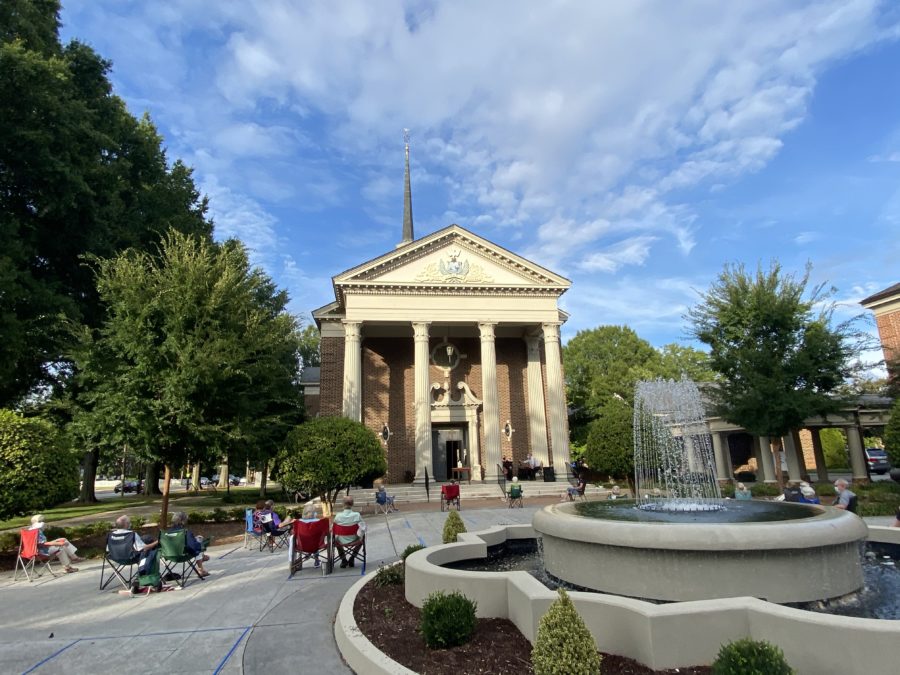
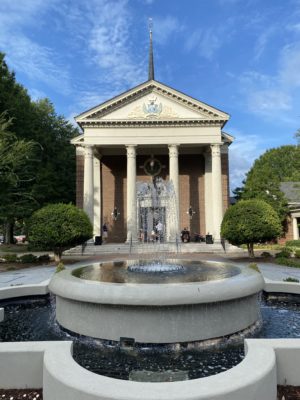
Last Wednesday we had our first Vespers service — it was the first time our congregation gathered physically since March. Let me tell you what I saw. I saw burning bushes all over the church courtyard. I saw the sun alighting on the Latin phrase at the top of our sanctuary entrance, Lucet et tenebris — “the light shines in the darkness.” I saw tears in the eyes of my beloved church members who got to look at one another for the first time in six months. I saw a sacred stillness sweep over our courtyard as we sat in silence together. I saw the power of music as the cello and piano sang sweet tones of hope. I saw how chaotic my interior life has been, how beyond the wilderness I have been feeling and yet how holiness is at my fingertips. I was moved to tears. I saw how sacred is every moment, how holy is every breath, how aflame is the world with the burning fire of God. I saw the sacred.
Download the vespers safety guidelines: Vespers safety
Download the vespers worship bulletin: Vespers bulletin
 JOSHUA MUSSER GRITTER co-pastors First Presbyterian Church in Salisbury, North Carolina, with his wife Lara. They watch movies together with their dog Red.