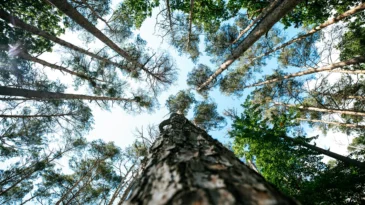
Terrence Malick’s 2011 film “The Tree of Life” begins with a quote from God talking to Job in a whirlwind: “Where were you when I laid the foundation of the earth? … When the morning stars sang together and all the heavenly beings shouted for joy?” (Job 38:4-7).
“The Tree of Life” is not only a deeply theological film, it is a deeply liturgical one. Watching it feels like a meditation, an act of wonder and worship. In a time where most self-proclaimed “Christian” movies are disappointingly shallow and usually amount to the message of “pray more and things will get better,” “The Tree of Life” takes a bold look at the immensity, complexity, and mystery of the cosmos through an existential perspective that focuses more on asking questions than presenting solutions.
Its characters walk through the joys and pains of living instead of finding shortcuts around the complex parts of what it means to live, because there is no shortcut in our spiritual journey toward God. Sometimes we take the long way around to get to where we need to be. Sometimes we realize we already are where we need to be. Through it all, we find that our questioning of why things happen is ultimately never fully answered or explained.
“The Tree of Life” tells a cosmic story (the birth of the universe, the beginning and evolution of life, and the eventual death of our planet through the expansion of the sun) alongside a more intimate picture of the O’Briens, a family living in the suburbs of Waco, Texas, devastated by the death of one of their sons. Each family member processes this death differently, with the reverberations echoing throughout the rest of their lives, as the experience of losing a loved one can do to any of us.
This mixture of grand and personal storytelling emphasizes the movie’s tension between what Mrs. O’Brien, the family matriarch, names as “the way of nature” and “the way of grace.” Where the way of nature is brutal, hot-tempered, and cares only about serving itself, the way of grace is kind, forgiving, and seeks to serve others. At one point, Mrs. O’Brien even embodies the way of grace in a voiceover, saying, “Help each other. Love everyone. Every leaf. Every ray of light. Forgive.”
“The Tree of Life” is a beautifully painted theological representation of how God is at work in the world, both as the Creator of all things in the grand and awe-inspiring cosmos and as the Spirit walking alongside us, invested and involved in our lives, small as they may be compared to the vast history of the universe.
Even among the ever-expanding universe where things are happening billions of light-years away that we may never witness, where nebulas paint interstellar space with a radiance that can overwhelm us, and the longest span of time we could possibly comprehend is a blip on the calendar of the cosmos, God walks beside us in our place in all of it.
Witnessing her grief, a priest tries to comfort Mrs. O’Brien, telling her that her son “is in God’s hands now.” She responds, “He was in God’s hands the whole time. Wasn’t he?”
God is always with us, no matter where we are.
God is with us from beginning to end, just as God is present with all things in the universe. We may never know exactly where or how, just as we will never understand why things happen the way they do in our lives. The mystery slips out of our grasp every time we try to capture it. Yet, even in the mystery of what we do not and may never know, even in the existential awe of the cosmos that causes us to wonder, God is always with us, no matter where we are. No moment of our life is insignificant to God.
May our joy and wonder be renewed when we know this perfect love.