
When I was 15 years old, my father died. He had been somewhat absent from my life for several years, but the way he died left questions that burned in my mind and heart. As time passed, that burning only intensified. His absence gave me the space to recognize how damaging, manipulative, and traumatic his presence had been during the brief period he was part of my life.
Over the last 17 years, my healing has required me to accept mystery: why he did what he did, why I was left with a hollowed-out ache that existed even before his death, and why any of it had to happen at all. Letting go of the hope for clear answers was painful. I once believed those answers would make everything better. They did not exist. There is no such thing as an apologetic ghost — only one that haunts.
Film became a surprising tool as I learned how to live well without reconciliation.
Film became a surprising tool as I learned how to live well without reconciliation. Movies allowed me to encounter lives I would never live and experiences I would never have. Film allowed me to connect with people, places, and moments beyond my own time and location in ways I’m still learning to understand. Through fictional and real characters alike, I could glimpse something of our shared humanity—something I might not have known otherwise. Film became a teacher, offering me an empathetic lens through which to see how others move through the world.
At the end of “Train Dreams,” a film that follows the life of logger and laborer Robert Grainier, the narrator emphasizes just how small a space Grainier occupied during his eighty years in Bonners Ferry, Idaho:
“His life ended as quietly as it had begun. He’d never purchased a firearm or spoken into a telephone. He had no idea who his parents might have been, and he left no heirs behind him.”
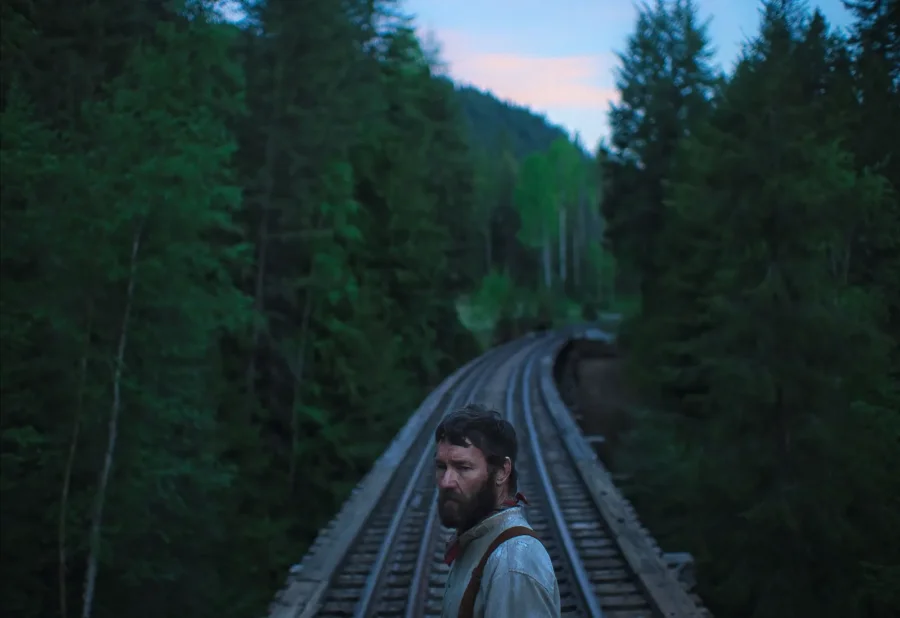
In the hour and a half leading up to this moment, the film presents the fullness of Grainier’s life with deceptive simplicity — from his arrival in Bonners Ferry as an orphaned child to his death in November 1968. More than a record of events, “Train Dreams” is a meditation on how a person learns to live with suffering without surrendering the capacity for wonder.
On the surface, Grainier’s life is marked by tragedy. One of his earliest memories is witnessing the mass deportation of Chinese immigrants, carried out with chilling casualness. His work as a logger keeps him away from home for long stretches, and while he is gone, his wife and young daughter disappear when their house is destroyed in a wildfire. He clings, guiltily, to the hope that they might somehow return. Over time, he watches the work that defined his life — work that cost the lives of friends and fellow laborers — rendered obsolete as industry replaces wood with concrete and steel. As he ages, the world slowly forgets him.
And yet, Grainier responds to this pain by attentively observing the world around him. He contemplates trees, animals, and the land itself, searching for meaning in all that his life has come to hold. Like Job in Job 12:7-10, he speaks to the earth and asks creation for answers, only to arrive where Job does. Neither is given explanations. Neither is granted immediate restoration. Instead, both are invited into a wider, more beautiful vision of the world in its wholeness.
Instead, both Grainier and Job are invited into a wider, more beautiful vision of the world in its wholeness.
Through contemplation, Grainier encounters beauty that brings him joy and connects him to others, their lives quietly enriching his own. He does not take wonder for granted, even amid the steady sadness that shapes his life.
This sense of wonder is carried by understated, tender performances; luminous cinematography of the Pacific Northwest; and a deliberate pace that invites us to walk alongside Grainier rather than rush toward his end. The film is so inwardly reflective that it is nearly impossible to watch without empathy. As Grainier reaches outward to the world until his final moments, the film calmly but insistently asks: Will he be forgotten?
It is a devastating question in a world that so often overlooks the ordinary. It is also a necessary one for those who believe every person bears the image of Christ. How many of our neighbors spend their lives simply scraping by, only to die with their stories erased — reduced to expendable parts in the machinery of profit, power, or what we are told is “progress”? How many possessed rich interior lives, capable of recognizing beauty and meaning, but lacked wealth, power, or the ability to preserve their stories? How much unseen labor do we miss when we value public recognition over quiet faithfulness? How often do we overlook the wisdom of our neighbors simply because they are not elevated in the public square?
I don’t think it’s possible to forget Robert Grainier after encountering him through “Train Dreams.” I want to live as he did, unburdened by the need to leave a grand legacy. I want to be present to the fullness of my life – its beauty and its pain – attentive to every living thing and honoring the image of God in each person. I want to feel a deeper connection to the world around me and to accept the mystery that undergirds it all. I want to be both humbled and freed by the small space I occupy in the cosmos. And when my end comes, I hope to leave quietly, having moved through the world with kindness, wonder and care.