After a session that stretched nearly four hours – including more than a dozen amendment votes and an unscheduled recess over concerns about language some leaders said promoted violence or demeaned people – the Reformed Identity Around the World Committee recommended Wednesday that the 227th General Assembly of the Presbyterian Church (U.S.A.) declare the Israeli government’s actions in Gaza a violation of international law prohibiting genocide.
RIW-04, submitted by Presbytery of the Redwoods, passed 55-4 as amended. The committee then answered a companion overture from Olympia Presbytery, RIW-06, with its action on RIW-04 by a unanimous vote of 55-0. Both overtures asked the assembly to name Israel’s conduct in Gaza a genocide; the committee consolidated them into a single recommendation rather than send two overlapping measures to plenary.
All committee recommendations go to the full assembly for consideration in plenary next week, when commissioners will gather in person in Milwaukee, and every item of business can be debated, amended and voted on again.
Why the language matters to denominational staff
PC(USA) advocacy staff told commissioners during Wednesday’s committee meeting that the question of terminology had direct consequences for their work.
Sue Rheem, who serves as the representative to the United Nations for the Presbyterian Church (U.S.A.), acting under the auspices of Presbyterian Life & Witness (PL&W), said the denomination’s inability to use the word “genocide” in official communications had limited its credibility with international coalitions. “The fact that we have not been able to officially call it a genocide as authorized by PC(USA) hinders our efforts somewhat in being able to be more authoritative and credible in our advocacy efforts, particularly at the U.N. and in the international community,” she said.
“The fact that we have not been able to officially call it a genocide as authorized by PC(USA) hinders our efforts…” — Sue Rheem, PC(USA) representative to the United Nations
Catherine Gordon, who represents international issues for the PC(USA)’s Office of Public Witness in Washington, D.C., told commissioners that in the past year, there had been moments when her office could not support “productive legislation that used the term genocide.” Passage of the overture, she said, would free the denomination “to advocate with other coalitions who are using the term genocide, and to support legislation aimed at stopping the genocide.”
Voices from the hearing
Overture advocates grounded their arguments in visits to the region and in the testimony of Palestinian Christians.
Kevin Moran, an overture advocate for RIW-04 from the Presbytery of Greater Atlanta, told commissioners he had joined a delegation to Palestine in November 2025 and attended the 16th annual Kairos Palestine Conference, an international gathering organized by the Kairos Palestine movement to address the Israeli-Palestinian conflict through theological discussion, non-violent resistance advocacy and global solidarity networks.
“To help find solutions to a problem, one must honestly name the problem…” — Kevin Moran, overture advocate
“To help find solutions to a problem, one must honestly name the problem,” Moran said. “This overture simply asks us to acknowledge that Israel is committing genocide against the Palestinian people, so that the church can work nationally and internationally to find ways to address this problem.”
Craig Hunter, also an overture advocate for RIW-04 from Grace Presbytery, argued the overture carried pastoral weight beyond its policy directives. “Passing this overture would let the Palestinians know that they are not alone,” he said.
“That’s a form of ministry of presence, and the power of knowing that you are not alone in your suffering. That’s a power far greater than any bomb. That’s the power of the gospel.”
Fahed Abu Akel, moderator of the 214th General Assembly (2002) from the Presbytery of Greater Atlanta, described growing up unable to leave his village without a government permit. “I’m a citizen, but in their mind, I’m an occupied person,” he said.
“Passing this overture would let the Palestinians know that they are not alone … That’s the power of the gospel.” — Craig Hunter, overture advocate
Nuha Shaheen, the committee’s partner advisory delegate from Palestine, spoke several times. When commissioners debated whether to add explicit condemnation of Hamas by name – a motion that ultimately failed – she urged them to place the conflict in a longer historical frame. “The story didn’t start on October 7, 2023,” she said. “If we want to condemn Hamas in 2023, we have to condemn the Israeli militias in 1948 first.”
A divided debate
The session included an unannounced recess midway through while committee leadership conferred.
The pause came after Jason Polgar, a young adult advisory delegate from Washington Presbytery, moved to replace the phrase “interfaith siblings” with “fellow image bearers” and to remove the word “Islamophobia” from the overture. He argued the committee should keep its language aligned with the Book of Confessions, saying that “our fellow image bearers in Israel and Palestine stand in need of Jesus Christ.” The motion failed to receive a second.
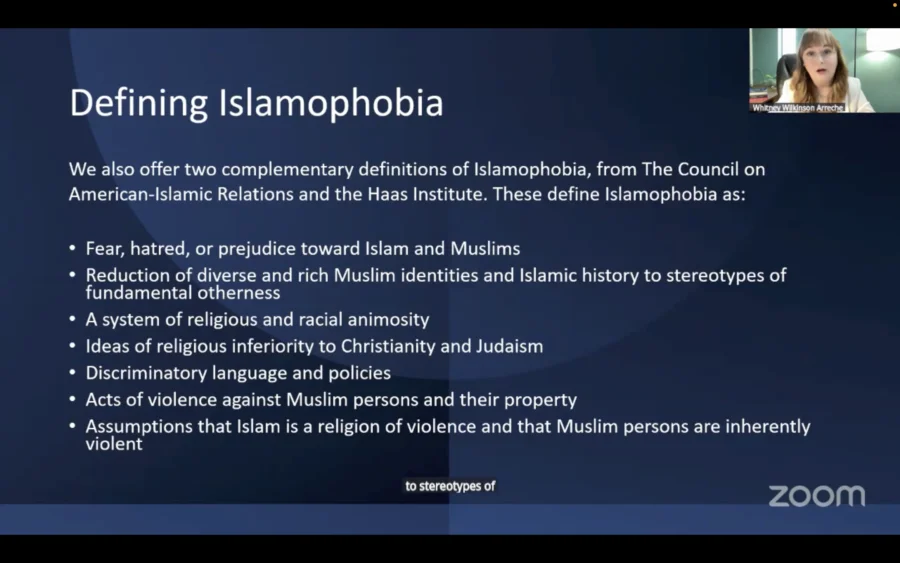
Shortly after, Brandon Tacadena, a ruling elder commissioner (REC) from Seattle Presbytery, asked the committee to revisit a resource slide on antisemitism and Islamophobia that had been shared at the session’s opening, suggesting a comment had implied religious superiority.
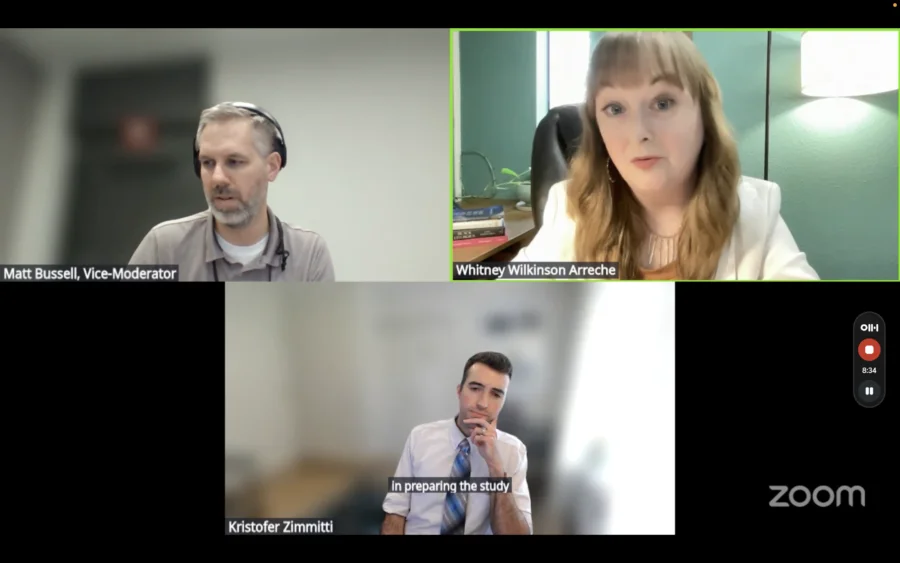
When commissioners returned from the recess, Vice Moderator Matt Bussell of Salem Presbytery told the committee: “We don’t condone any violence, violence against any person for any reason, and so any language which demeans people or promotes violence is inappropriate and out of line.” He did not identify what had prompted the pause or his remarks.
The sharpest early fight was over the word “genocide” itself. Nanette Sawyer, a teaching elder commissioner from the Presbytery of Chicago, moved to replace the word genocide in the overture with language condemning Israel’s “excessive force leading to unacceptable levels of loss of civilian life.”
Others argued that softening the language served the wrong audience. “This amendment is kind of softening language for White Americans to feel more comfortable than for the people who are experiencing what is happening,” said Heather Casiano, a REC from the Presbytery of Wabash Valley, speaking against the substitute. The motion failed.
Commissioners also debated the scope of the overture’s boycott encouragement, with some pushing to limit it to companies whose work or products specifically contribute to violations of international law rather than applying it to Israeli companies broadly. That narrower formulation is what ultimately passed.
A motion to add language from RIW-05 – a separate overture calling for a full trade embargo – failed. The committee later narrowly voted 35-25 to answer RIW-05 with its approval of RIW-04 as amended. Another motion to add an explicit condemnation of Hamas’ military actions by name also failed.
What the assembly will consider
As amended and approved by the committee, RIW-04 asks the assembly to:
- “[c]all the government of Israel’s war in Gaza perpetrated with U.S. support against the Palestinian people a genocide,” with language tying that finding explicitly to U.S. military support for Israel’s campaign in Gaza;
- call on PC(USA) members and congregations to contact their congressional leaders and the U.S. president to block further military aid and arms sales;
- encourage Presbyterians to refrain from purchasing products made or distributed by Israeli companies whose work or products contribute to violations of international law concerning genocide — a narrower formulation than a blanket boycott of Israeli goods; and
- affirm that the actions of the secular Israeli government do not represent the will of all Israelis or the global Jewish population, language commissioners added specifically to guard against conflating the government’s conduct with Jewish communities more broadly.
The committee’s full week of work
Wednesday’s Israel and Palestine votes were the committee’s most contentious business, but not its only work. Over three days, the RIW Committee acted on 11 overtures spanning nuclear disarmament, Syrian Christian persecution, a Korean historical tragedy, global mission accountability and Cuba solidarity. A full account of Monday’s and Tuesday’s business — including the committee’s recommendation of a 17-member task force to review the closure of PC(USA) World Mission and the approval of a new missiological statement — is available in a previous Outlook article.
After dinner on Wednesday, the committee approved RIW-10 — affirming Kairos Palestine II, a statement issued by Palestinian Christians in November 2025 calling for solidarity and creative resistance — 51-5. Then they turned to RIW-11, a commissioner resolution on solidarity with the Iglesia Presbiteriana-Reformada en Cuba (IPRC) and relief from U.S. sanctions, which passed 54-4 as amended. Read the full story.