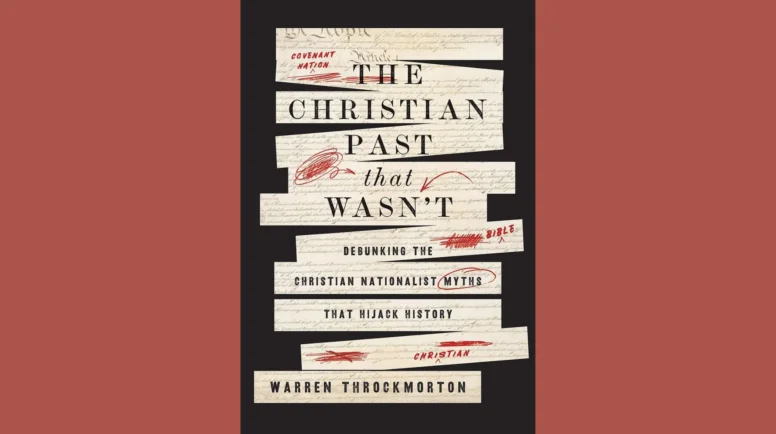
The Christian Past That Wasn’t: Debunking the Christian Nationalist Myths That Hijack History
By Warren Throckmorton
Broadleaf Books, 319 pages
Published May 19, 2026
As Abraham Lincoln wended his way from Springfield, Illinois, to Washington, D.C., to become the 16th President of the United States, he stopped to address the state senate in Trenton, New Jersey. In his remarks, he expressed his hope that he might be instrumental in the struggle to perpetuate the union. Then he captured the nature of his task with a remarkable phrase: “… I shall be most happy indeed if I shall be a humble instrument in the hands of the Almighty, and of this, his almost chosen people, for perpetuating the object of that great struggle.” What did the senators make of these curious words, “his almost chosen people”? What do we make of them today? And what kind of alchemy do we see in the interaction of faith, politics and government that comprises American culture and polity?
The Christian Past That Wasn’t responds to these questions with the belief that the United States was never a Christian nation – at least not as characterized by Christian nationalists – and that the Founding Fathers fully intended a separation of church and state. As journalist Warren Throckmorton’s title makes clear, the historical claims of Christian nationalists are mythical, and he proves it through exhaustive documentation: records of America’s original Constitutional Convention, the accounts and diaries of the participants, colonial history, and close analysis of the founding documents themselves. The result is a definitive case for the broad acceptance at creation of a secular polity in America and a clear separation of church and state.
Throckmorton clearly speaks to his evangelical siblings; I, probably best characterized as a progressive Presbyterian layperson, am likely not the intended audience for his book. While I appreciated his courage in describing the myths that seem to flourish in that world, I was more deeply drawn in by his determination to share those myths with other evangelical leaders, even though he was repeatedly told that winning the culture war was more important than telling the truth.
I was more deeply drawn in by his determination to share those myths with other evangelical leaders, even though he was repeatedly told that winning the culture war was more important than telling the truth.
Perhaps it is unfair to ask Throckmorton to go further, but this reader yearned for him to return to Lincoln’s “our almost chosen people.” What role has faith played in American politics and government, even as we firmly separate church and state? What do we make of the occasional use of biblical language in public speech, the powerful invocation of the Exodus during the Civil Rights Movement, or the ebb and flow of the term “covenant” in American political discourse?
In light of those questions and others, readers, either on their own or in book groups, might choose to read this book on its own or alongside other works such as Philip Gorski’s American Covenant: A History of Civil Religion from the Puritans to the Present, Michael Walzer’s Exodus and Revolution, or Randall Balmer’s Bad Faith: Race and the Rise of the Christian Right. At a time when American political institutions and our communal life are grievously threatened, going back to basics may be key to moving forward in the struggle for union for which both Lincoln and Throckmorton earnestly hanker.
Presbyterian Outlook supports local bookstores. Join us! Click on the link below to purchase The Christian Past That Wasn’t from BookShop, an online bookstore with a mission to financially support local, independent bookstores. As an affiliate, Outlook will also earn a commission from your purchase.
Sign up for Page Turners, our monthly email newsletter, to receive book-related content in your inbox once a month.