MILWAUKEE — On Monday, June 29, commissioners to the 227th General Assembly of the Presbyterian Church (U.S.A.) meeting in Milwaukee approved five climate-related items of business without debate, folding them into the consent agenda the Climate and Environmental Justice Committee (CLJ) had recommended.
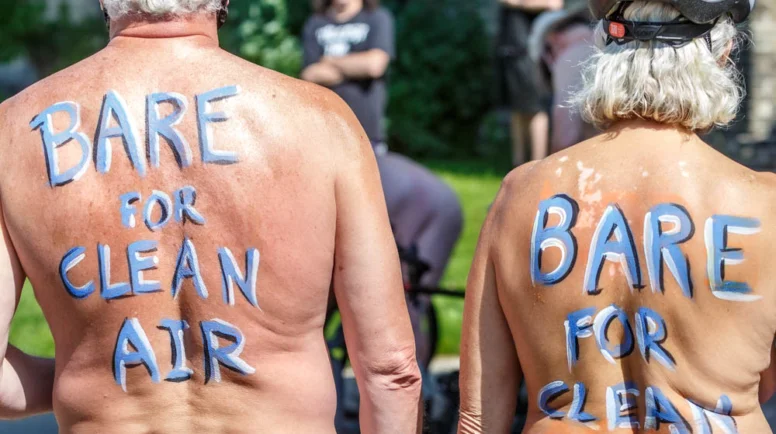
Two days earlier, on Saturday, several hundred nude cyclists rode through the city’s streets carrying their own message about fossil fuel dependence, painted across their bodies with marker and body paint.
The two events were unconnected — no commissioners are known to have participated in the ride, and no riders interviewed referenced the General Assembly. But for one week in late June, Milwaukee hosted two communities independently wrestling with the same question: What actions can we take to fight the warming planet’s dependence on oil and gas?
What did the assembly approve?
The assembly’s action on the consent agenda approved the full slate of business the CLJ committee brought to the floor.
CLJ-05, “Intent, Effect, Haste: Ethical Guidance on Fossil Fuels,” passed by the widest margin in committee, 58-3, and seeks to establish guiding principles for the denomination’s decisions about fossil fuel use.
CLJ-02, “On Changing Course for a Green Future,” directs the church to align continued investment decisions with those same ethical guidelines and was passed as amended, 50-13.
CLJ-03 establishes a Green Future Fund and was passed as amended, 51-9.
CLJ-04 calls on Presbyterians to learn about and support regenerative farming practices and directs Presbyterian Life & Witness to develop educational resources on the subject; it passed as amended, 55-5.
CLJ-01 directs the church to prioritize responses to the climate crisis in line with the Paris Agreement’s goal of limiting global warming to well below two degrees Celsius.
A different kind of protest
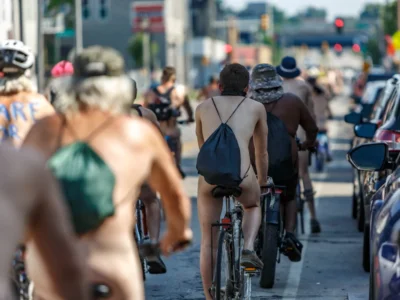
The World Naked Bike Ride is not a Presbyterian event. It is, by its organizers’ account, an international movement — this year’s Milwaukee ride was its sixth annual local installment, part of a series that organizer John Jankowski said spans 70 cities nationwide. Jankowski, who runs the Milwaukee-based nonprofit We Bear All, said the ride exists at the intersection of two causes: body positivity and opposition to fossil fuel dependence.
“The world is so dependent on oil,” Jankowski said. “We know everything’s going up, but is there really a reason?”
That framing was visible on riders’ bodies as much as it was audible in their voices. One rider had “Less gas more ass” painted across his back in rainbow lettering — the event’s informal slogan. Another pair wore “Bare for clean air” across their backs.
The route took riders through downtown Milwaukee, past the convention center, where commissioners were gathered for the assembly. Several commissioners said they witnessed the procession but declined to comment further.
Brian Knauf, who drove from Madison, Wisconsin, for the ride, said he has been participating in similar events since 2007, when he attended his first in Chicago. He was skeptical that the rides have changed fossil fuel habits in measurable ways, but said the underlying concern stays with him.
“It would just be nice if people would just bike more,” Knauf said, “quit buying giant, gas-guzzling vehicles.”
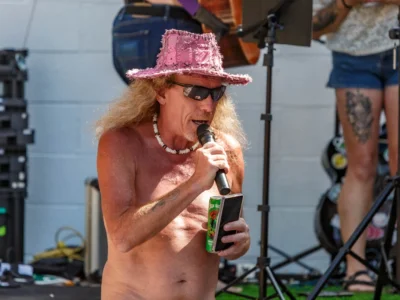
The event wasn’t about fossil fuel for all the participants. For Murray Dietz, who drove nearly 600 miles to join the ride, the appeal was less about climate messaging than the freedom the ride represented in a state where public nudity, he said, is not legal. Dietz, a Seventh-day Adventist, said his home congregation would likely embrace the event’s spirit even if it wouldn’t endorse the event itself; the denomination had a naturist wing among some adherents in the 1800s, he said.
Jameas Rogers, co-owner of the skin care company Lillie B, was one of about a dozen vendors at the event. She said the company’s products – made without the petroleum-based and synthetic chemicals she eliminated after being diagnosed with a thyroid condition – found a natural audience among riders whose skin would spend the day exposed to sun and heat.
Two Milwaukees, one week
Nothing in the ride’s organizing materials referenced the General Assembly, and nothing in the assembly’s climate business referenced the ride. What the week showed, instead, was a city briefly host to two unconnected expressions of the same anxiety — one routed through committee recommendations and electronic votes, the other through painted skin and a slow procession around town.