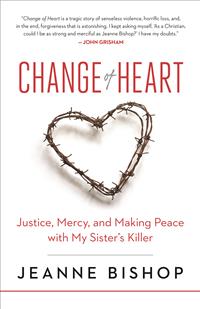
 by Jeanne Bishop
Westminster John Knox Press, Louisville, Ky. 208 pages
I had just inserted the metal buckle and pulled the strap to tighten my belt low across my lap and was prepared to open Jeanne Bishop’s book, when the man seated beside me on the plane leaned close and said with satisfaction, “Did you hear? They gave the Boston bomber the death penalty.” He smiled and waited for my response. I muttered, “No, I hadn’t heard.” I opened my book hoping to signal that our conversation was over.
It was a strange juxtaposition: reading public defender Jeanne Bishop’s account of her journey to forgive — and even work to reconcile with — the man who murdered her sister and brother-in-law, all the while thinking about the breaking news of Tsarnaev’s death penalty sentence. The chasm between a desire for punishment (and sometimes vengeance) and the drive for mercy and relationship, even with those who have caused unspeakable harm, seemed too large to bridge. How does such a transformation happen?
Jeanne Bishop’s brave telling of her personal tragedy answers that question. And the answer for her is Scripture, faith and the power of the Holy Spirit. The transformation is in no way easy or quick, but it is nonetheless real and life-giving.
Bishop learns of the murders on Palm Sunday morning. Still in her choir robe, sitting in the church office, her father tells her the news over the phone. He tells her to wait there. Her murdered sister’s minister is on the way to pick her up and take her to meet her parents at the police station. Upon hearing for the first time that her sister and brother-in-law had been shot she writes, “I tried to fathom it, tried to understand what would cause someone to do such a horrible thing. As I did, I spoke for the first time since arriving at the station. It wasn’t a thought I had formulated; it just emerged. I heard myself saying these words to the assembled group: ‘I don’t want to hate anyone.’”
The chapters that follow describe what happens to that hope. Bishop is to be commended for not shying away from the incredibly painful parts of her story and of others. Some of the most difficult passages to read are those that describe horrific crimes and the trauma that is left in their wake. Bishop is honest about the anger her advocacy for mercy elicits in others, even those closest to her. She refuses to let the reader believe that reconciliation comes without deep personal costs.
While Bishop’s story is extraordinary in both its horror and its grace, all of us are called to forgiveness, mercy and reconciliation. This book demands that we examine how and where we are to exercise our faith in these ways.
I recently attended a worship service that included this assurance of pardon:
One: There is no chasm that cannot be bridged, no loss that cannot be recovered, no mistake that cannot be forgiven, no life that cannot be redeemed — by the grace of Jesus Christ.
All: We can begin again. Glory to the Holy One, who can make all things new! Alleluia!
Reading “Change of Heart” reminded me that those words of assurance are true, — not just for me and for you, but for everyone.
JILL DUFFIELD is the editor of the Presbyterian Outlook.