July 2015 marks the 600 year anniversary of the martyrdom of Jan Hus. This week, writer Jim Nedelka offers exclusive reflections for the Outlook on the spiritual and cultural events of HusFest 2015 in Prague.
PRAGUE, CZECH REPUBLIC – It is the afternoon of the first Friday in July ahead of a celebratory weekend marking the importance of the Czech people in the history of the Protestant Reformation, if not the entirety of Christianity itself. It is the eve of commemorating that day 600 years ago – July 6, 1415 – when the priest, Jan Hus, was burned at the stake for committing six acts of what were deemed religious heresy.
Huge kiosks throughout this historic capital city, once the seat of The Holy Roman Empire, are emblazoned with posters trumpeting Husovské slavnosti 2015 (which translates into English as HusFest 2015,) a two-day celebration of the fully exonerated Jan Hus. In this nation where upwards of 80 percent of the population considers itself to be agnostic or atheistic, Hus routinely appears among the top 10 national heroes listed by Czechs.
The forum for much of Hus’ reform platform is Betlémské Kaple (the Bethlehem Chapel, which means “House of Bread”), situated on Husova Street in what is known today as Old Town. Like the majority of churches surrounding Old Town Square and those spread out across the city, Bethlehem Chapel is a full-time museum and part-time functioning house of worship and event space, now under the care of České Vysoké Učení Technické v Prava (the Czech Technical University of Prague).
 A museum official leads our party of two into the chapel, asks us what language we prefer, hands us a neatly arranged information sheet then leaves us with our thoughts for a self-guided tour
Initially constructed in 1391 by a local businessman and his “courtier” on 800 square meters of land he donated, the chapel – never surrounded by a true parish – was chartered with the stipulation that all sermons must be delivered in Czech and not Latin, as was the church custom.
A former head of Charles University turned priest, Mister Jan Hus (meaning Master but pronounced akin to the German word Meister) assumed the pulpit in 1402, gaining a loyal group of followers that came to be known as “Hussites.”
 For 10 years, Hus preached his reformist views from the wooden perch accessible only via a small door off the main staircase outside the sanctuary.
He campaigned for the Bible to be made available for all people to read in their own language, not strictly in Latin as decreed by the church. He vilified the church’s hierarchy for its practice of raising money by selling indulgences – in other words, filling its coffers while absolving the donors’ of their sins (the more egregious the sin, the higher price of the indulgence), fast-tracking the sinner to their final, Heavenly reward.
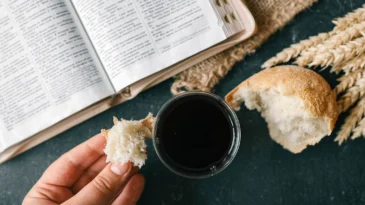
But perhaps Hus’ greatest “heresies” were his views surrounding Holy Communion: distributing the sacrament to the “common people” more frequently rather than the standard practice of once a year. And, when serving the communicants, Hus advocated not only providing them with a piece from the bread of life but also with his radical addition – a taste from the cup of salvation – which, at that time, was the sole purview of the priests.
As we start our afternoon walk through Hus’ “home base,” we begin in the enormous ground floor sanctuary, a space with just a pair of interior columns and an interior well. Above the main entry are three rooms replicating Hus’ apartment, now containing a timeline and artifacts from the Bethlehem Chapel.
The fact that Jan Hus’ primary pulpit stands today fascinates me and reminds me of the legacy he had on the Czech people. On this particular Friday afternoon, amidst the additional chairs, multi-level stage and modern lighting and television gear installed in the choir loft ahead of the weekend’s events, a tour group of several dozen Korean Presbyterians react with wonder as their guide details Hus’ life, his works in the chapel and his execution, which is depicted in a fresco high up on the North Wall.
An even more fascinating detail is the rumor floating among the Czech religious leaders that Pope Francis is seriously considering canonization for Hus because he died as a religious martyr. Yes, sainthood.
That would be interesting news to Hus, considering Rome was at his heels trying to squash Hus and the Hussites. In 1412, when Hus preached that no pope should take up a sword in defense of Christ, but should pray for his enemies, the papal pressure was so intense that Hus gave up his pulpit for a safer space. If Rome thought they had won, they probably hadn’t counted on successor prelates carrying on in the Hus tradition – one they continued until 1622, when the Jesuits assumed control of the chapel and began holding “traditional” Catholic masses. That lasted until 1773, when the state expelled the Jesuits; after languishing for a time, the chapel’s custody was eventually assumed by the 1st Technical University.
Taking stock of their aging structure, university officials pulled down the decaying roof and interior structures before they collapsed, leaving the exterior walls standing. At some point during the 19th century, a tenement was built inside the ancient walls.
Flash forward to 1948: A government decision was made to restore the chapel. Using every available wood cut, drawing, chart, painting and diary entry, the project took a year of planning and five years of construction, opening to the public July 7, 1954. Yes, a place made famous by a hero of the Protestant Reformation restored and reopened during the Communist-influenced government of Czechoslovakia.
Several paintings adorn the chapel walls depicting scenes from Hus’ life and his execution, some with Hus quotes and transcriptions of opening lines from hymns.
 In a corner of the sanctuary to the right of the pulpit is an area for musicians. Hanging in its scaffolding is a bell cast to honor this 600th anniversary. Painted black with gold leaf highlights, it stands at the ready, awaiting its life following an official dedication during an ecumenical worship service to be broadcast live on Czech TV.
A pair of plaques marking the occasion – one for Constance, Germany, where Hus was tried and convicted, the other to remain here in the chapel – are also at the ready for their unveiling and permanent installation.
Upstairs, a bas relief of Hus dominates one wall. A timeline stretches across all three rooms and includes, artifacts, wood cuts and other depictions of the clergyman, his chapel and photographs of its reconstruction. One symbolic painting shows Hus’ inspiration: John Wycliffe lighting a spark, Hus lighting a candle from that spark and Martin Luther wielding a torch. It was Luther who, in 1517, cited the connection between Hus, the Hussites, the Bohemian Reformation and his Lutheran Reformation.
JIM NEDELKA is an award-winning journalist, writer and editor who actively searches for the “humanity” within every story. A ruling elder in the PC(USA), he is a member of Jan Hus Presbyterian Church & Neighborhood House in New York City. He and his wife, Holly, are the proud parents of two adult children.