
 While there is an emerging spirit of collaboration on the need for an urgent response to climate change, Presbyterians still disagree on whether the Presbyterian Church (U.S.A.) should divest from its holdings in the fossil fuel industry.
Hudson River Presbytery has submitted an overture asking the 2018 General Assembly to direct the Board of Pensions and the Presbyterian Foundation to divest from the fossil fuel industry, and to seek out and invest in securities of companies focused on renewable energy or energy efficiency.
That overture has concurrences from at least 40 presbyteries (possibly the greatest number of concurrences ever for an overture, according to advocates), and marks the third consecutive assembly where fossil fuel divestment is likely to be a hot subject of debate.
But others – who want to work through the PC(USA) system of corporate engagement and who are concerned about the potential impact of divestment on Presbyterians who work in the oil and gas industry – are suggesting different approaches. This sets up the 2018 General Assembly to revisit an issue that proved controversial in 2016 – with deep concern about global warming, but also deep disagreement about the best Presbyterian response.
The Presbytery of New Covenant in Texas has sent a series of four overtures on environmental issues that ask the assembly to express “profound concern about the detrimental effects of climate change on all God’s creation.” Those overtures call for corporate engagement on climate change issues and a more diversified PC(USA) energy portfolio; advocacy for the use of alternative energy sources; support for carbon pricing; a reduction in the use of products made of polystyrene by PC(USA) agencies and congregations; and dialogue among congregations and individual Presbyterians about how they can reduce their carbon footprints and slow climate change.
Mission Responsibility Through Investment (MRTI), which shepherds the PC(USA)’s efforts in socially responsible investing, is not recommending fossil fuel divestment — instead asking the assembly to direct MRTI to continue to pursue its corporate engagement process and to approve a set of metrics that MRTI is using to measure progress during the 2019 and 2020 shareholder proxy seasons, with “possible selective divestment recommendations” to the assembly in 2020 for companies who aren’t moving towards compliance.
All these recommendations will come to the assembly’s Environmental Issues committee, which also will consider a handful of other overtures on related issues — including overtures regarding environmental racism and encouraging congregations to consider the idea of a carbon fee and dividend.
While MRTI argues for continued corporate engagement, the Hudson River overture contends that the PC(USA) needs to act now — that “by continuing to hold investments in the fossil fuel companies that most egregiously contribute to the climate crisis, the PC(USA) is complicit in harming God’s creation and ‘the least of these’ who are disproportionately affected by climate change.”
This is complex terrain — with obvious and sometimes passionate disagreement regarding the wisdom of divestment, but also with some mutual frustration with how the 2016 General Assembly acted regarding this issue, and a willingness to search for common ground as much as possible in responding to the urgency of climate change.
“Those of us who vigorously disagree on the divestment or engagement question are actually largely in agreement on most of the other questions,” such as the need to develop cleaner sources of energy, said Jim Allison, a ruling elder from Houston who is one of the leaders of a network called Faithful Action on Climate Change, based in the Synod of the Sun. “I don’t intend to suggest that there’s not vigorous disagreement. But if we only focus on that one area where we disagree, we miss the bigger picture, and we also amplify all the dissension in the denomination.”
The players in the debate over the Presbyterian response agree “that climate change is a real and urgent threat, and the effects of it are being felt right now,” said Rob Fohr, director of faith-based investing and corporate engagement for the PC(USA). “We may disagree on certain tactics, but we are united against climate change.”
The 2016 assembly
Another point of unity seems to be frustration with how the 2016 General Assembly responded to the measures it considered regarding climate change — with some disappointed that the assembly didn’t choose divestment, and some who supported the outcome wanting clearer instructions.
An overture that the Presbytery of San Francisco presented seeking fossil fuel divestment came to the 2016 assembly with dozens of concurrences and some momentum, as Presbyterians from Fossil Free PC(USA) joined forces with and drew energy from divestment movements among faith-based groups and in the secular world. Student environmentalists had already pushed through divestment measures on some college campuses, including at Stanford University and the University of Massachusetts.
And the United Nations Paris Climate summit in December 2015 produced an historic international accord to lower greenhouse gas emissions, with 195 nations signing on.
MRTI, however, did not support fossil fuel divestment in 2016. MRTI stressed its more than 30-year history of corporate engagement and the importance of following a process of focused corporate engagement on climate change issues, with possible divestment down the road if that process did not produce acceptable results.
And a network then called Faithful Alternatives to Fossil Fuel Divestment, from the Synod of the Sun, pushed for approaches to combatting climate change that focused on reducing energy consumption and renewable energy.
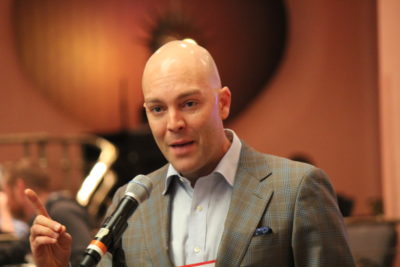
Representatives of that group told the 2016 assembly that there are “a lot of faithful Presbyterians who work in the energy sector,” people who felt “calling their life’s worth morally reprehensible is problematic for a lot of reasons,” Fohr said. That group proposed other strategies for addressing climate change — focusing in part on actions congregations and individuals could take to cut back on the amount of energy they use.
Allison, one of the leaders of what’s now known as Faithful Action on Climate Change, is an elder from Pines Presbyterian Church in Houston. Until his retirement, Allison spent decades working in strategic planning for an oil company (that’s where he met his wife) and later as a risk manager for a natural gas firm.
For people employed in the fossil fuel industry – in coal mining regions, for example, or for oil and gas firms – the call for divestment “comes across as a personal insult, because you don’t work for a company for 10 or 20 or 30 years without becoming emotionally invested in the company as a good actor,” Allison said. “The divestment arguments say no, the company is a bad actor,” responsible for climate change.
Those who advocate for continuing corporate engagement with fossil fuel companies, rather than divestment, are focused on the demand side, placing responsibility for reducing the carbon footprint on energy consumers, both individual and corporate. “It’s my consumption decisions that drive my carbon footprint, not my investment portfolio,” Allison said — decisions about what kind of car to drive, how much to heat or cool one’s house, what kind of food to eat and where it comes from.
With a background in economics, Allison also focuses on the impact that removing or restricting fossil fuels would have on the world’s energy supply, when energy poverty remains a global concern.
At the 2016 assembly, the Immigration and Environmental Issues committee voted in favor of divestment, but during plenary the assembly voted 391-161 to approve a minority report, which in part directed MRTI to pursue focused engagement and report back to the 2018 assembly with recommendations – including the possibility of selective divestment – “if significant changes in governance, strategy, implementation, transparency and disclosure and public policy are not instituted by the corporations” during the engagements with MRTI and its ecumenical partners.
That marked the second time in a row a General Assembly turned down a proposal for fossil fuel divestment, despite significant support from Presbyterians at the grass roots.
The 2016 assembly gave MRTI “very vague” instructions for measuring the progress of corporate engagement, Fohr said, and the lack of specificity “made our task quite a bit more daunting.”
The moderator of Fossil Fuel PC(USA), abby mohaupt (mohaupt prefers not to capitalize her name), wants this year’s assembly to do more.
At the 2016 assembly, “the commissioners basically decided to do nothing about climate change and divestment,” mohaupt said. “It was late on a Friday night at GA. People were tired. … We don’t think that’s what they meant to decide, but it’s what they decided” — as commissioners essentially said, “MRTI will figure out what we should do,” without giving concrete instructions regarding divestment, carbon offsets or a carbon tax.
The assembly’s decision “meant all of us are frustrated,” mohaupt said, and people spent about a year trying to figure out what the mandate to MRTI actually was.
“When we don’t think clearly about climate change and the urgency about it as a body, we end up not making a decision, or making a decision that nobody’s happy with,” she said. “General Assembly has to be about taking action.”
Walk to St. Louis
In September 2017, Fossil Free PC(USA) became an official project of the Presbyterian Peace Fellowship.
From June 1 to 16 before this assembly, Fossil Free PC(USA) and the Presbyterian Peace Fellowship are organizing a PC(USA) Walk for a Fossil Free Worldfrom Louisville (where the denomination has its national offices) to St. Louis (where the assembly is being held) — in part to tell the stories of people affected by climate change. Participants will walk 10 to 14 miles a day, using mostly back roads and either camping or staying at churches. In the evenings, the walkers will gather either in person or via Skype with activists, pastors, theologians, local people and international partners who will share their experiences with climate change, mohaupt said.
The goal is three-fold, she said:
- To tell the stories of people who have been affected by climate change;
- To encourage the PC(USA) to divest from fossil fuel companies;
- To draw attention to overtures on divestment coming to this assembly; and
- “To lower our footprint as we travel to General Assembly,” which convenes June 16.
mohaupt expects about 25 people to do the majority of the walk and others to come and go, with about 200 people being involved altogether. “It came out of a sense that we need to get the denomination back to its roots,” she said, “and its long history of caring about creation.”
The 2018 proposals
Both the national political climate and the conversations on climate change within the PC(USA) have changed significantly since 2016.
Since 2016, MRTI has focused on developing metrics it can use for evaluating and measuring whether fossil fuel companies are making progress on moving towards such things as reducing greenhouse gas emissions, turning towards renewable energy and improving energy efficiency. Fohr said those metrics provide “a road map for navigating complexity.”
MRTI has engaged in dialogue with 59 companies on climate change issues and filed or co-filed shareholder resolutions with 18 — working through broader coalitions such as Climate Action 100+, Fohr said. MRTI began using the metrics in 2017; expects them to generate baseline data this year; and is asking the 2018 General Assembly to affirm the metrics and the process.
MRTI is not recommending divestment now, saying in its report to the assembly that “the most efficient way to discourage the burning of fossil fuels is to aggressively engage and challenge producers and consumers to reduce their carbon footprint. Applying pressure at only one point along this chain of fossil fuel production and consumption – say through divestment from fossil fuel-extracting companies – would be less efficient and ultimately slower.”
The landscape of the divestment movement has shifted too, mohaupt said, in part because President Trump has announced the United States will withdraw from the Paris climate accord. The country has “a president who doesn’t think climate change is real” and is defunding environmental work, she said. “If there has ever been a time for us as a denomination to be bold and prophetic … now it is even more urgent,” she said. “Climate change is continuing to get worse. And climate change exacerbates all the other things that are important to creating a just society.”
As this assembly approaches, mohaupt and Allison have been collaborating to find as many areas of cooperation as possible regarding climate change, while remaining on different sides of the fossil fuel divestment issue.
At the 2016 assembly, “I think people were concerned about how it would look to workers in the fossil fuel industry — that if we divested from the industry that it would shame individual workers,” mohaupt said. There also was a perception that “if we categorically divest, that would send a signal to the denomination that we don’t care about MRTI’s work and that would undercut them,” as MRTI had recommended against divestment, in part because no clear criteria had been established for holding fossil fuel companies accountable.
The 2018 assembly will consider two overtures on fossil fuel divestment: one from Hudson River and another from the Presbytery of East Tennessee. And “the differences between them are pretty nuanced,” mohaupt said.
Two years ago, “the final vote indicates the denomination clearly wasn’t ready to divest,” said Dennis Testerman, moderator of Presbyterians for Earth Care. Another change since then: the growing number of communities filing lawsuits against fossil fuel companies, contending that the products they sell contribute to global warming and also storms, droughts, wildfires and more.
Whatever happens at this assembly regarding divestment, those involved in the discussion are pushing for some movement on climate change.
“If the General Assembly simply comes out and puts it down to a yes or no vote on the one issue people disagree with, that will really distort where the denomination is on the climate change issue,” Allison said — obscuring progress on other fronts, including PC(USA) churches becoming Earth Care congregations; the Restoring Creation program that Presbyterian Investment and Loan Program offers, providing loans to congregations wanting to become more energy efficient; the commitment the Board of Pensions has made to offering a fossil fuel-free investment portfolio as part of its retirement savings plan options; and the efforts of the Presbyterian Foundation to invest in clean energy.
“Our tradition includes the phrase ‘mutual forbearance,’ and the idea that we display the kingdom of God to the world,” Allison said. “What are we saying about the kingdom of God by the way we treat one another on these issues in which we disagree” — be it same-gender marriage, policy in the Middle East or global warming. “That compels us to treat each other properly. You can’t demonize your opponent and display the kingdom of God.”