Last week I was traveling in Costa Rica with my family. We were spending a few days near Manuel Antonio National Park, doing the things tourists do: walking rainforest trails, watching monkeys swing through the trees, giving thanks for the beauty of a small and peaceful country.
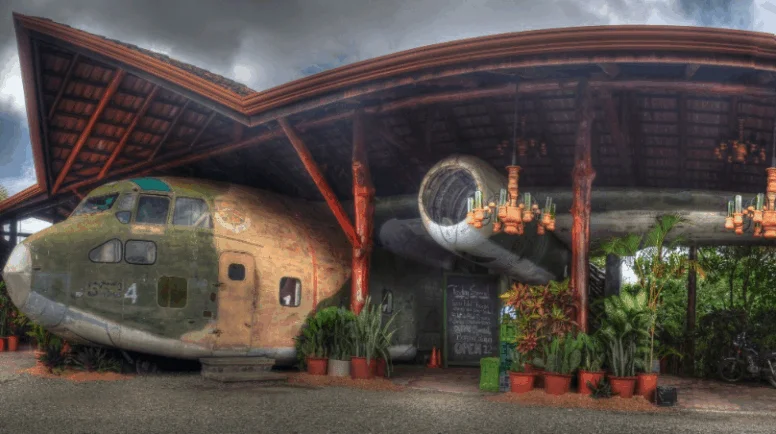
One morning we had brunch at a restaurant called El Avión. The name means “The Airplane,” and it is not metaphorical. The restaurant is literally built around the fuselage of a Fairchild C-123 cargo plane perched on a cliff above the Pacific. Diners eat beneath its broad aluminum wing; you can even climb into the cockpit for photos and there is a pub inside the body of the aircraft.
The plane is an odd relic to encounter in this paradise-like setting. In the 1980s, this aircraft and its twin sister were used in the secret CIA supply operation that supported the Nicaraguan Contras during the Iran-Contra affair. In 1986 that sister plane was shot down over Nicaragua. A crew member parachuted into the jungle and was captured, exposing a covert network of arms sales, lies, and political manipulation that would become one of the largest scandals in modern American history. The surviving plane was abandoned in San José, purchased in 2000, cut into pieces, shipped to Quepos, hauled up the hill, and reborn as a tourist attraction and bar.
Related reading: “The Rev. Jihyun Oh speaks out concerning US military action taken against Venezuela” by Jihyun Oh
While we were eating brunch under that wing, my phone buzzed with news from Venezuela. It was the same day the world learned that Nicolás Maduro’s grip on power had finally been broken. I felt a jolt of irony: enjoying ceviche and fresh fruit in Central America while reading about yet another moment in which the United States had inserted itself into the affairs of a Latin American nation.
I thought, too, of the prophet Micah’s simple summary of God’s desire: “What does the Lord require of you but to do justice, and to love kindness, and to walk humbly with your God?” (Micah 6:8). Humility has not always been the hallmark of U.S. policy in our hemisphere.
I have spent much of my adult life moving between these worlds. Before becoming a pastor, I lived and worked in Guatemala as the International Field Operations Manager for a mission organization. Later, as a pastor in Nebraska, I helped lead delegations to the U.S.–Mexico border with Frontera de Cristo. I have preached and taught and sung hymns alongside my sisters and brothers in Christ in Cuba, Haiti, Mexico, Guatemala, El Salvador, Ecuador, and Argentina. I love Latin America and its many cultures, its incredible people, and its inspiring resilience. Because of that love, I also carry grief over its history.
A long pattern of intervention
From the days when the kings of Israel trusted horses and chariots more than God, great powers have always been tempted to rely on military strength as the final word. Nations are no different today. The United States’ involvement in Latin America includes moments of genuine partnership and generosity. It also includes a long trail of interventions that, intentionally or not, have contributed to instability and suffering.
There are the visible examples many of us learned in school: the Spanish-American War, the ongoing economic embargo that still shapes Cuban life, and the complicated status of Puerto Rico, where sovereignty, democracy, and economic self-determination remain unresolved questions.
And then there are the military and covert interventions of the Cold War era:
- Guatemala in the 1950s, where the CIA, with the support of both President Truman and President Eisenhower, helped overthrow the democratically elected government of Jacobo Árbenz after he threatened the interests of the United Fruit Company. This led to decades of military rule with continued U.S. intervention.
- The Dominican Republic in 1965, when U.S. Marines landed in the name of preventing communism.
- Chile in 1973, where American political pressure and intelligence operations contributed to the fall of Salvador Allende and the rise of Augusto Pinochet’s brutal dictatorship.
- Grenada in 1983, when the U.S. invaded, civilians were killed, and the U.N. declared this intervention a “flagrant violation of international law.”
- Panama in 1989, when the invasion designed to remove Manuel Noriega resulted in over 200 civilian casualties.
In Nicaragua, El Salvador, Honduras, and elsewhere, U.S. policy poured weapons and money into proxy conflicts. The stated goal was freedom. The actual legacy was often fear and death of innocent people.
When peace is sacrificed to ideology, the church must notice.
These stories are not identical. Each arose from its own context. But taken together they reveal a pattern: again and again the powerful nation to the north decided that it knew what was best for the nations to the south. As Christians, we should be able to look at that pattern clearly; when peace is sacrificed to ideology, the church must notice.
The Guatemala I experienced
When I arrived in Guatemala in the early 2000s, I stepped into a country still living with the consequences of 1954; the wounds I encountered were deep. The U.S.-backed coup empowered a series of military governments and helped set the stage for a 36-year civil war.
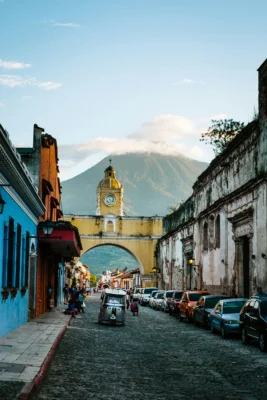
More than 200,000 people were killed or disappeared. The vast majority were rural and Indigenous Maya. I remember visiting villages in the western highlands where elders could point to hillsides and tell stories of massacres and bullet holes still scarred the sides of building.
I sat in a country where the words of Jesus: “Blessed are those who mourn,” felt less like a sermon and more like a national condition. Those wounds were not caused only by the United States, Guatemalans also bear responsibility for their history. But it is impossible to pretend that our nation’s fingerprints are absent from the story.
At the same time, I also saw the good. I drove on highways built with USAID funding. I visited water systems and clinics and schools that existed because Americans had invested in development. I met generous Peace Corps volunteers and idealistic aid workers who loved Guatemala as much as I did. The truth, as always, was mixed.
A cloud of witnesses
Our Christian tradition insists that we read history in community: with Scripture, with the saints, and especially with those who have suffered. Hebrews calls them a “great cloud of witnesses.” In Latin America that cloud includes martyrs, prophets, and ordinary believers whose names we will never know.
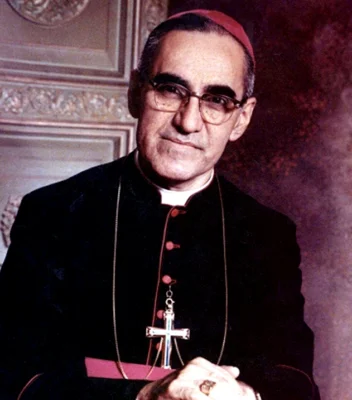
One of the saints who most shapes my thinking is Archbishop Óscar Romero of El Salvador. Romero was no radical ideologue, he was a quiet and scholarly priest who became archbishop in 1977, at a time when El Salvador was descending into violence and repression.
As he listened to the cries of the poor, Romero was transformed. He began to preach boldly against government brutality, calling soldiers to stop following unjust orders and pleading for international powers, including the United States, to stop fueling the conflict. Romero insisted that the church must hold together love of God and love of neighbor.
“A church that doesn’t provoke any crises,” he preached, “a gospel that doesn’t unsettle, a Word of God that doesn’t get under anyone’s skin … what gospel is that?” His theological vision was profoundly Christian and deeply pastoral. He reminded his flock that Christ is encountered not only in sanctuaries but in the suffering of the streets. “There are many things that can only be seen through eyes that have cried,” he told them.
Romero reminds me that the primary Christian calling is not to protect national interests but to defend human dignity.
On March 24, 1980, he was assassinated while celebrating mass. Romero reminds me that the primary Christian calling is not to protect national interests but to defend human dignity; we are first and foremost citizens of the kingdom of God.
Two things can be true
This is where our faith becomes especially important. The gospel trains us in the discipline of holding more than one idea at the same time. We claim that Jesus was both fully human and fully divine; our faith allows us to appreciate paradox.
Our faith allows us to appreciate paradox.
In the case of Venezuela, Nicolás Maduro can be a destructive dictator who has harmed his own people by suppressing dissent and impoverishing a nation that was once among the most prosperous in South America. And it can also be true that the United States, in confronting him by sending in military troops and extracting him, overstepped and violated international norms and the sovereignty of a nation. Our tradition teaches us to pray for our enemies and to seek the welfare of every city where people dwell. Those commands push us beyond triumphalism toward empathy.
Related reading: “Presbyterian Hispanic Latino leaders call for de-escalation after U.S. strike on Venezuela” by Dartinia Hull
In pastoral ministry I have learned this again and again. I can love my country and give thanks for the freedoms it has provided me, my family, my congregation, and my community. And I can also acknowledge that American power has sometimes been exercised in ways that contradict the values we claim. Holding those tensions is not weakness, it acknowledges complexity and makes room for curiosity and nuance.
Beyond simplistic narratives
Foreign policy analysts, by vocation, speak of national security, power, and economic leverage. Those tools shape the nations of the world. But the gospel reminds us that Jesus modeled a deeper kind of influence, one that does not coerce but loves, does not dominate but serves, and finds its power in the costly grace of self-giving compassion.
The gospel reminds us that Jesus modeled a deeper kind of influence, one that does not coerce but loves, does not dominate but serves, and finds its power in the costly grace of self-giving compassion.
As Christians who are assessing our government’s action in Latin America and around the world, we are called to ask questions like:
What happens to ordinary people when governments are destabilized?
Who suffers when embargoes and sanctions are imposed?
How are poor and marginalized communities affected when powerful nations treat smaller countries as chess pieces?
The Presbyterian tradition brings particular gifts to this conversation. We believe in the sovereignty of God over every nation. We affirm that sin infects systems as well as souls. We confess that power must always be accountable to justice. Those convictions do not yield easy answers. They do, however, require honestly wrestling with these questions.
A different kind of involvement
As I looked out over the ocean from that Costa Rican cliff last week under the shadow of the military cargo plane, I realized that thinking deeply and truthfully about U.S. involvement in Latin America is part of Christian discipleship.
The United States can contribute to democracy and human rights without assuming it can impose them. We can support fair elections without undermining legitimate governments. We can invest in infrastructure, education, and health care; the kinds of involvement that heal rather than destabilize.
I realized that thinking deeply and truthfully about U.S. involvement in Latin America is part of Christian discipleship.
In Corinthians 12, Paul describes the church as a body with many members, each dependent on the others. The metaphor works for nations as well. Neighbors flourish when they treat one another with respect. That would create a policy rooted in the kingdom values that we are called to uphold as disciples of Jesus Christ.
I write these words as a pastor serving in a deeply “purple church” in a very red state. Every week I stand in a pulpit looking out at Republicans and Democrats, immigrants and lifelong Nebraskans, people who instinctively trust American might and people who instinctively fear it. My job is not to erase their differences. It is to help them see more clearly. The same is true when we read history.
Our faith has room enough for lament and gratitude, critique and hope.
We do not need to pretend that every American action in Latin America has been evil. Nor should we pretend they have all been good. We can tell the truth about the airplane on the cliff in Costa Rica: it is a clever restaurant attraction. And it is also a symbol of how easily good intentions can go wrong. Christian faith calls us to careful memory, compassionate listening, and the courage to admit complexity. Under the wing of El Avión, I was reminded that our faith has room enough for lament and gratitude, critique and hope. May the church in the United States grow in that spaciousness of spirit, and in doing so become a more faithful neighbor to the Americas.