Louisville, Kentucky – One of the difficulties a General Assembly faces is that it deals with items of business one at a time. It can be like focusing on a piece or two of the denominational jigsaw puzzle without necessarily seeing the whole picture.
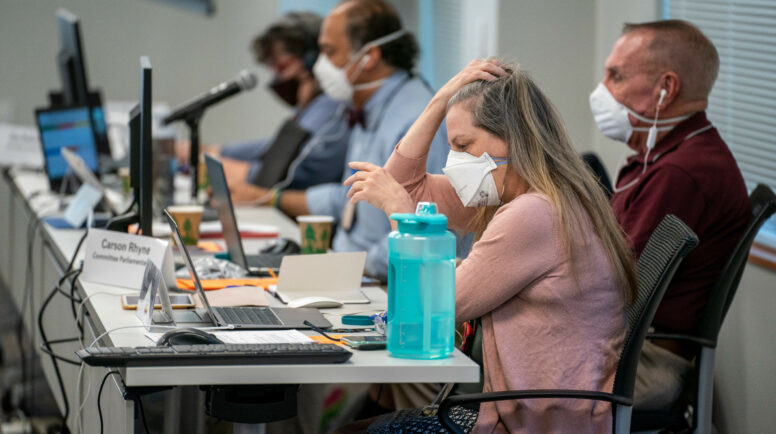
So the Financial Resources Committee of the 2022 General Assembly approved on June 30 FIN-01, a recommendation from the Presbyterian Mission Agency (PMA) Board concerning a report from the Special Offerings Review Task Force. Among the recommendations: affirm the current interpretation and distribution of the Presbyterian Church (U.S.A.)’s four Special Offerings. At least for now, the recommendation basically says, keep doing what we’ve been doing.
Here’s what that report – one piece of the big puzzle – did not say.
That recommendation in FIN-01 differs dramatically from a report the task force made of its findings to the PMA board in February.
At that time, the task force recommended no change in One Great Hour of Sharing, which supports Presbyterian Disaster Assistance, the Presbyterian Hunger Program, and Self Development of People. One Great Hour of Sharing is “the most popular, best understood, and well-supported” of the four offerings, the February report stated.
But it recommended a “comprehensive reshaping” of the other three Special Offerings – the Pentecost Offering, the Peace & Global Witness Offering, and the Christmas Joy Offering – to give each a more unified vision and to more closely align those offerings with PMA’s Matthew 25 initiative.
The offerings badly need revision, the task force contended in February. “The warning signs have been there for decades,” Linda Badger Becker, the chair of the task force, told the PMA board during its Zoom meeting Feb. 11. “Sadly, many of us would rather just not look up.”
That February report (P.102 Special Offerings Task Force Report) stated: “Everything is not fine. … While we acknowledge that each of the program areas are doing valuable ministry, opportunities for making a significant impact are being missed.”
Now, four months later, the recommendation coming to the assembly is considerably different than that report. It asks the assembly to “affirm the current interpretation and distribution of Special Offerings.”
It does ask the assembly to suspend the goal of raising $20 million through Special Offerings by 2025, and to establish a new goal of increasing by 10% by 2025 the number of PC(USA) congregations that participate in all four of the offerings (known as “Four by Four”). In other words: a focus on greater participation by churches, not necessarily greater dollar amounts.
And Bill McConnell, interim director of Special Offerings, gave a mostly positive report, saying overall receipts from Special Offerings are up, when revenue from the Giving Catalog is added in as well.
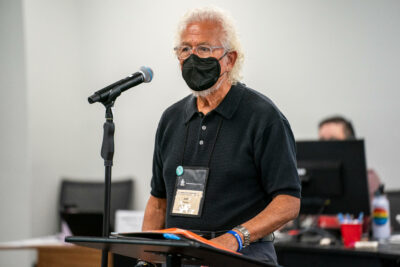
Tamara Williams, a ruling elder from the Presbytery of Charlotte who was a member of the Special Offerings Task Force and also serves on the PMA board, presented the report to the Financial Resources committee. She told the committee that the task force tried to evaluate how each of the Special Offerings aligns with PMA’s Matthew 25 initiative — but held off making comprehensive recommendations because PMA is presenting to this assembly a new Mission Work plan for 2023 and 2024 (FIN-11) that potentially could result in a PMA restructuring in the near future.
“We didn’t want to put the cart before the horse,” Williams told the committee. “We didn’t want to get ahead of that.”
In an interview, Williams explained that the report the assembly is considering is the original report the task force submitted in 2020 — business the assembly didn’t act on at the time because it was meeting virtually due to the COVID-19 pandemic and only considering limited business. But the task force continued to work after 2020 — and the report presented to the PMA board in February reflects its additional learnings over the last two years.
But that updated recommendation isn’t coming before this assembly because of concerns it might interfere with a plan for a major reconfiguration of PMA announced last fall — the result of a year’s work that Diane Moffett, PMA’s president and executive director, has said will transform PC(USA) mission work for a generation.

A new Special Offerings Review Task Force likely will be appointed soon, Williams said. By then, the assembly will have voted on the PMA Mission Work Plan. And perhaps the findings of the work the task force has done over the past two years can inform the work of the next task force going forward, she said.
Evangelical Seminary of Puerto Rico. The committee voted 20-1 to disapprove FIN-03, an overture from the Synod of Boriquen to ask the assembly to direct PMA to recognize that seminary as a racial ethnic institution, and to include it on the list of institutions supported by the Christmas Joy Offering. “Our seminary is going through a very difficult time financially,” said Elioreph Rivera-Pagan, a theological student advisory delegate from the Evangelical Seminary of Puerto Rico who serves on the committee. Providing more money “could help the students,” he said, speaking in Spanish.
The difficulty, according to PMA staff members: the Christmas Joy Offering only supports undergraduate schools that equip communities of color, taken from a list included in the articles of agreement approved when the northern and southern branches of the Presbyterian Church reunited in 1983. Nine schools were on the list at that time; only three are still operating as schools that meet the standards and receive Christmas Joy funds.
PC(USA)-related seminaries are funded through the Theological Education Fund — and the Evangelical Seminary of Puerto Rico is on that list and does receive money, with the money divided among 11 seminaries through an agreed-upon formula, said Barry Ensign-George, coordinator for Theology and Worship with PMA.
In short, PMA employees said, there’s no way give the Evangelical Seminary in Puerto Rico funding through Christmas Joy under the current rules.
So the committee voted to disapprove the recommendation, adding this comment: “Recognizing its status as an institution of color associated with the PC(USA), the Financial Resources Committee supports the Evangelical Seminary of Puerto Rico receiving more funding. We ask that the Committee on Theological Education (COTE) reevaluate its formula, so that this Seminary may receive more funding without conflict with the Standing Rule for the Christmas Joy Offering.”
Presbyterian Foundation
The committee voted unanimously to ask the assembly to confirm the election of Thomas Taylor (FIN-08) for a fourth four-year term as president and chief executive officer of the Presbyterian Foundation. Taylor, a minister and attorney, has served in that role since 2010, after serving as deputy executive director for mission at the Presbyterian Mission Agency (PMA). The rationale states that under Taylor’s leadership, the Foundation has increased the amount of new gifts to $146 million in 2021, developed online giving services used by 1,800 congregations, and grown the assets the Foundation manages for ministry from $1.3 billion in 2010 to $2.6 billion in 2021.
“This has without a doubt been the most meaningful and exciting work of my life,” Taylor said.
The committee also approved a series of recommendations (FIN-07) giving direction from the assembly on how the Foundation does its work. Among them are two initiatives to which the Foundation has been giving attention in recent years – to encourage congregations and mid councils to “learn and promote best practices” in wealth transfer and church property issues.
Eileen Lindner, a consultant the Foundation has hired to do research, says the baby boomer generation (those born from 1944 to 1964) are expected to transfer somewhere between $34 trillion and $64 trillion in assets over the next 20 years. In that time, more money will change hands than all the private wealth that has changed hands since the founding of the nation.
And some say it’s time for Presbyterians to talk directly about the values that will guide decisions about how that money will and should be spent, if some is given to the church.
The offering taken during open worship at this assembly will go to support a Restorative Action program – a wealth-transfer program initiated by the Synod of Lakes and Prairies, which challenges congregations, organizations and individuals to donate a portion of their assets to trusts that will be governed by African American and Indigenous people, and used for the benefit of their communities.
Another question the Foundation is considering through its Project Regeneration program is what can and should happen with church property when a congregation closes or grows smaller, and no longer needs all the infrastructure it has built.
Churches in this situation have found creative solutions — using the buildings or proceeds for low-income housing, for example, or as space for community non-profits to meet. And presbyteries are sometimes intentionally setting aside all or part of the money generated from the sale of church property for ministry and sometimes for reparations.
Other business.
The committee also considered these items June 30:
- Voted 23-0 to ask the assembly to direct particular parties to continue a process of reconciliation involving the Jarvie Commonweal Endowment, a fund established in the 1920s to provide services to senior citizen Protestant adults living in the New York City area. Those discussions are attempting to resolve disagreements over administration of the endowment, formerly managed by PMA (FIN-05).
- Heard a report for information from the New Covenant Trust Company, a subsidiary of the Foundation that provides trustee and investment management services for individuals and church institutions. Greg Rousos, president of New Covenant Trust Company, said the company can construct portfolios that serve as “a witness to your values,” highlighting two offerings: a targeted investment strategy focusing on climate change and fossil free companies and another targeting companies with a strong track record in diversity, equity and inclusion.
- Heard a report for information from the PC(USA) Investment and Loan Program (ILP). Jim Rissler, who described how ILP – which historically has provided loans for purchasing, building or renovating church buildings – has in recent years broadened the scope of who they lend to and for what purposes, such as lending to Presbyterian camps and conference centers or theological institutions. Clare Lewis, vice-president for sales and marking at ILP, said special purpose loans include:
- Restoring Creation loans for energy efficiency – with $20.3 million loaned to 131 churches for projects including solar panels, insulation and energy-efficient roofs and heating and cooling systems.
- Accessibility loans, for such things as adding elevators, ramps and bathroom renovations to comply with Americans for Disabilities Act standards.
- Safety and technology loans, for congregations needing equipment for online or hybrid worship.
- Disaster relief loans, which can serve as a bridge for congregations until insurance payments come through.
Still to come for the committee: consideration of PMA’s Mission Work Plan. A major report from the Special Committee on Per-capita Based Funding and National Church Financial Sustainability (FIN-10). And budgets:
- A unified budget presentation for 2023 and 2024 (FIN-14) from PMA, the Office of the General Assembly and the PC(USA), A Corporation.
- A proposed General Assembly per capita budget (FIN-12) for 2023 and 2024.
- A proposed General Assembly per capita rate (FIN-13) of $9.61 per member for 2023 and $10.28 per member for 2024 — a proposed rate that could change, depending on what decisions this assembly makes that could add to projected costs.