Steven Spielberg has spent nearly 50 years imagining encounters with visitors from the stars. From “Close Encounters of the Third Kind” to “E.T. the Extra-Terrestrial,” his films have consistently asked humanity to respond with curiosity rather than fear. “Disclosure Day” revisits that familiar territory, but with a new question at its center: What would happen if the whole world learned the truth at once?
This is the most conceptually dense of Spielberg’s movies on well-meaning extraterrestrial visitors — and the first set in a world with smartphones. The sprawling and unhurried narrative of “Close Encounters” saved its reveal for the last reel and used music as a common bond. “E.T.” focused on a single personable visitor, befriended and protected by children.
“Disclosure Day” lets us in early on the existence of UFOs and their inhabitants, kept undercover and dating back nearly eight decades to an incident in Roswell, New Mexico. It’s not a question of the extraterrestrials’ presence; it’s how the world – and that means every connected person on the planet – handles an 80-year-old living secret.
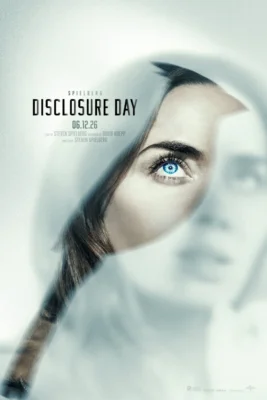 On the surface, the movie is a highly entertaining chase story — one that spans the first two hours of the movie’s 2-hour-29-minute running time. There are so many visceral thrills and spills along with the possibility of major reveals around every corner that the viewer could miss the moment when a soft-spoken character named Hugo states the film’s moral theme in a single sentence: “Empathy is our foremost evolutionary advantage.”
A second viewing allows one to focus on the film’s gentle forays into issues of faith. Jane and her boyfriend, Daniel, a whistleblower on the run, find shelter at the convent where she had been a novitiate a few years earlier. She left, she tells Daniel, after losing not her faith, but her calling.
Still, she’s clearly a favorite of Sister Maura, who maintains that Jane believes in God but lost her faith in people. As Jane struggles with Daniel’s intent to disclose decades of alien visitors’ presence on Earth, she tries to reconcile her biblical understanding of humans as God’s supreme creations. “On Earth,” Sister Maura adds with a smile, “God’s supreme creations on Earth. … Why would God make such a vast universe yet save it only for us?”
Meanwhile, TV weatherperson Margaret is about to receive a literally mind-blowing download of empathic powers. Her mysterious new abilities become the film’s most compelling metaphor. Rather than functioning like traditional superpowers, they allow her to experience another person’s inner life so completely that conflict gives way to understanding. Spielberg imagines empathy not simply as kindness but as an evolutionary leap.
Jane worries that the reality of aliens will untether believers from their faith. Daniel believes the truth belongs to everyone. And Hugo is anxious to unleash that “foremost evolutionary advantage”: empathy.
How would we – how would the world – react to learning life from the stars is among us? David Koepp’s screenplay, based on a story by Spielberg, hints at an end to war. What a wonderful world that would be!
My adult kids – who saw the film with me – felt this represents too easy a way out. Would humanity really be excused from the important work of understanding why war happens? While not a bad thing, massive doses of empathy would not undo the structures that harm so much of this world for the benefit of a privileged few, they argued after the film. They’re smarter than me and probably more moral, viewing the world through a cold-eyed stare. I’m grateful to spend a few hours in the thrall of Spielberg’s work, imagining him as a fellow senior traveler with hope in his backpack.
The somewhat basic questions about God and faith make this movie a good entry-level choice for discussion in a Sunday School class or youth group. Its emphasis on empathy could inform a sermon and maybe even fuel a sermon series — especially if it included the Presbyterian Outlook’s February “Empathy” issue as a resource!
The film ends with a single word — a revelation I will not spoil for you here. The word is not faith, grace, love, or peace, but it’s a fairly churchy word all the same. My church sings it every Sunday, and some years ago we built an entire weekend retreat around it. It suggests not only empathy but learning, openness, and vulnerability. My first time watching the film, it came as a surprise, but with a repeat viewing, I enjoyed the subtle scaffolding that built to that final word.
Go see “Disclosure Day” for the fun, excitement and excellent cast. Go listen for its message.